
Most of us drive past the best sight-fishing water we have access to. The storm-water pond at the end of the subdivision, the canal behind the industrial park, the rocky shoreline of the nearest Great Lake — they all hold carp, and carp behave far more like a bonefish on a flat than like the trout we spend our money chasing. They live in inches of water, they eat with their heads down, they can be twenty pounds, and they will humiliate you. Our guest on this episode guides for carp in southern Ontario, which is still a rare thing to do professionally, and what he laid out is a genuinely transferable playbook. Here's the part that will change your results fastest.
Spooking one fish costs you the whole group
This is the single most important thing to understand about carp, and it is not true of trout. When a carp spooks, it releases a pheromone into the water that triggers the other carp in the area to spook as well. You do not get to blow one shot and try the next fish ten feet away. One bad cast can empty a fifty-foot stretch of shoreline.
That reframes everything about how you move. Carp have a strong lateral line and are extremely sensitive to vibration and to the shadow and slap of a fly line — our guest's framing is that they're more line shy than leader shy, much like a big bonefish or a permit. So the cost of a rushed, low-percentage cast isn't one fish, it's the flat. Slow down. Wade like you're trying not to wake someone up. Take the shot you can actually make rather than the one you wish you could.

Lead the fish and let the fly sink into the feeding zone
The instinct most trout anglers bring to carp is to drop the fly right on the fish's nose. It is exactly wrong. Put an unweighted fly down on top of a carp and it spooks — something landing on the surface above their heads reads as a threat, not as food.
Instead, lead a moving fish. Cast well in front of it and let a weighted fly sink down into the feeding zone so the carp swims up on it already on the bottom, where its food actually lives. Our guest pointed out something worth thinking about with your leader math: with a nine-foot leader, your fly line is landing roughly four feet from your fly. That's four feet of the thing carp are most sensitive to, arriving in the neighborhood. Build your leads accordingly.
There's also a nice analogy in here to dry-fly work. If your fly line isn't drifting in the right feeding lane, sometimes you lift slightly and skate the fly toward you to reposition. Same logic with carp — if the presentation isn't in the lane the fish is working, fix the lane rather than casting again on top of the fish.
One caution on the leader: on bright, flat, sunny days, a long fine leader turns over badly and costs you accuracy. Our guest's fix is to go shorter, not longer, to get the accurate cast. Accuracy beats stealth when the leader is what's failing.
Strip-set, and then fight them with the rod low
Carp have a relatively small feeding window and they inhale rather than chase, so the eat is subtle. When a fish forty feet away takes, the strip-set is your best bet — keep stripping, feel the pressure, then give it a harder strip. Do not lift the rod. The trout set pulls the fly straight out of a downward-facing mouth, and the whole point of the strip-set discipline is to stop yourself from doing it reflexively.
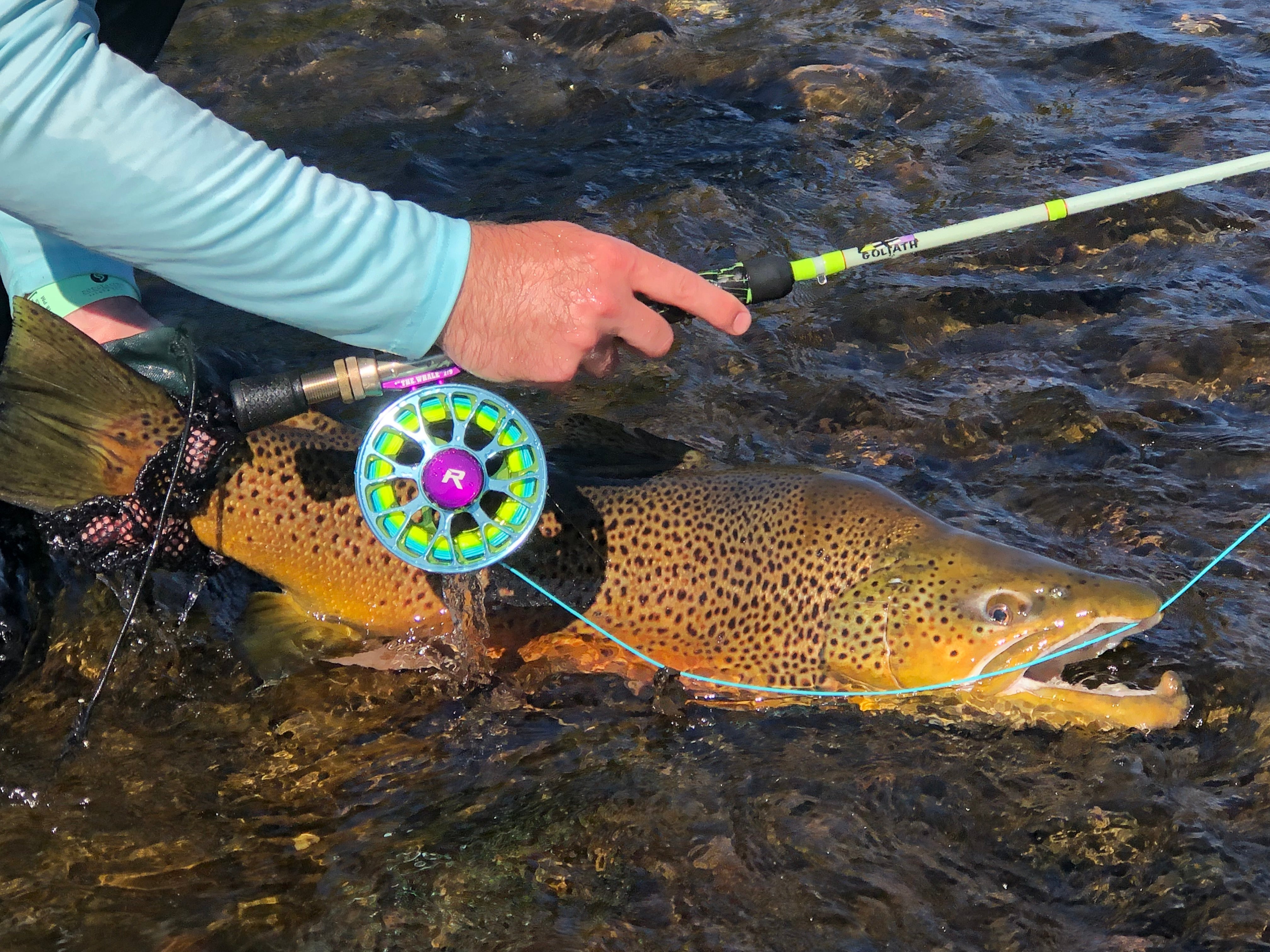
Then the fight. Play these fish on a low rod angle. Our guest has seen more than a couple of rods break on carp from anglers holding the rod high overhead. A low angle is more forgiving to the blank, lets you apply real pressure, and — this is the useful part — lets you steer the fish. Change the rod angle to pull their head one way or the other and you'll land them meaningfully faster. Worth remembering that on a small pond you may hook a fish that's practically under your rod tip with nine feet of rod in your hand and nowhere to go.

When and where to go
Post-spawn is a gift. Those fish push out onto rocky flats to feed and cruise, and that's about as close to a saltwater flats experience as most of North America gets. Urban fish and rural fish also behave differently: carp in a park pond where people drop bread, french fries, and ice cream are conditioned to commotion — they spook, but they come right back. The fish in canals and back water that rarely see a person are effectively wild, and those get the full stalking treatment.
Worth checking your local regulations too. Some jurisdictions allow up to three rods per angler specifically for carp where everything else is one rod per person — a rule written for bait anglers that's a little comic if you're fly fishing.
Gear
The rig is simpler than you'd guess. A nine-foot eight-weight is the best all-around carp rod — enough backbone for a big fish, and it makes a quick accurate cast without having to load it with a ton of power. Start with a nine-foot 0X tapered leader and go shorter on bright days for accuracy. Run at least twelve-pound tippet; they aren't especially leader shy, and you want to be able to put the screws to a heavy fish.
Honestly, the piece of gear that will help you most here isn't something we sell. It's a good pair of polarized sunglasses — you cannot lead a fish you cannot see, and carp fishing is entirely a spotting game. Go see your local fly shop, put a few pairs on, and look at water through them before you buy. Same for weighted flies in the sizes your local fish are eating; your shop will know the local forage better than any list we could write.
What we can help with: if the leader and tippet talk above raised questions — taper choice, knots, how to build and adjust a leader on the water — that's covered in Tips and Tricks for Fly Fishing. And since this is a sun-and-glare game played on open shorelines, a brimmed FFIP five-panel cap genuinely earns its place next to the polarized lenses — cutting overhead light is half of what lets you see down into the water.
Go find the pond you've been driving past.