
The White River below Bull Shoals Dam and the Norfork Tailwater are Arkansas's premier trout fishery, based around Cotter. Both are controlled by hydropower releases, so generation — not the hatch — decides your day. As of February 1, 2026 the upper 45 miles are effectively rainbow-only, with every trout 14 inches and longer released.
This is a tailwater, which means the river you fish at eight in the morning may not exist at noon. Bull Shoals Dam has eight generators. Each one moves roughly 3,200 cubic feet per second. Run them all and the difference between low water and high water is about eight feet of river.
That single fact reorganises everything else — where the fish sit, whether you wade or float, which fly you tie on, and whether the spot you drove to is a gravel bar or a standing wave. Learn to read the releases and this is one of the most productive trout fisheries in the country. Ignore them and you will spend a week confused.
What Is Fly Fishing the White River Actually Like?
The White and the Norfork are one system and two completely different rivers. The Norfork is the short one — a few miles from Norfork Dam to the confluence — steep and fast, with short pools and good broken water. It reads like a western river. The White is big and wide and, on first look, featureless: a broad sheet of water where the structure is all along the banks rather than out in the middle.
The regulated stretch runs from 100 yards below Bull Shoals Dam down to the Highway 58 bridge at Guion, and the Arkansas Game and Fish Commission designates it a Blue Ribbon Stream. The first 45 miles, dam to the Norfork Access boat ramp, is the heart of it and the water most visitors fish.
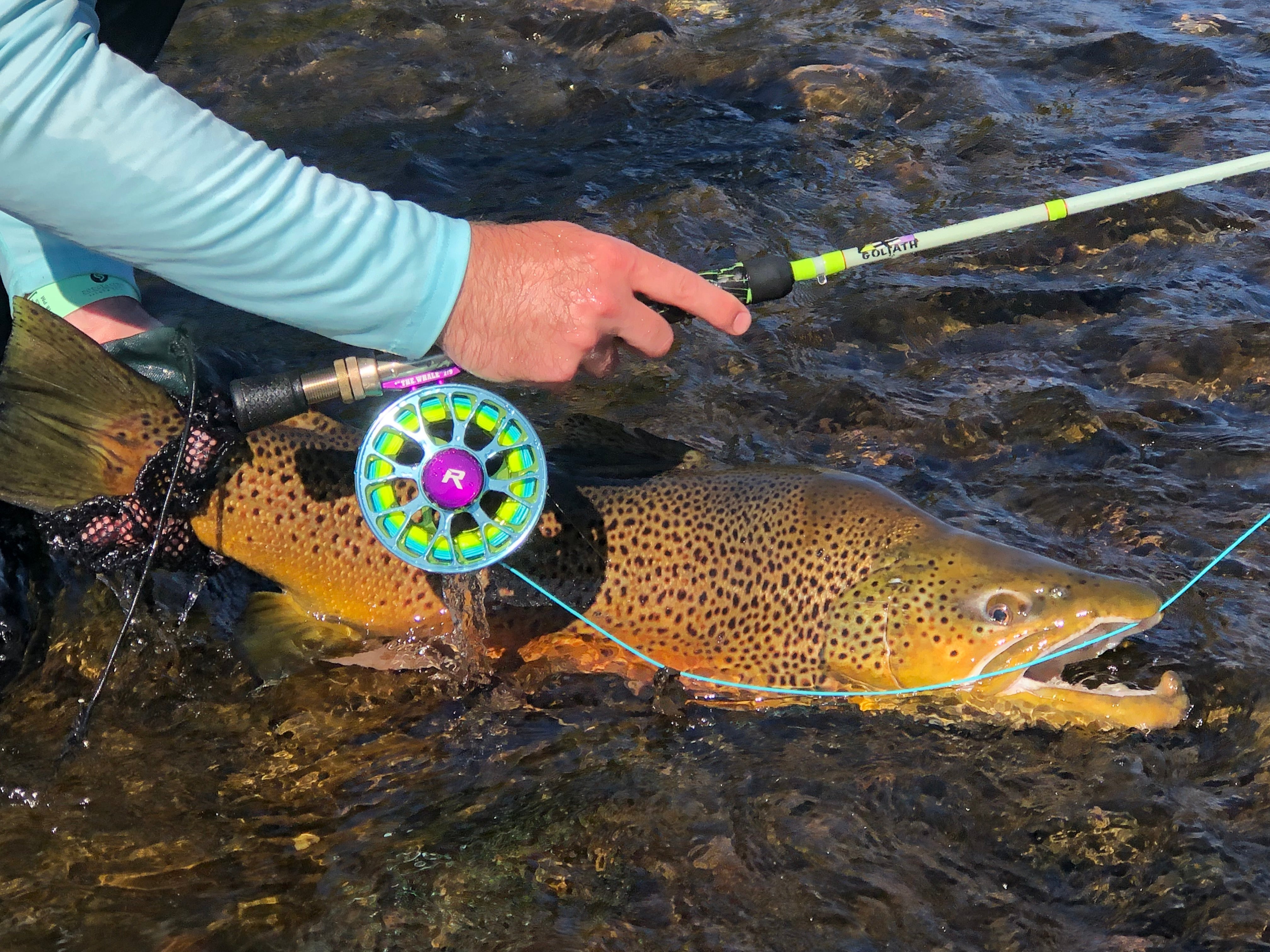
Rainbows are stocked heavily and run 12 to 14 inches. Browns are the trophy species, with good numbers in the 19 to 24 inch range and a handful every year that are considerably more than that. Cutthroat and brook trout are both present, and the Norfork holds the state records for both. Local guides on the White count only browns in the day's tally, which tells you something about the standard here — anglers routinely shake off rainbows that would be the fish of the trip on another river.
Author's Stories & Key Insights
Steve Dally, who runs Dally's Ozark Fly Fisher in Cotter, came on the podcast to talk about this system, and the most useful thing he said had nothing to do with flies. He is Tasmanian, came to the United States in 2001 by way of southern California, and ended up in Arkansas because of a job move. He has been guiding the White since around 2007, and he frames his edge not as breadth but as depth — this is the first river he has come to know across many complete cycles of seasons, and he says watching those cycles repeat is a different game from fishing a lot of rivers once.
He was blunt about what separates local guides from visiting ones here, and it is not fly selection. It is water. He has watched experienced guides from elsewhere get caught out by a dropping river, particularly on the Norfork, because they could not read where the flow was going. Adaptability and a real plan B are the job.
The other thing worth repeating is his correction to a piece of vocabulary that confuses almost everybody. The Norfork tailwater comes out of Norfork Dam — but the river itself is the North Fork of the White. Two names, one water, and it cost him years of mild confusion too.
He also flagged a change in the fishery that nobody has fully explained. When he arrived, the caddis hatch did not run much above about twelve miles below the dam. Now the top ten miles below the dam is the best of it. The hatch moved, and the reasons are not settled.
Access Points and Navigation
- Upper White, dam to Cotter. White Hole Access, Bull Shoals-White River State Park, Rivercliff Drive, Jim Griffin Access, Wood State Park Access and Cotter Access. This is the stretch with the best caddis fishing and the year-round catch-and-release area below the dam.
- Cotter to Buffalo City. Wildcat Shoals, Rim Shoals Access and the Rim Shoals walk-in, Ranchette and Buffalo City. Rim Shoals carries its own catch-and-release area.
- Lower White. Cartney, Shipps Ferry, Norfork Access, Red's Landing, Chesmond Ferry, Round Bottom, Mount Olive, Optimus, Sylamore and Guion. Norfork Access is the regulatory dividing line, so know which side of it you are on.
- Norfork Tailwater. Quarry Park, the Bill Ackerman / River Ridge walk-in, and the confluence with the White. Dally's describes practical access on the Norfork as effectively three points.
- Dry Run Creek, the outflow from the Norfork National Fish Hatchery, is restricted to anglers under 16 and mobility-impaired anglers. Catch and release, single barbless hook, artificial lures only. It is the best kids' trout water in the country and it is worth planning a family trip around.
- Walk-in access exists, but there are long stretches between access points that you simply cannot reach on foot, and rising fish tend to sit on the outside bends under steep bluff banks rather than the accessible inside bends. That is the argument for a boat, and it is a real one.
Recommended Techniques
- Read the generation before anything else. Current conditions come from the Corps of Engineers recording at 870-431-5311. Projected conditions come from the Southwestern Power Administration at 866-494-1993, and SWPA publishes a daily schedule online. Check the date at the top of that page — if it still shows yesterday, today's schedule is not up yet.
- The unit count on the recording is a maximum, not a flow. Generators are infinitely variable, and as Dally's puts it, three full units is the same water as six units on half. The recording does not talk in halves. An angler who plans a wade day off the unit number alone will be wrong. Cross-check actual discharge on the Corps' site, remembering that data runs a couple of hours behind.
- You can outrun the rise. Three to four units of generation pushes downstream at roughly three miles an hour. Start at the dam on low water, and when the horn goes, drive downstream and keep fishing the same body of low water at the next shoals. Most people pack up instead.
- On scuds and sowbugs, change your depth before you change your fly. That is Dally's explicit advice. Split shot six to eight inches above the fly, adjusted until the shot ticks the gravel and the fly swims just above it. Sowbugs in subtle greys and olives, with a darker centre and translucent edges.
- Set the hook straight up, not downstream. With eight feet of water, a lot of line and heavy weight to move, a downstream sweep pulls the fly out and leaves you nowhere to go if the fish runs at the boat. The bass-style low sideways set costs people fish here every day.
- High water is not a write-off for dry flies. Terrestrials fish better on higher flows, because the current forms seams along the bank that fish can hold in. Dally's likes at least 6,000 cfs for that. Shorter leaders, abrupt turnover, foam flies used as their own indicator — and match the set to the take, fast on a crashing eat, a deliberate pause on a slow one.
Do not shuffle your feet. Dislodging material from the streambed to draw fish — the San Juan Shuffle — is legally chumming under Arkansas regulations, and chumming is prohibited in every catch-and-release and artificial-only area on this river. That is Rim Shoals, the Bull Shoals area and the Norfork area: precisely the water people fly across the country to fish. A habit that feels normal elsewhere is a citation here.
Fish Population and Species
Rainbow trout are the backbone and are stocked heavily. Brown trout are the reason people come back — and worth knowing, the Arkansas state record brown of 40 pounds 4 ounces came from the Little Red River, not the White. The White holds the state rainbow record at 19 pounds 1 ounce, set in 1981.
The Norfork punches above its size on record fish: it holds the Arkansas brook trout record at 5 pounds and the cutthroat record at 10 pounds 2 ounces. Tiger trout are present in the system too — they appear by name in the regulations with their own 24-inch minimum.
Smallmouth bass are in the White as well, with a one-fish limit and a 15-inch minimum. Dally's also guides smallmouth on Crooked Creek, which is worth knowing if you hit a week of heavy generation.
When Is the Best Time to Fly Fish the White River?
Dally's own answer is mid-March through October, with fish catchable year-round. The two windows most worth planning around are the April to May caddis and the winter shad kill.
The shad kill is the one that surprises people. When lake surface temperature drops to around 41 to 43 degrees, shad move deep, get pulled through the turbines at the base of the dam, and come out the other side. It can start as early as mid-December and run as late as April. Because the shad come through at every depth, you fish anything from the surface down. Water is high, so it is a boat game, and it is the best shot at a genuinely large fish in the year.
| JAN | FEB | MAR | APR | MAY | JUN | JUL | AUG | SEP | OCT | NOV | DEC | |
|---|---|---|---|---|---|---|---|---|---|---|---|---|
| Scuds & Sowbugs | ||||||||||||
| Midges | ||||||||||||
| Shad Kill | ||||||||||||
| Caddis | ||||||||||||
| Sulphurs | ||||||||||||
| Terrestrials | ||||||||||||
| Streamers for Big Browns |
Caddis, sulphur and terrestrial timing is from Dally's Ozark Fly Fisher; shad kill timing from White River Fly Guide. Sources disagree on sulphurs — the shop says June to July, others put the window from late May into August. Scuds, sowbugs and midges are in the river every day of the year.
What Does a White River Trip Cost?
Guided days here are among the best value in American trout fishing, largely because the rate covers one or two anglers rather than being charged per head.
| Line item | Cost |
|---|---|
| Dally's Ozark Fly Fisher, full dayFor one or two anglers. Includes lunch. Wade, drift boat or river boat. Guide rods provided at no extra charge. A 50% deposit confirms the booking — confirm the cancellation window directly with the shop, as their published pages state it differently in different places. | $600 |
| Dally's Ozark Fly Fisher, half dayFor one or two anglers. Lunch not included. | $500 |
| Dry Run Creek kids' trip, full dayOne or two anglers under 16. Half day $350. | $400 |
| Nonresident annual fishing licenceArkansas Game and Fish Commission. Three-day trip licence $30; one-day $15. | $60 |
| Nonresident trout permitRequired in addition to the licence to fish these tailwaters at all — not just to keep fish. | $20 |
| Resident licence and trout permitFisheries Conservation Licence $10.50 plus Resident Trout Permit $10. | $20.50 |
| Gaston's White River ResortOn the river near Lakeview. Published 2026 nightly rates run from a standard bedroom to a twenty-guest villa. Rates are based on the first two guests. | $130 – $2,100 |
A nonresident week of licences and permits is $80. There is no seven-day Arkansas licence — the options are annual, three-day and one-day. Guide rates and state fees verified September 2026.
Recommended Fly Patterns
Recommended Gear
Where to Stay and Who to Book With
Steve Dally's shop is the full-service operation in Cotter — a fly shop plus a roster of guides deep enough to put around eleven boats on the water. Guided trips by wade, drift boat and river boat on both the White and the Norfork, smallmouth on Crooked Creek, and youth trips on Dry Run Creek. Booking is direct, by phone or email. You book with them; FFIP takes no commission.
See the full profile & enquireThe trip you keep talking about — go take it
Every angler has one destination they've described a dozen times and never booked. Tell us which one it is and we'll build the trip around it.
Book a TripFly Fishing Insider Podcast has a referral partnership with Frontiers International Travel. If you book after being introduced through us, we may receive compensation at no additional cost to you.
Keep Reading
If you take one thing from this page, make it the phone numbers. Everything else on the White River follows the water.
Tight lines, everyone!

By Christian Bacasa
Host of the Fly Fishing Insider Podcast
Fly Fishing Insider Podcast Official Website
Instagram Fly Fishing Insider Podcast
Facebook
Pinterest
Watch on YouTube