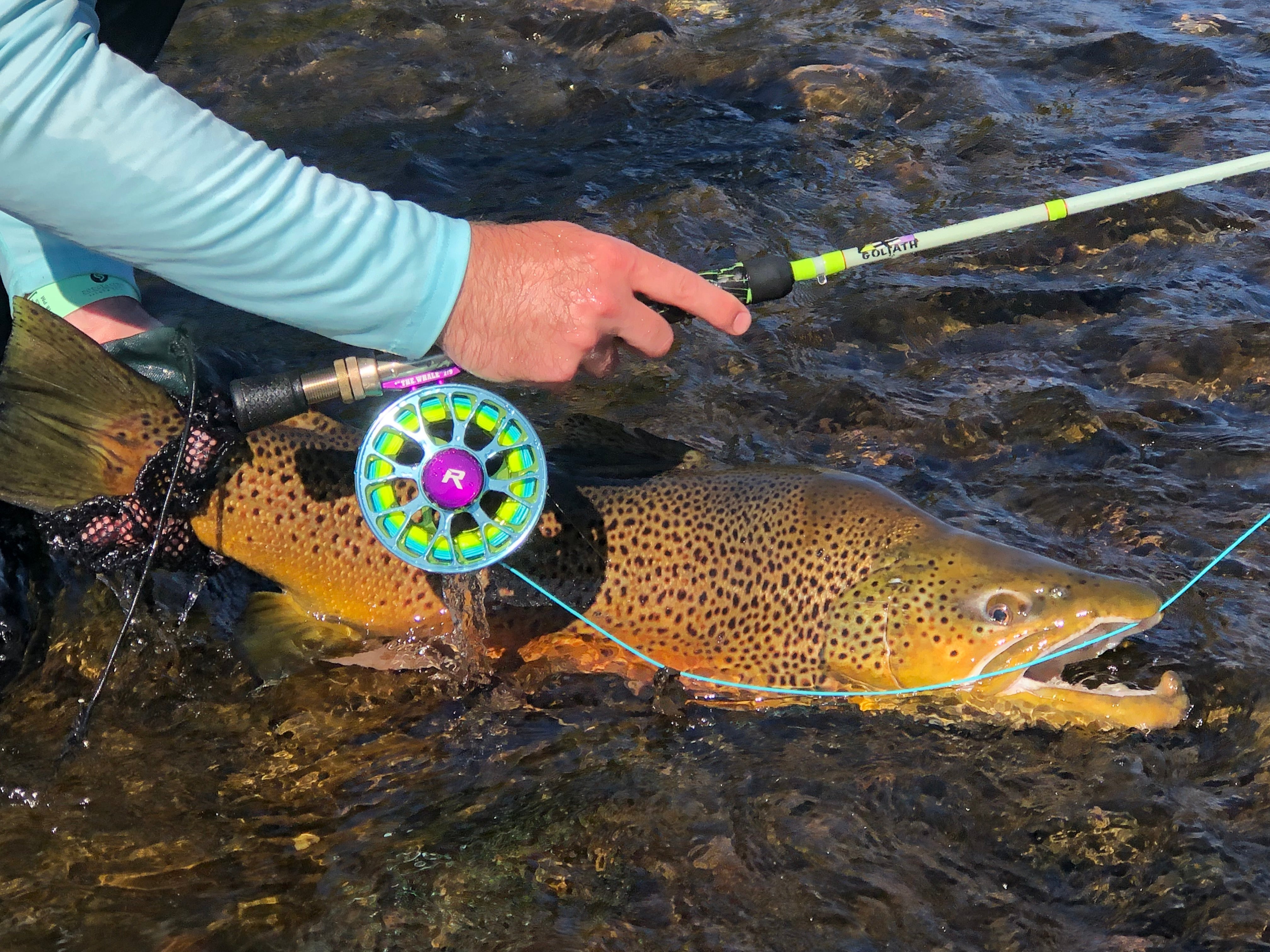

Walk into a shop and every reel on the wall is described with the same four or five phrases. Large arbor. Sealed drag. Fully machined. Narrow spool. They get printed on every box, which means they've stopped telling you anything — and that's a shame, because each of those phrases was a genuine engineering argument before it became marketing copy. On Episode 72 I talked with our guest from Waterworks-Lamson about where those features actually came from and what problem each one was built to solve. Here's how to translate the spec sheet back into fishing.
Large Arbor: It's About Retrieve Rate, Not Looks
This one is worth understanding because of how strange it looked at the time. When Lamson started building wide, large-arbor reels with big cutouts in the frame, the reaction was that they looked like a spaceship. Nothing else on the wall looked remotely like that. The reels were also startlingly light for the era — our guest put one of the early models at right around 2.73 ounces, which was the lightest thing anybody had seen. Meanwhile the competition was building reels out of eighty-plus separate parts with no sealed drag at all.
The point of the big arbor is simple geometry: the larger the diameter of the spool where your line sits, the more line you recover per crank of the handle. That matters in exactly one moment — when a fish has run at you and you're trying to come tight again before it throws the hook. A small-arbor reel makes you spin the handle like you're starting a lawnmower. A large arbor picks it up. As a secondary benefit, line stored at a bigger diameter takes less coil memory, so it lies flatter when you strip it off.

Sealed Drag: The Spec That Actually Earns Its Price
If I had to pick one line item on a reel spec sheet to spend real money on, it's this. A sealed drag means the friction stack is enclosed — grit, sand, salt, and water don't get into it. Our guest was direct that the drag system is the thing that defines the brand, and it's the piece they've refused to compromise on across the entire lineup.
Here's why it matters in practice. An unsealed drag is fine right up until the day it isn't. You wade a silty flat, you dunk the reel on a slip, you fish three days in salt without a proper rinse — and then a good fish takes off and the drag either grabs or gives way. Startup inertia, that first instant when the spool breaks loose, is where tippet snaps. Contamination is what makes startup inertia unpredictable. Sealing solves it.
If you only ever fish small freshwater streams and land fish by stripping line, you can live without it. If you fish salt, big water, or anything that runs into the backing, don't.
Machined vs. Die-Cast: Where the Money Goes
This is the distinction most people get wrong, and the conversation clarified it nicely. Waterworks-Lamson's bread and butter is fully machined, US-made reels — cut from bar stock, tight tolerances, the premium tier. But they also build reels with a die-cast case and spool, and the key detail is that those value reels carry the same drag system as the machined ones. Die casting lets them produce more units at a lower cost; it doesn't mean a lesser drag.
So the practical translation: machining buys you lighter weight, tighter tolerances, and a more refined finish. It does not necessarily buy you more stopping power. If your budget is tight, a die-cast reel with a genuinely good sealed drag will fight fish just as well as its machined sibling and will simply weigh a bit more.
The three-pack deal he described makes the point concretely — a reel plus two spare spools in a case, which at the time ran around $189. That setup lets you carry a floating line, a sink tip, and a third line and swap them streamside in thirty seconds. For most anglers, that flexibility is worth far more than shaving an ounce off the frame.

Narrow Spool: A Specialist's Spec
A very large but narrow arbor is a deliberate choice, and it's aimed at one job: fish that take a lot of line and then turn. Because the diameter is big and the spool is shallow, line stacks in a narrow band at maximum diameter, which means you recover line as fast as physically possible without it piling unevenly to one side. Our guest described that design specifically in the context of fish that will strip you into backing and then come back at you.
Translation for your shopping: if you chase steelhead, bonefish, tarpon, or anything that runs long, this spec is real and useful. If you're fishing a small freestone for eleven-inch brookies, it is doing nothing for you. Buy it for the fish you actually catch, not the one you daydream about.

Gear
We don't sell reels here, so I'm not going to steer you toward something of ours that doesn't answer the question. Take this spec-sheet checklist to your local fly shop and ask them to put three reels in your hand in your price range — feel the drag start under tension, not just spin the spool on the counter. That two-minute test tells you more than any review.
What I can point you to is the Tips and Tricks for Fly Fishing eBook, which covers the rigging and line-management habits that make a good reel worth owning in the first place — backing knots, loop-to-loop connections, and keeping line off the ground where it belongs.