
The best saltwater fly fishing tips from Fly Fishing Insider Podcast guests come down to five habits: hold a 90-degree rod angle on big fish, rig strong fluorocarbon leaders, keep a permit fly moving, scout channels before a DIY trip, and ask your flats guide specific questions every evening. Twelve guest lessons below show exactly how.
I'm a trout guy at heart, and most of us show up to our first flat carrying trout habits: lifting the rod like we're fighting a 14-inch rainbow, stripping too slow, and squinting for fish the guide already pointed out twice. Guests who spend their lives on skiffs and atolls share their best closing tips, and the saltwater ones are gold.
Every lesson here comes from a card in our FFIP Tips Library and the episode it came from. Some of the older episodes were hosted by former host Greg Keenan, and I've noted which ones so credit lands where it belongs. If you're packing for a flats trip this winter, keep a few proven saltwater fly patterns handy and read on.
- Fighting fish: hold a 90-degree rod angle and keep the bend shallow on big fish.
- Gear: spend real money on the reel drag; it's the piece that loses trophies.
- Permit: keep the fly moving and switch after two refusals.
- DIY trips: mark flats next to channels on Google Earth before you go.
- Learning curve: bring two specific questions to your guide every evening.
How do you fight and land big saltwater fish on a fly rod?
This is where trout habits hurt most. Saltwater fish run farther and break more rods than anything most of us grew up catching.
Keep a 90-Degree Angle Between Rod Tip and Fish
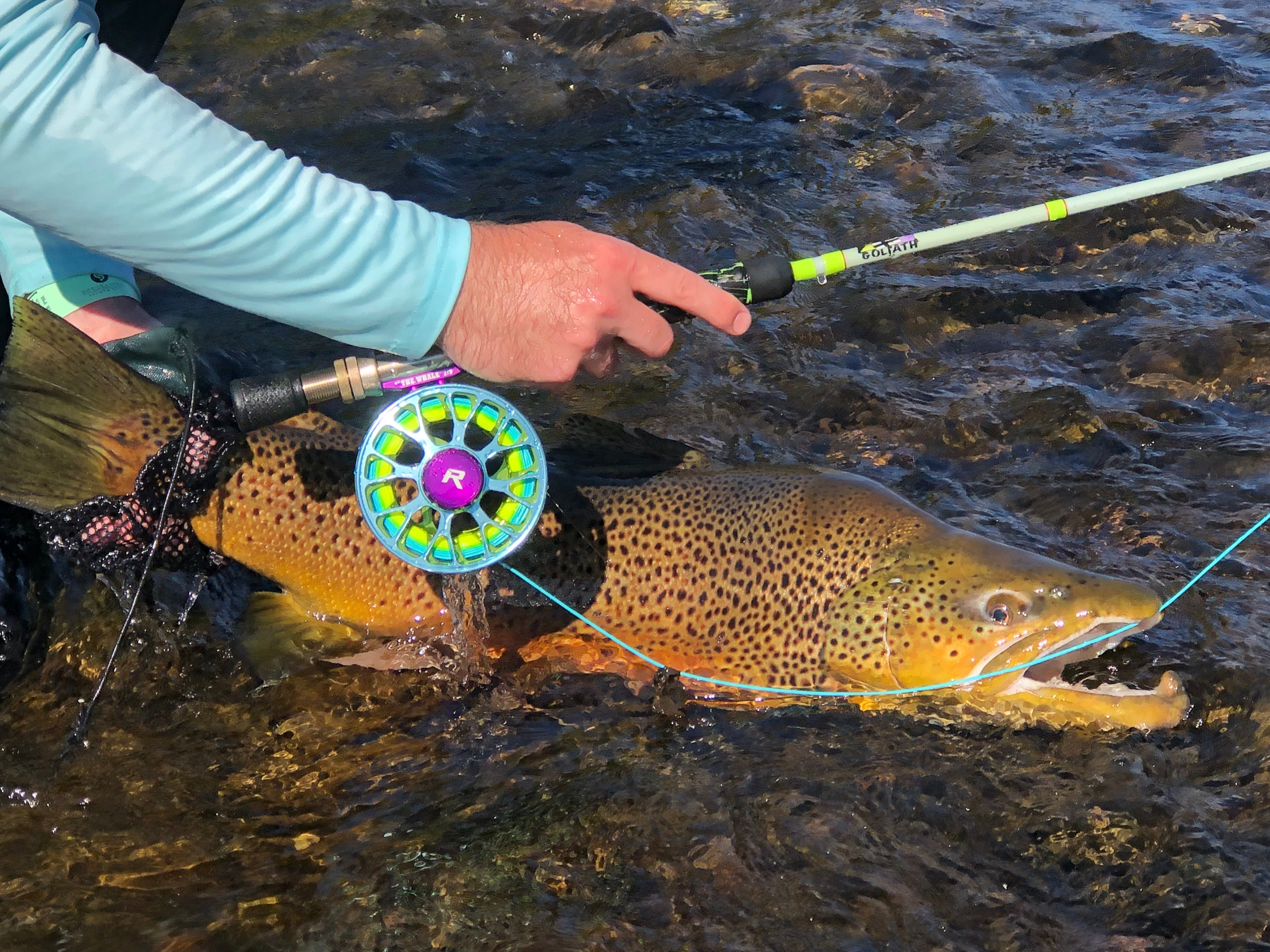
Zen Tenkara founder Karin Miller thinks about every fight as a triangle: you, the fish and your rod tip. When I had her on the show, she explained that life is good while the angle between rod tip and fish sits near 90 degrees, and things fall apart once it collapses below roughly 65 degrees. That's your cue to swing the rod to the other side and rebuild it.
From: Karin Miller, Bonefish on Tenkara and the Fishing Triangle for Fish Management · Read the full tip
Fish Heavy Tippet and Keep the Rod Bend Shallow
Traveling angler Jeff Currier told former host Greg Keenan that the deep, dramatic rod bend you see in photos does not win a fight with a giant trevally. Jeff keeps only a slight bend running down into the cork and turns the fight into a tug-of-war that breaks the fish's spirit.
His GT rig is just as blunt: four to six feet of 130-pound tippet off the line's factory loop, stretched to a 10-foot leader for pressured fish.
From: Jeff Currier, Guided EP # 10 Jeff Currier (hosted by Greg Keenan) · Read the full tip
Strip-Strike Every Tap When You Can't See the Eat
Costa Rica guide Jesse Males fishes river mouths too muddy to sight-fish, where tarpon eat several feet down. He told me anglers miss those fish because they wait to feel tarpon-sized weight, so he strip-strikes every tiny tap.
From: Jesse Males, Fly Fishing the Jungle of Costa Rica (S3E144) · Read the full tip
Practice the Hookset Before You Worry About Distance
San Diego mako guide Conway Bowman told Greg that casting is not the hard part. Putting the fly within about five feet of the shark's head matters more than raw distance, and knowing how to set a hook and fight a big fish on a fly matters most of all.
A soft, trout-style lift won't get past a mako's teeth, so rehearse a hard strip-set at home until it's automatic.
From: Conway Bowman, Guided EP # 1 Conway Bowman (hosted by Greg Keenan) · Read the full tip
Which saltwater fly fishing gear and rigging tips matter most?
Flats gear has to survive salt, sun and a fish that wants your backing. Our fly lines, leaders and backing are a good place to start building a saltwater kit.
Put Your Money Into the Reel and Its Drag
Florida Keys tarpon guide Captain Joel Dickey shared on the Fly Fishing Insider Podcast that the reel and line matter most when you come to salt. His point was simple: a cheap reel stays cheap only until you buy a second one, and nobody wants to travel thousands of miles and watch the fish of a lifetime leave because a drag slipped.
From: Captain Joel Dickey, Florida Keys tarpon guide · Read the full tip
Build Stepped Fluorocarbon Leaders From Spools
Australian flats guide and filmmaker Josh Hutchins runs fluorocarbon on everything. He told Greg he builds a 9 to 10-foot leader in halves (40-pound to 20-pound) or thirds (40, 30, then 20-pound), joined with a double uni or surgeon's knot.
Carry straight spools instead of pre-tapered leaders and you can rebuild right on the boat. Practice the double uni at home first.
From: Josh Hutchins, Guided EP # 13 Josh Hutchins (hosted by Greg Keenan) · Read the full tip
Pack a Multi-Piece Travel Rod Inside Your Bag
Author and traveling angler John Childress told me a six or seven-piece travel rod fits in regular luggage, breaks down easily in a boat and doesn't snag when you hike. He has landed big, toothy fish in the Amazon and Africa on an 8-weight travel rod and hasn't broken one.
From: John Childress, Amazon Fly Fishing and Preservation (S5E236) · Read the full tip
How should you present a fly to permit, parrotfish and bonefish?
Presentation is where flats fishing gets humbling: one species wants a still fly, another wants a fly that never stops.
Place the Fly and Let Parrotfish Find It
Seychelles guide and lodge operator Keith Rose-Innes explained that bumphead parrotfish graze coral and crustaceans, so they won't turn and chase a stripped fly. Read the direction the school is moving, drop a crab pattern on a clean patch of bottom ahead of them, and leave it still.
Stay in direct contact and watch for a fish turning sideways over the fly. That's the eat, and that's when you set.
From: Keith Rose-Innes, Keith Rose-Innes and His Playbook for Fly Fishing in the Seychelles (S3E130) · Read the full tip
Keep a Permit Fly Moving and Switch After Two Refusals
Keith wants no static fly at all: a steady two to three-foot strip, a lead of no more than about half a rod length, and constant contact so you feel the take the instant it happens.
If a permit ignores the same fly twice, change it. Keith rotates to a light tan or white fly, then a weighted or eye-added version.
From: Keith Rose-Innes, Keith Rose-Innes and His Playbook for Fly Fishing in the Seychelles (S3E130) · Read the full tip
Bring Your Hauling Hand Back to the Reel
Belize lodge hosts Mary Alice and Chris see the same casting fault often: anglers make a haul, then leave the hauling hand out in front. That creates a triangle of slack between hand and reel, and the next haul has to take up slack before it adds any power.
Make returning the hand to the reel a deliberate motion after every haul, especially into wind. If Belize is on your list, our Belize fly fishing guide is a good next read.
From: Mary Alice and Chris, Belize DIY bonefish and permit lodge hosts · Read the full tip
Keith Rose-Innes and His Playbook for Fly Fishing in the Seychelles
Tips 8 and 9 both come from this conversation with Keith Rose-Innes about pioneering fly fishing on the remote atolls of the Seychelles. Listen here, or open the full episode page.
How do you plan a flats trip and learn faster once you're there?
DIY or guided, the anglers who improve fastest do homework before the trip and ask better questions during it. Our Florida Keys fly fishing guide is a good companion for both lessons below.
Mark Flats Next to Channels on Google Earth
Fish and Grits founder Jake Oliver fishes Florida lagoons from his own skiff. He told me he starts on Google Earth by tracing a channel, then marking any flat or small pocket right next to it, because fish push up out of the deeper water to feed. He also heads away from other boats, since pressured fish are less cooperative.
From: Jake Oliver, Fish and Grits - Get to Know - The Angler · Read the full tip
Ask Your Guide Two Specific Questions Every Evening
Florida Keys flats guide and casting instructor Bruce Chard told Greg he wants to hear at least two questions or concerns from every client at the end of every day. If you aren't asking, you aren't getting what you paid for out of a school or a guided trip.
Make them specific: the set you missed, the cast that didn't turn over, the fish that spooked. Then apply the answer the very next morning.
From: Bruce Chard, Guided EP # 19 Bruce Chard, Grand Slams All Day (hosted by Greg Keenan) · Read the full tip
Start near deep water, then go digging in old forums. Jake Oliver had one more DIY lesson for me on the Fly Fishing Insider Podcast: start close to a channel or open water like the Gulf, with mixed shoreline such as grass, mangrove, oyster beds or docks. Before he travels, he searches his target species plus the destination and the word microskiff to turn up old forum threads and trip reports. The occasional hit can save a trip.
Sun protection is half the battle on a bright flat, and our fly fishing apparel is worth a look before you pack. If you're still choosing where to go, 8 Best Winter Saltwater Fly Fishing Trips lays out the options.
- Saltwater Flats Tips for Bonefish, Tarpon, Permit and Redfish, all 22 saltwater tips in one place
- Permit on the Flats: Accuracy, the Drop, and the Eat You Have to See
- Bonefish on the Flats: How to See the Fish Before You Cast
- 11 Saltwater Fly Fishing Gifts for the Flats Angler on Your List, our saltwater gift companion
- 15 Lessons Alaska Guides Shared on the Fly Fishing Insider Podcast
Frequently Asked Questions
What is the most important saltwater fly fishing tip for a trout angler?
The most important saltwater fly fishing tip for a trout angler is to stop lifting the rod straight up on a big fish. Keep roughly a 90-degree angle between rod tip and fish, as Karin Miller teaches, and keep the bend shallow so the butt section does the work.
What leader should I use for saltwater flats fly fishing?
Josh Hutchins builds a 9 to 10-foot fluorocarbon leader stepped from 40-pound down to 20-pound, joined with double uni knots. Big giant trevally call for far heavier tippet; Jeff Currier uses four to six feet of 130-pound.
How do you fish for permit on a fly?
Keith Rose-Innes keeps a permit fly moving with a steady two to three-foot strip and never lets it sit still. Lead the fish by about half a rod length and change flies after two refusals.
Can you fish the saltwater flats without a guide?
Yes, many anglers fish the flats DIY. Jake Oliver scouts on Google Earth for channels with flats or pockets right next to them. If you do hire a guide, Bruce Chard suggests bringing two specific questions back to the dock every day.
Every one of these lessons came from someone who learned it the hard way so you don't have to. Stock up on proven flies, dig into the full library of guest tips, and go chase something that pulls back.
Tight lines, everyone!
Get new guest tips like these in your inbox and keep learning how to catch any fish, any time, and anywhere.
Join freeShow us your first permit on Instagram @flyfishinginsiderpodcast