
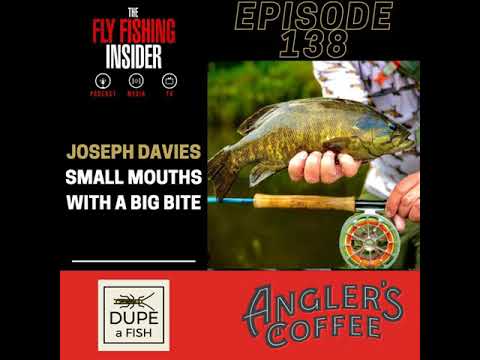
Every trout angler I know who tries smallmouth for one summer comes back a little bit changed. That's exactly what happened to my good friend and longtime FFIP ambassador Joe Davies, who guides out of the Milwaukee area and works at a Wisconsin fly shop. Joe spends his falls and springs chasing steelhead, salmon, and big browns, but by his own telling, smallmouth stole his soul this season. In Episode 138 he walked me through the system he and his clients built for catching big river bass on the fly, and the biggest lesson is one every angler can use: when a fish refuses, change your depth before you change your fly.
Depth Before Pattern
Joe's key insight from the season: smallmouth refusals are usually about where your fly is in the water column, not what it looks like. Rather than cycling through a box of patterns, he carries the same general profile in several weights. A neutrally buoyant fly, a lightly weighted version, and a dumbbell-eye fly that gets down fast. If a fish follows and turns, he changes the sink rate first.
This matters most early in the season. Joe found pre-spawn fish, especially the big ones, holding tight to structure. Tight means tight: if your fly is ten inches off the log, you aren't fishing to that fish. That kind of precise, repeated casting doesn't suit a drift boat sliding past the target. Anchor up or wade, and work each piece of structure methodically until the fly is ticking right where the fish lives.

Read Summer Bass Like Trout Water
Once fish move into their post-spawn summer pattern, Joe says you can almost read a river for smallmouth the same way you would for trout. Bass sit behind rocks, conserve energy, and pick off easy food drifting into them. Seams, pockets, and the soft water below boulders are all prime. Break the river apart tactically, just like a trout run, rather than blind-casting across open water.
Summer fish are also predictable through the day, which makes them a great fish to plan around:
- Morning: topwater in the top one to three inches. Joe noted that this season nearly all of their surface fish came on deer hair rather than foam, and most eats happened within the first handful of strips.
- Midday: go deeper with weighted streamers and crayfish patterns worked near the bottom and along structure.
- Evening: come back up with neutrally buoyant flies or surface bugs.
He also described aggressive summer behavior on the Wisconsin River, where groups of bass push baitfish to the surface and crash them together, something he's seen on a smaller scale on the Milwaukee River too. When that happens, a baitfish streamer stripped fast through the commotion is hard to beat.
Joe's Smallmouth Rig
Big river smallmouth pull far harder than their size suggests, and Joe sets up accordingly:
- Rod: an 8-weight. Lighter rods work for small fish, but a 16-inch smallmouth in current will bury an 8-weight, and when 20-inch fish are possible you want the power to turn them away from wood and rock.
- Line: a floating, bass-taper line about 90 percent of the time. A sink-tip comes out when the fish are deep and a weighted fly alone won't get there.
- Leader: short, about eight feet, with a heavy butt that turns over bulky flies.
- Tippet: when fish are spooky, Joe cuts the last 18 inches off his leader and blood-knots on fluorocarbon. He runs 12-pound around structure and in current, and drops to 10-pound in clear, open water where the fish have nothing to wrap you on.
Low water this summer had his clients sight fishing to cruising bass almost like bonefish, which is where the thinner, less visible fluoro really earned its place.
Strip Set and Keep a Logbook
Two final habits separate Joe's clients from the crowd. First, strip set. Smallmouth have hard mouths, and a trout-style rod lift pulls the fly away. Keep the rod tip low and set with your line hand. Second, keep records. Joe logs where he fished, when, water temperature, and water level, then uses that history to predict where fish will be next time. Plenty of his clients spend hours on the bow before that first big fish, and good notes shrink that learning curve fast.
Gear
If you're crossing over from trout to bass, our Tips and Tricks for Fly Fishing eBook covers the leader building, knots, and line management that make the transition smoother. Long days on a bright river call for a good lid, so grab a five-panel cap to cut glare while you sight fish. For the 8-weight, bass-taper line, and fluorocarbon tippet, stop by your local fly shop and ask what's working on your home river. Shop staff like Joe know exactly what's moving fish right now.