
Put the Heavy Gear on Your Hips
Short answer: Carry the heavy items on a wading belt — net, water, wading staff, tool pouch — and keep only light, high-use items on your chest. Hip carry puts weight at your center of gravity, frees your casting shoulder, and keeps a loaded vest from pulling you off balance in current.
Take a loaded chest pack off at the end of a long day and pay attention to your neck.
That ache is a design problem, not a you problem. We hang three pounds of boxes, tools and water off our shoulders, then spend eight hours making a repetitive overhead motion and wading uneven cobble with a high center of gravity.
Move the heavy half of that load to your hips and both problems go away. Short hitting your regular hole kind of days it often doesn't matter much. However when going somewhere that is a bit extended it makes a difference. I can remember taking a sling pack up a small stream in Utah with my friend Rachel. It's the kind that once you get in the canyon, you can't get out until the end. I had extra water, food, more fly boxes than I need, an extra puff and rain gear. It was a horrible situation as all my weight was on one shoulder and I was stuck with it.
What gear should you carry on a wading belt?
Carry the dense, bulky, occasional-use items on a wading belt: water, a landing net, a wading staff, a small tool or tippet pouch, and your phone or a camera in a dry case. A wading belt handles weight far better than shoulders do.
- Hips: water, net, staff, spare spools, a pouch with bulk tippet and floatant.
- Chest: the one or two fly boxes you’re actually fishing, nippers, forceps, one spool of working tippet.
- Nowhere: the four boxes you haven’t opened since April.
Why is hip carry better than a loaded vest?
Hip carry beats a loaded vest because weight at your waist sits near your center of gravity, where your legs manage it, instead of up high where it swings. In moving water, a high load turns a stumble into a swim.
It also clears your casting arm. A vest stuffed with boxes catches your line hand on the reach and hides the rod-hand side of your chest. Carry a backpack and the argument is the same — a wading belt still takes the water and the net off your shoulders.
Carry less, fish better. Leonard Schoenberger makes the case for carrying fewer flies and spending that saved time and attention on the drift instead. Hip carry is the same argument applied to everything else you haul. Cut the load to what the day actually needs, put the heavy part on your belt, and you spend the day fishing rather than managing gear.
What kind of belt holds fishing gear best?
The best belt for carrying gear is a wide, stiff webbing belt — roughly two inches — with a solid buckle that stays put under load. A thin belt folds over as soon as you hang weight on it and starts sliding down your waders by mid-morning.
Width is what keeps the belt from digging in, and stiffness is what keeps accessories from wandering around to your back. A wading belt built for this job also does the safety work a wading belt is supposed to do: cinched snug, it keeps waders from filling if you go in.
Where should you carry a landing net?
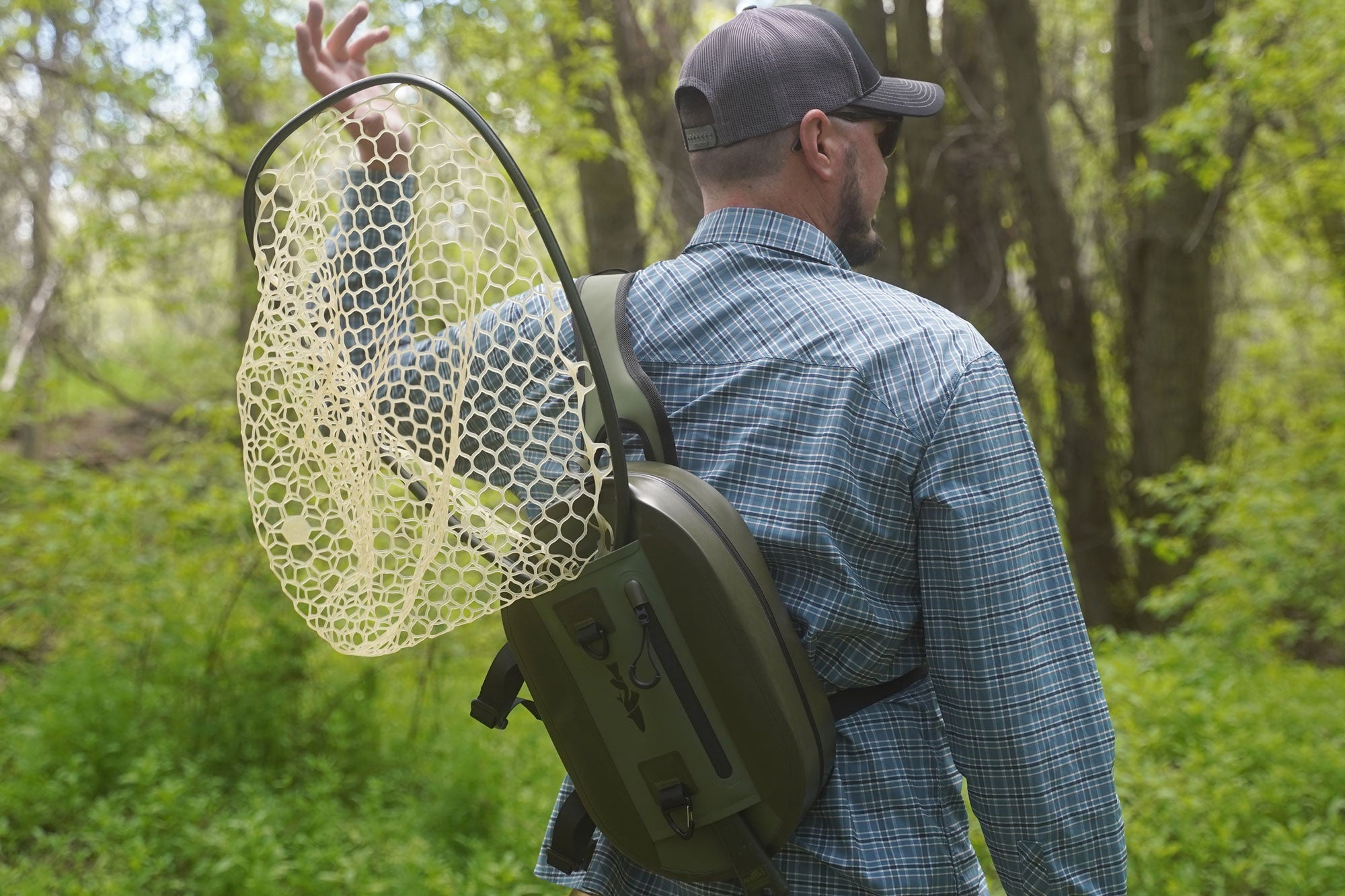
Carry a landing net on your hip or the small of your back, handle forward, hung on a magnetic release or a simple net clip. A net on the hip comes to hand with one motion; a net hung between your shoulder blades needs a shrug and a grab while a fish is running.
Size the net to the water. A short-handled net like a Brookie net rides comfortably on a belt all day and lands a 14-inch wild brown just fine; save the long-handled boat net for the boat, where it isn’t hanging off you.
My shoulders suck so I have a hard time reaching for a net. Moving to a hip pack of having a way to hang it on a belt has made a huge difference.
How do you carry a wading staff so it stays out of the way?
Carry a wading staff in a holster on your belt, on your downstream hip, on a short tether so it can’t float away. A folding staff in a hip holster stays behind your arm while you cast and drops into your hand when you need it.
The tether length matters more than people expect. Long enough to reach bottom in waist-deep water, short enough that the staff isn’t dragging behind you like an anchor. If you’re new to fishing with one, start with how to use a wading staff.
How much water should you carry while wading?
Carry about a liter of water per three hours on the water, and more in summer heat — a liter weighs just over two pounds, which is exactly the kind of weight that belongs on your belt rather than your shoulders. Most anglers carry too little water and too many flies.
A hip-mounted bottle holder also means you drink, because reaching a bottle takes two seconds instead of taking a pack off. For the rest of the load-sorting, see what to actually carry in a fly fishing vest.
Before your next trip, dump everything on the floor and rebuild the load by weight: heavy on the hips, light on the chest, the rest at home. Your shoulders will notice by lunch. Come tell me what you cut — the Fly Fishing Insider Podcast crew loves this argument. Tight lines, everyone!