
Three rules cover almost all crowded-water conflict. Give another angler at least a long cast of room, never drop in below someone who is working downstream (that is low-holing), and rotate through a run instead of camping on it. When a confrontation starts, lead with a question rather than a verdict, and be willing to walk.
Six trucks in a pullout that holds four. Somebody is rigging on a tailgate, somebody else is already halfway down the trail, and the run you drove an hour for has two anglers standing in it. That is a normal Saturday on good water now, and it is the moment most new fly anglers quietly decide they hate fishing near people.
Here is the thing: you do not need a thicker skin, you need a system. Crowded water has its own set of rules, separate from general stream manners, and once you know them the whole day gets easier. We already have a friendly rundown of the basics in Fly Fishing Etiquette: Your Guide to Stream Swagger, and this is the companion to it: what to do specifically when the water is busy, what low-holing is, how much room is enough, and how to handle it when someone gets it wrong at you.
Why This Matters: Crowding Is a Skill Problem, Not a Luck Problem
Popular trout water is finite and the number of anglers is not. The rivers close to a city absorb most of that pressure: in Utah, where I guide, the Provo River runs from the high country down toward Utah Lake and takes an enormous share of the state's fishing traffic simply because it is the closest good water to the most people. Every state has its Provo.
What separates anglers who thrive on busy water from anglers who go home angry is not tolerance. It is that the first group has a plan for entering water that already has people in it, a spacing standard they apply consistently, and a calm, specific thing to say when something goes sideways. None of that is personality. All of it is learnable in one day.
What Does Low-Holing Mean in Fly Fishing?
Low-holing is stepping into the water below an angler who is fishing downstream, so that you intercept the water they were about to fish. It is the single most common crowded-water conflict in fly fishing, and most beginners commit it without any idea they have done anything at all.
The reason it stings is that a fly angler working downstream — swinging a wet fly, fishing streamers, covering a run step by step — is fishing a moving lane of water, not a fixed spot. Their next thirty minutes are already spoken for. When you drop in fifty feet below them, you have not taken a spot, you have taken their afternoon. The same thing happens in reverse to an angler nymphing upstream when somebody wades in above them.
Two things make low-holing an honest mistake rather than a hostile one. First, from the bank it is genuinely hard to tell which way somebody is working. Second, on a busy tailwater the gaps between anglers can look like open water when they are actually somebody's next twenty casts. The fix for both is the same, and it is the cheapest habit in this whole post: watch for two full minutes before you step in. Direction of travel becomes obvious fast.
How Much Space Should You Give Another Angler?
There is no legal answer, and anyone who tells you there is a universal number of feet is guessing. What does exist is a workable default by water type. Start here, then give more room than the table says if the water is technical, if the angler is clearly working a specific fish, or if you are the newer angler in the conversation.
| Water type | Default spacing | What actually matters |
|---|---|---|
| Small stream or mountain creek | Out of sight, or a full pool between you | Fish spook down the whole run. If you can see each other, you are too close. |
| Freestone river | A long cast plus the drift, so roughly 100 feet or more | Leave them the water below their feet, not just the water around their feet. |
| Tailwater or spring creek | One clearly separate run, seam or pool | These fish are pressured and wary, so wading noise carries further than your casts do. |
| Steelhead or salmon run | Join the rotation at the top and step down behind the last angler | Never enter the middle of a run in rotation. Ask where the bottom of the line is. |
| Wader versus drift boat | The boat gives way and rows around, wide and behind | The wader cannot move. The boat can. Boats should also avoid rowing through the water an angler is about to fish. |
| Stillwater from shore | Two long casts, more if you are both moving | Cruising fish work the bank. Crowding a shoreline pushes them out of reach for both of you. |
The one rule that overrides the whole table: if you cannot make your cast without the other angler adjusting, you are too close. That standard travels. It works on a Utah tailwater, an Oregon steelhead run and a bonefish flat.
Step-by-Step: How to Fish Water That Already Has People in It
- Read the parking lot before you rig.
Count the trucks and look at what is in them. Three drift boat trailers means the float is busy and the walk-in water might be empty. Waders hanging out of a tailgate means people are already on foot near the access. This tells you where to go before you have invested an hour in the wrong spot.
- Walk further than feels necessary.
Pressure drops off a cliff about a half mile from any access point, and it collapses again at any spot that requires crossing. Most anglers fish within sight of their vehicle. Walking twenty minutes is the single highest-return crowded-water tactic there is, and it costs nothing.
- Know where you are legally allowed to stand.
Access law is state by state and is not intuitive, especially in the West. Check your state wildlife agency's stream access page before you go, not from the riverbank with an irritated landowner walking toward you.
- Stop and watch for two minutes before you wade in.
Which way is each angler moving? Is somebody working down a run, or parked on one fish? Two minutes of watching prevents almost every low-holing incident, and it also shows you where the fish are actually eating.
- Ask, out loud, before you enter.
"Which way are you working?" or "Mind if I start below you?" answers everything, defuses everything, and costs nothing. Most anglers will tell you exactly where to go, and a surprising number will hand you a fly while they are at it.
- Enter behind, not in front.
If they are fishing downstream, get in well above them or well below the water they will reach in the next half hour. If they are nymphing upstream, get in below. When you genuinely cannot tell, pick the option that costs you water instead of them.
- Rotate, do not camp.
Work a run through, then step out and move. Standing in one good seam for three hours on busy water is the behavior that makes people resent each other, and it is usually bad fishing anyway, because you have already shown those fish everything you have.
- Leave it better than the parking lot suggested.
Pick up the tippet, pack out the coffee cup that is not yours, and pull your vehicle in tight so a fourth truck fits. Crowded water works when people act like they will see each other again, because on good water, you will.
Where you are allowed to stand is a legal question, not an etiquette question
Herbert "Bert" Ley, Vice President of the Utah Stream Access Coalition, walked me through this on his Fly Fishing Insider Podcast episode, and it reframed how I think about crowding. Utah's 2010 Public Waters Access Act made it unlawful to walk or wade on privately owned streambeds without written permission, and the Utah Supreme Court upheld that law in 2023. By the Utah Stream Access Coalition's own count, that puts roughly 2,700 miles of Utah streams, about 43 percent of the fishable water in the state, off limits to wading anglers.
That is the real reason the Provo feels packed on a Saturday. When you close off nearly half the stream miles in a state, the anglers do not disappear, they concentrate. Bert Ley's practical advice was to do the homework before the trip: read your state wildlife agency's stream access page, learn what a legitimate access point is, and know that walk-in access programs, highway rights-of-way and bridge easements are the legal doors in. The Utah Division of Wildlife Resources publishes the Weber River rules that came out of the Coalition's 2017 court win, and about 40 miles of that river bed are open to the public below the ordinary high water mark because of it.
Bert Ley of the Utah Stream Access Coalition on what stream access law actually says and how anglers can get informed, from the Fly Fishing Insider Podcast.
How Do You Handle a Confrontation on the Water?
Sooner or later somebody drops in on you, or thinks you dropped in on them. The goal is not to win. The goal is to be fishing again in ninety seconds. Four moves get you there.
Open with a question, not a verdict. "Hey, I was working down through here, which way are you headed?" invites an answer. "You just low-holed me" invites an argument. Nine times out of ten the other angler had no idea, and the question hands them an easy way to fix it without losing face.
Assume they did not know. Most crowding is ignorance, not aggression. Fly fishing has grown fast and a lot of people on the water this year learned it from videos, where nobody ever explains the rotation. Teaching costs you one sentence.
Name what you want, specifically. "I've got about twenty minutes left in this run, then it is yours" is a deal. Vague irritation is not. Specific requests get honored far more often than general complaints.
Be the one who walks. If somebody wants to be angry, they are going to be angry, and no river is worth it. Walking away from a run is not losing, it is the same adjustment good anglers make all day anyway. There is always more water, and the guy who stays to argue catches nothing while he does it.
My take on elitism in fly fishing and why the anglers with the most to teach are usually the ones who act like it least, from the Fly Fishing Insider Podcast.
Common Beginner Mistakes
Walking the bank right at the water's edge. You spook every fish in the run you are about to fish, and every fish in the run the angler below you is about to fish.
Walk high and back from the water, out of sight of the seam, and drop down only when you are at the spot you intend to fish. On small water, this alone doubles your catch rate.
Treating an empty-looking gap as open water. A hundred feet of "nobody there" on a busy tailwater is frequently somebody's next twenty casts.
Watch for two minutes. If the nearest angler is moving toward that gap, it is not a gap, it is their run. Go above them or well below them.
Asking where somebody is catching fish instead of where they are going. It reads as fishing their spot rather than respecting it.
Ask about direction and intent: "Which way are you working?" It is the useful question, and it also happens to be the polite one.
Wading in deep because it feels like real fly fishing. On crowded water, wading to your chest pushes fish out of everyone's reach, including yours.
Fish from the bank or from shin-deep first. Most trout on pressured water hold closer to the edge than beginners believe, and staying out of the water keeps the run alive for the next angler.
Camping on the one good run all morning. It creates a queue behind you and it stops producing after the first hour anyway.
Fish it through, then leave. Come back at lunch when it has rested. Rotation catches more fish than occupation does.
Arguing to win. A confrontation you win still costs you the run, the mood and the afternoon.
Say your specific piece once, calmly, then either fish or move. Being the person who de-escalates is the fastest way to be the person still fishing.
It is fine to walk away from a run without catching every last fish. Brian Niska, a Skeena region spey guide and lodge owner in British Columbia, makes that point about conservation and fresh fish, and it is exactly the mindset crowded water runs on. A run you have fished through is a run you can hand off, and the angler who can leave fish behind is the one who never ends up in a standoff over forty feet of river. Brian Niska says it on his Fly Fishing Insider Podcast episode.
Author's Story & Key Insights
A few summers ago on the middle Provo I was about ten minutes into a run when a guy waded in maybe forty feet below me and started casting straight across. My first reaction was the one everybody has, and I did not act on it. I reeled up, walked down and said, "Hey, I was going to work down through here, are you headed up or down?" He looked genuinely startled and said he had no idea there was a direction to any of it. He had been fly fishing for five weeks.
We fished the rest of the run together, leapfrogging, and he caught his first brown on a size 18 pheasant tail about an hour later. My buddy Jay, who was fishing above us, still brings it up as the day I "recruited a guy off the riverbank." The point is not that I was nice. The point is that the sentence cost me nothing and it bought me a better afternoon than being right would have.
- Most crowding conflicts are misunderstandings about direction of travel, not territory.
- Two minutes of watching before you wade in prevents almost every low-holing incident.
- Walking twenty minutes from the access point beats every other crowd tactic combined.
- Access law decides how crowded your local water is. Learning it is part of learning to fish it.
- Leaving a run early is a fishing skill, not a concession.
Pro Tip from Christian
Fish the first and last ninety minutes of daylight and most of this stops being a problem. The same run that had four anglers on it at eleven in the morning is empty at 5:45 a.m., the fish are less spooky, and you get the rotation to yourself. A headlamp and an early alarm are worth more on crowded water than any fly in your box.
Terms You'll Hear
Low-holing. Entering the water below an angler who is fishing downstream, cutting off the water they were about to cover. The same idea applies in reverse above an angler nymphing upstream.
The rotation. The queue system used on steelhead and salmon runs. Anglers enter at the top, fish down a few steps at a time, and exit at the bottom so everyone covers the same water in turn.
Right of way. The informal understanding that the angler already fishing a piece of water decides how it gets shared, and that boats give way to waders.
Combat fishing. Shoulder-to-shoulder fishing on a heavy run, common on salmon and steelhead water. Perfectly legitimate where it is the local norm, and the one place where normal spacing rules do not apply.
Pinch point. The spot where a trail, bridge or easement funnels every angler onto the same hundred yards of river. Where crowding is worst and where walking pays best.
Walk-in access. A program where a landowner is compensated for letting anglers cross private ground to reach a river. Common in Utah, Idaho and Montana, and a legitimate way onto otherwise closed water.
Ordinary high water mark. The line on a bank, often marked by permanent vegetation, that defines the bed of a river. In several states it is the legal boundary of where the public may stand.
Recommended Starter Gear
Nothing on this list makes people nicer. All three make it easier to be somewhere else, which is the actual solution to crowded water. Everything is live in the FFIP shop and prices were checked the day this was published.

Beacon Rechargeable 500 Lumen Headlamp
The cheapest way to have a famous run to yourself is to be standing in it before sunrise. A rechargeable headlamp is what makes a 5 a.m. walk down an unfamiliar trail a normal thing rather than an adventure, and it gets you off the water safely at dark when everyone else left at four.

Trails Sling Pack
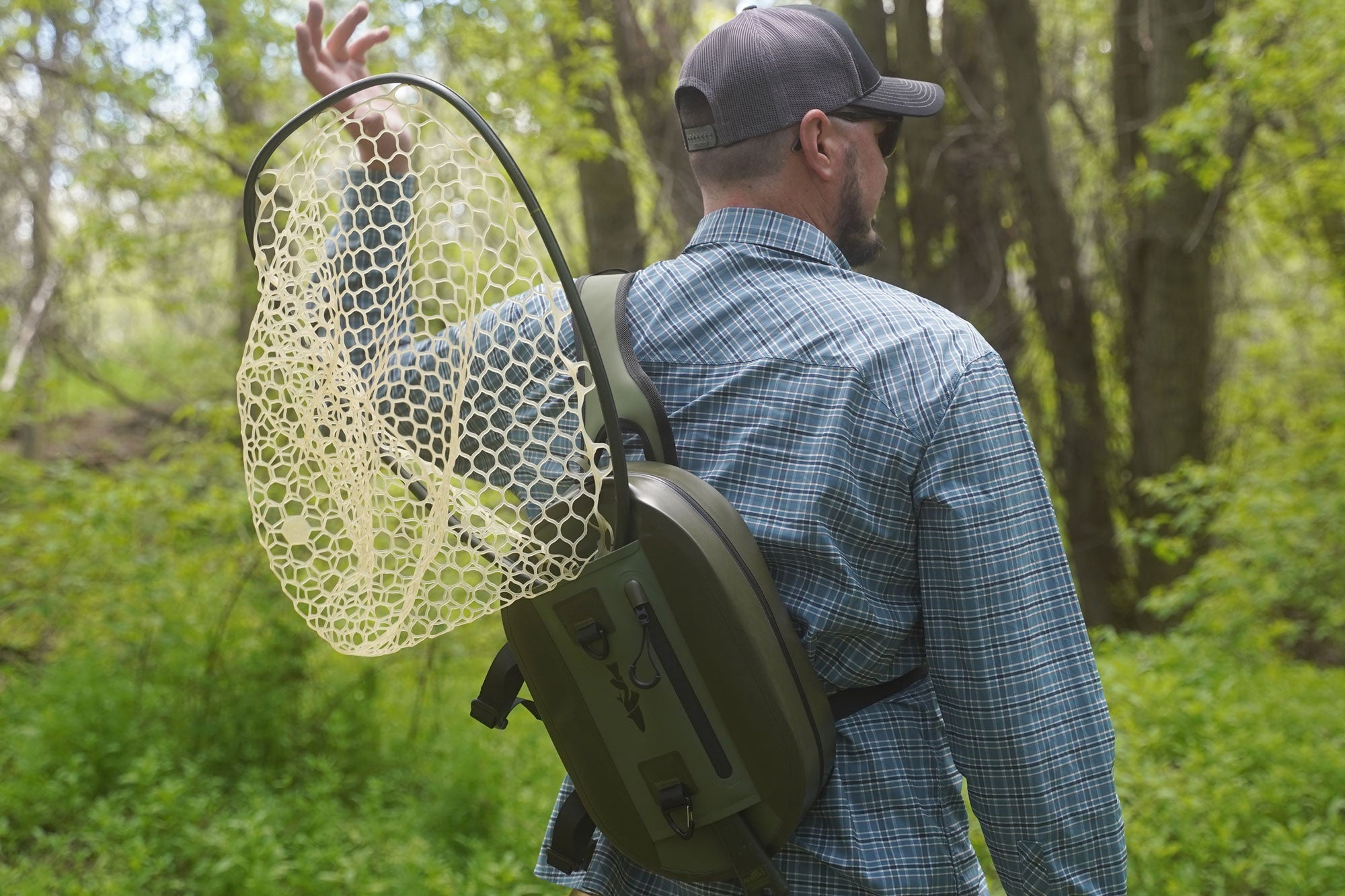
Walking a mile past the pullout is the whole strategy, and you will not do it with a vest full of gear you do not need. A sling holds a couple of boxes, tippet, water and a rain shell, swings around for access without coming off, and keeps the load light enough that twenty extra minutes of hiking sounds appealing instead of ambitious.

Stone Creek Wading Staff
The far bank is usually empty for exactly one reason: getting there is intimidating. A staff turns a sketchy crossing into a walk, which opens up water most anglers on the road side never touch. It is also the piece of gear most likely to keep you upright on a slick tailwater bottom.
The get-away-from-the-crowd kit
- Beacon Rechargeable 500 Lumen Headlamp — $39.95
- Trails Sling Pack — $59.99
- Stone Creek Wading Staff — $112.00
Total: $211.94. If you are learning to find the water other people walk past, start with reading water like a pro, and if your home water is a pressured tailwater like mine, our complete Provo River guide and the notes on guiding high-pressured water are the next two reads.
Crowded water is not the end of good fishing, it is a filter. The anglers who learn the spacing, ask the question, walk the extra half mile and leave a run early end up with more fish and better days than the ones who show up at ten and stand in the first thing they see. Be the one people are glad to find upstream of them.
Go on a fly fishing trip you'll never forget
We partnered with Frontiers International Travel to put you on water that's worth the flight. Tell them where you want to go. Don't wait.
Book a TripFly Fishing Insider Podcast has a referral partnership with Frontiers International Travel. If you book after being introduced through us, we may receive compensation at no additional cost to you.
Tight lines, everyone!
Got a crowded-water situation I did not cover? Send it over, because there is always a new one. Join the FFIP Insiders for gear deals, trip intel and tactics to help you catch any fish, any time, and anywhere.
Join freeBrowse the episodesTag your setup on Instagram @flyfishinginsiderpodcast
Prices and stock were checked against the FFIP shop on September 24, 2026, and can change. Stream access law is state specific and changes with legislation and court rulings; the Utah figures here reflect the 2010 Public Waters Access Act, the Utah Supreme Court's 2023 decision upholding it, and the Utah Stream Access Coalition's own mileage estimate as reported by Utah Public Radio, alongside the Utah Division of Wildlife Resources Weber River rules. Confirm current access rules and regulations with your state wildlife agency before you fish.