
Trout anglers who wander into stillwater striper fishing usually make the same mistake I did: they treat it like big-fish trout fishing. It isn't. Stripers and hybrids in a reservoir are a moving target that follows bait, and the anglers who catch them consistently aren't casting better than everyone else — they're in the right place, at the right depth, with the right rhythm. In this episode of our how-to series, Henry Cowen walked me through exactly how that works on a lake, and it reframed how I think about chasing these fish.
Start With Two Rods, Not One
The first thing worth internalizing is that stillwater striper fishing is a depth problem before it's anything else. Henry's advice is to go out with two rigged outfits: one with a slow-sinking intermediate line, one with a fast-sinking line. The intermediate covers fish that are up top or feeding down to roughly five to seven feet. The fast sinker is your answer when the fish get secretive and sit ten, fifteen, twenty, even twenty-five feet down. Having both rigged means you're changing depth in ten seconds instead of ten minutes.
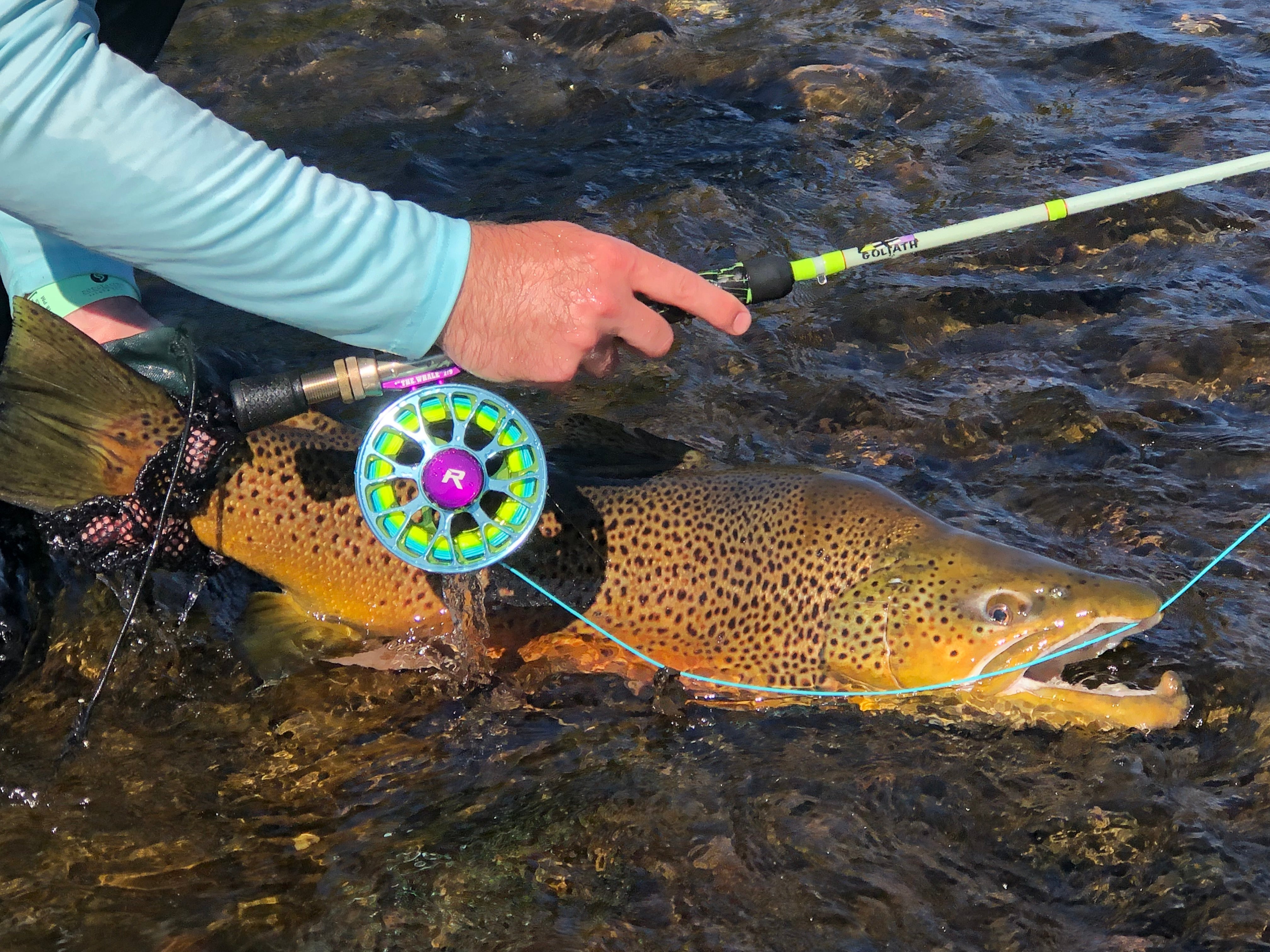
For the rod itself, think saltwater. An eight or nine weight at nine feet is the sweet spot. If you're specifically targeting hybrids, which typically run one to six pounds, a seven weight is genuinely more fun. The eight and nine are more striper-appropriate, because a true striper on a lake can run from two or three pounds up into the teens. For the reel, the only real requirement is capacity: something that holds about 150 yards of backing. These fish run, and they will get you into backing.

Keep the Leader Stupid Simple
This is where trout anglers overthink it. On the fast-sinking line, Henry runs a straight piece of five feet of 20-pound test — no taper, no steps. You can get away with 16-pound, but 20 gives you more margin when you're dragging a line along structure. On the intermediate, a short tapered leader with fluorocarbon tippet works well, though mono is fine too; fluoro is a preference, not a requirement.
The logic is simple: a sinking line already does the work of getting the fly down and turning it over. A long, delicate leader just fights the line and lets your fly ride higher than the line you paid for. Short and stout keeps the fly in the same water column as the line.
The Retrieve Is the Whole Ballgame
If you take one thing from this episode, take this: the pause is what gets eaten. Henry's cadence is short, quick strips of roughly three to six inches, followed by a three-second pause. Not a one-second pause — a real, counted, three-second pause. His shorthand for clients is to actually count it out: strip-strip-strip, one Mississippi, two Mississippi, three Mississippi, strip-strip-strip.
He estimates the fish eat on the pause the overwhelming majority of the time. The angler who doesn't pause is the angler who doesn't hook up. And this is genuinely hard to do when fish are busting bait on the surface right in front of you — the instinct is to strip faster. Fight that instinct. When a client is told to pause two seconds, what they usually deliver is closer to half a second.

Reading a Lake: Points, Humps, and Blow-Throughs
On moving water you read seams. On a lake you read structure, and Henry ranks it. Points are number one — they concentrate bait and give fish an edge to push against. Humps come next, particularly humps with flooded brush on them, because bait stacks there and fish follow. Flats matter. So do blow-throughs and saddles, the pinch points between land features where bait funnels and fish set up to feed.
The critical nuance is seasonal. Fish don't use blow-throughs and saddles year-round, and bait isn't always sitting in the channel. Water temperature dictates where bait can be, and where bait is, fish are. That means the highest-leverage thing you can do isn't buying a new line — it's keeping notes. Write down where you found fish and where you found bait. Just as usefully, write down where you didn't find them. A season of honest notes will out-fish a season of guessing.
Flies: A Small Box Goes a Long Way
Henry's position is that a modest, well-chosen box travels anywhere stripers and hybrids swim. Two patterns anchor it. The Clouser Minnow is non-negotiable — arguably the most productive saltwater and warmwater fly ever tied, and still a go-to for stripers and hybrids. The other is Blane Chocklett's Game Changer, which he's been catching stripers on for years and which moves like nothing else in the water. Build outward from those two rather than filling boxes with one-off patterns.

When the Blitz Happens, Slow Down
Henry described pulling clients up on a surface blitz for the first time and watching them fall apart — the fish are everywhere, the adrenaline spikes, and the cast goes sideways. It happens constantly. The blitz is the moment your practiced cadence matters most, not least. Make one good cast into the edge of the school, strip, pause, and let the take come to you.
His closing advice was about perseverance more than tactics. Stillwater striper fishing is a challenging game with long quiet stretches. But when an eight-pound fish eats an eight-weight on a Clouser, the initial run tells you why people keep coming back.
Gear
If you're building out a stillwater striper kit, focus your money on lines and backing capacity before anything else — two lines on two rods will out-fish one expensive rod every time. For the smaller stuff that makes the day work, our Tips and Tricks for Fly Fishing eBook covers the leader formulas, knots, and rigging shortcuts that keep you fishing instead of fiddling, and it pairs naturally with the simple straight-shot leader approach Henry described here.
For the lake days themselves, the FFIP Five Panel Cap earns its keep when you're staring at glare hunting for birds and bait, and the FFIP Angler's Coffee Mug is for the 4 a.m. start that gets you on the point before the sun does. We don't carry striper-specific lines or flies in the shop — for those, your local fly shop is the right call, and Henry's point about walking into the local bait and tackle shop to learn what the forage is doing applies just as well.