
Made by Sage: See the Sage ESN 4100-4 fly rod on the official Sage site (farbank.com)
The Sage ESN 4100-4 is a 10-foot, 4-weight, four-piece European nymphing rod built on Sage's KonneticHD graphite and made in Washington State. It is a tight-line tool for anglers who want to feel subtle takes, protect fine tippet and still turn bigger trout. Christian Bacasa fished it hands-on. FFIP score: 7.9/10.
Overall: 7.9/10 | Badge: Solid Choice
Verdict: A feather-light, very sensitive euro rod that makes the fish tell on themselves.
Best For: Competitive and serious tight-line nymphers who want a sensitive, light 10-foot four weight for bigger flies and larger trout.
Not For: Anglers on a budget, dry-fly and streamer anglers, and anyone who wants one rod to do every job.
Price: MSRP at time of writing: $1,000 (per maker site)
Pros:
- Very light at 2 15/16 oz per the rod label, with a down-locking seat that pulls balance toward the hand
- Soft tip protects fine tippet; strong lower blank lifts fish out of heavy water
- KonneticHD blank, Fuji ceramic stripper and a snub-nose cork handle, made in the USA
Cons:
- Premium price for a single-purpose rod
- Specialist action is not ideal for casting dry lines or streamers
- The 4100-4 is the heavy-duty ESN, so smaller water may call for the 2100-4 or 3100-4
The FFIP Scorecard
| Criterion | Weight | Score | Why |
|---|---|---|---|
| Casting Performance | 30% | 7.5 | A nymph rod, so no big streamers. It does exactly what it should on short tight-line casts and even flings dry flies on mono pretty well. |
| Sensitivity and Feel | 20% | 9.5 | The best part: takes show up in the tip and in my hand, even in slow water. It is like holding a wire to the fish. |
| Fish-Fighting Power | 15% | 8 | Soft tip, strong butt, with enough flex to forgive and power where you need it. The tippet limits you more than the rod does. |
| Build Quality and Components | 20% | 9 | Clean finish and a comfortable cork handle with almost no filling. It feels light in the hand all day. |
| Value | 15% | 5 | At $1,000 it is a lot for one job, justified only if you nymph this way all season and want the warranty and the brand. |
| Overall (weighted) | 100% | 7.9 |
How Is the Sage ESN 4100-4 Built? The Engineering Behind It
KonneticHD: More Fiber, Less Resin
Sage builds the ESN on KonneticHD, which it calls “the next era in performance graphite rods.” According to Sage, the company optimized the graphite-to-resin ratio to create a higher density (HD) fiber composite, resulting in lighter, stronger blanks with better recovery, energy transfer and loop control. Resin glues the fibers in place, but it adds weight and does not carry load. Using a higher percentage of fiber for the same wall thickness gets you more stiffness for less mass. Less mass in the tip means a rod that starts and stops with less effort, and that recovers faster after a cast or a hookset.
Why Euro Nymphing Wants a Rod Like This
European nymphing is tight-line fishing. You hold a long rod, lift the fly line off the water and run a thin monofilament leader straight from the rod tip to a heavy fly, with no slack to hide a take. That makes the rod an instrument. The leader is stiff and does not stretch much, so a bump from a trout travels up the line to the tip. A light, stiff-enough tip gives you a visible, felt signal. A heavier tip would absorb part of it. Ten feet of rod gives you reach: you hold more water on a tight line without wading in on top of the fish. For more on terminal tackle, see our leader and tippet knots guide.
The Soft Tip and Powerful Butt
Sage describes the ESN as a “refined medium action” with a soft tip and a powerful lower end. The soft tip is a shock absorber. When a trout bolts, the force on fine tippet spikes in an instant, and a tip that flexes stretches that spike over more time, so the tippet sees a lower peak load. The stiffer lower blank is the lifting power: it pulls a fish out of a deep lie or heavy current without bending so far that you lose control. The 4100-4 sits at the larger-fish end of the ESN family, which Sage positions for bigger flies and larger fish. Its siblings, the 2100-4, 3100-4 and 3106-4, cover smaller flies and water, all-around use and all-around reach. Our guide to rod tapers explains how these actions develop.
Balance, Guides and Grip
Sage lists a Stealth Black anodized aluminum down-locking reel seat, a flor-grade snub-nose, half-wells cork handle, Fuji ceramic stripper guides and hard chromed single-foot snake guides with a tip-top. Sage says the down-locking seat pulls the balance point closer to the hand, which cuts fatigue and helps keep the tip high through a long drift. Ceramic strippers keep friction low where the line slides most. Sage builds these rods on Bainbridge Island, Washington, with each one passing through 23 sets of hands, per the maker. The rod comes in a black powder-coated aluminum tube with a Sage medallion and a black rod bag.
On the Water with the Sage ESN 4wt 10ft
My first time fishing a rod like this was on a small, slow stream with tall dry grass on the bank and bare mud at the edge of the water, somewhere remote in the western United States, with the trees in fall colors. The overcast morning was cool and quiet, and I spent it nymphing every deep pool and the small pockets in the riffles. I have carried the Sage ESN 4100-4 for several seasons of nymphing, usually alongside either a streamer rod or a dry-fly rod, and this day was one of many.
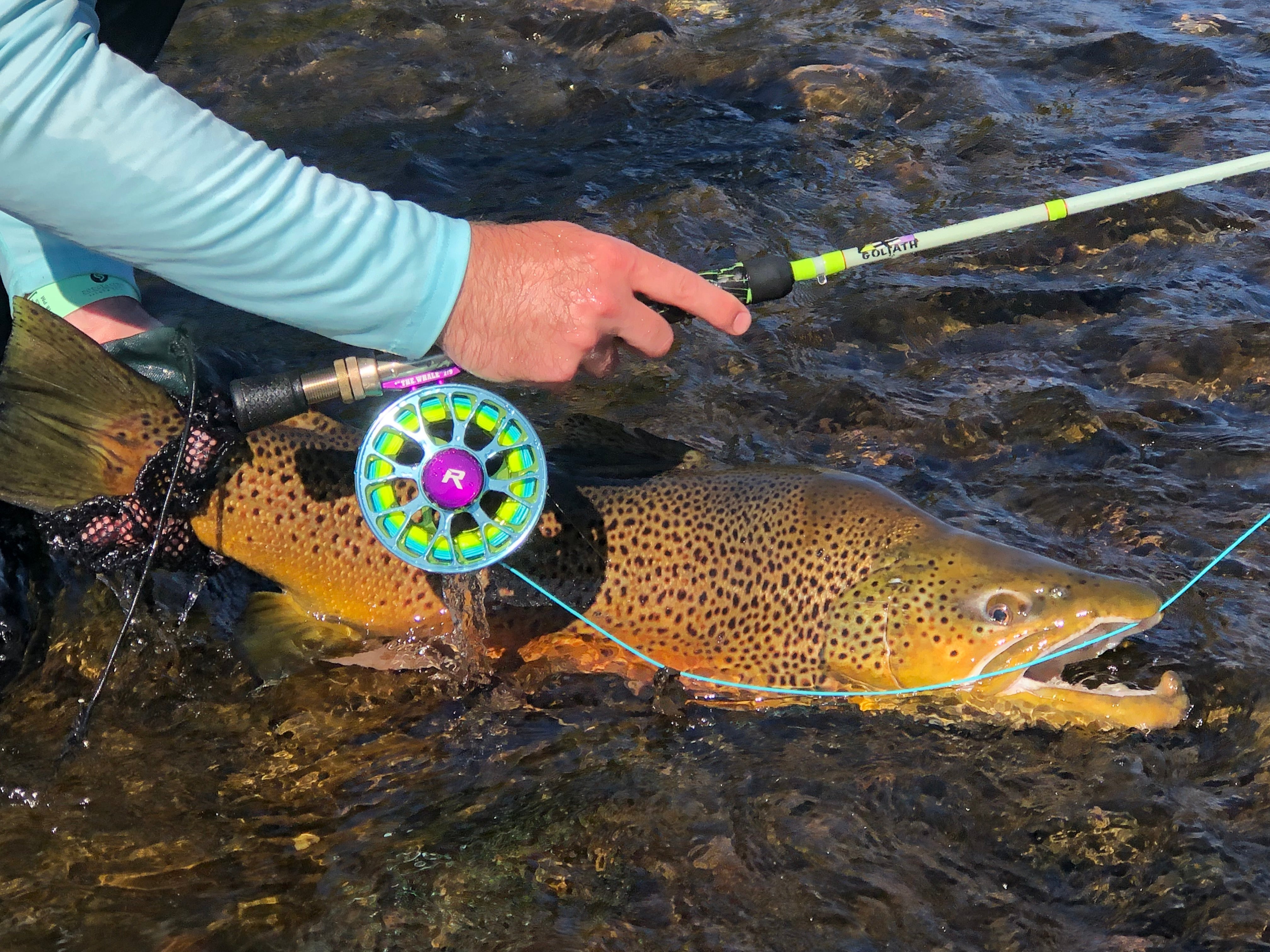
The moment I remember is the pause in the leader. I lifted, and the rod bent deep into the butt. The fish felt like far more than it was once it hit the current, but after a few side pulls it came in easy. It was a brown trout with orange and red spots and a golden belly, likely a late-summer fish starting to color up for pre-spawn. I laid the rod across a Rising Lunker net, with the fish resting partly in the shallows, for a quick photo before letting it go.
How Does the Sage ESN 4100-4 Cast, Feel and Fight Fish?
Casting Performance (Score: 7.5/10)
Casting a Euro rig is mostly a short, controlled lob with a light leader, a few flies and a sighter, not a line-loading exercise. The ESN's medium action and light tip let you flick a weighted fly into a pocket and keep the rig under control. Sage also designed it for a range of long and short line techniques, so you can reach beyond a tight-line style when the water calls for it. A 10-foot rod lets you hold the line up and off the water to reduce drag. It is a nymph rod, so I would not ask it to throw big streamers. For short, tight-line casts it does exactly what it should, and I have found it is pretty good at flinging dry flies on mono even though it was not designed to.
Sensitivity and Feel (Score: 9.5/10)
Sensitivity is the ESN's reason to exist. Sage builds the 4100-4 on a carbon-dense KonneticHD blank with a soft tip and says it is built for maximum sensitivity while tight-line nymphing. The rod label lists 2 15/16 oz, and the down-locking reel seat pulls balance back toward your hand so the tip feels lighter than the number says. Light, stiff-enough tips are how takes get from the fly to your fingers. This is the best part of the rod for me: takes show up in the tip and in my hand, even in slow water, like holding a wire to the fish. Some anglers prefer the 3wt, but that one feels like a wet noodle to me.
Fish-Fighting Power (Score: 8/10)
The 4100-4 is the ESN you pick for larger fish and bigger flies. A soft tip absorbs shocks to protect tippet, while the powerful butt lifts fish out of deep lies and heavy water, as Sage states. After the hookset, pressure and tippet protection are the same job: a rod that flexes through the run keeps the load low. See our hook-set and landing guide and our netting tips for finishing the job. Soft tip, strong butt. I am rarely limited by the rod's fighting ability and more often by the tippet, and the rod has enough flex to be forgiving and enough backbone to add power when and where I need it.
Build Quality and Components (Score: 9/10)
Component quality is high: KonneticHD graphite, Fuji ceramic stripper guides, hard chromed single-foot snake guides, an anodized aluminum down-locking seat, a flor-grade cork handle and an aluminum tube. Sage builds the rod in the USA. Single-foot guides keep weight down at the cost of some rugged strength, so take care when you move through brush. The finish is clean, the cork handle feels good with almost no filling, and the label lists 2 15/16 oz. It feels light in the hand all day.
Value (Score: 5/10)
Sage lists the ESN 4100-4 at $1,000 (per maker site). That is a premium price for a specialist rod, and you pay for lighter weight, a refined taper and domestic craftsmanship. If you nymph often, fish competitively or want the best-feeling tool, it is easy to justify. If you are testing the style, a less expensive rod is a smarter start. It is $1,000, which is a lot for one job. If you nymph this way all season, want a solid warranty and a brand you can believe in, the price is supported. These days rods are not normally worth the high price tags, in my opinion.
Who Should Buy the Sage ESN 4wt 10ft (and Who Should Skip It)?
Buy the Sage ESN 4wt 10ft if:
- You fish tight-line nymph rigs often and want to feel every tick of the drift.
- You target bigger trout on larger flies and need a rod with a strong lower blank.
- You value light weight, balance and USA craftsmanship.
Skip it if:
- You are new to Euro nymphing and want to try the style cheaply first.
- You mostly fish dry flies or streamers.
- You mainly fish small water and light flies, where the 2100-4 or 3100-4 may suit you better.
How Does the Sage ESN 4wt 10ft Compare?
A useful comparison is Moonshine's Epiphany, a budget Euro nymphing rod, using the makers' listings.
| Rod | Length and weight | Action | Listed price |
|---|---|---|---|
| Sage ESN 4100-4 | 10 ft, 4wt | Refined medium action (Sage) | $1,000 |
| Moonshine Epiphany 4wt | 10 ft, 4wt | Moderate-fast (Moonshine) | $199.99 |
The Epiphany costs about a fifth as much and is a fine way to learn the style. The ESN adds KonneticHD material, USA construction and a lighter, more refined feel.
Our Pick in the FFIP Shop
For a nymphing rod from our shop, check out the Moonlit Umbra V2 Fly Rod w/case, offered in 10-foot 3wt and 5wt nymph versions. It costs a small fraction of the ESN and gives you a way into the style, though it is not a 4wt and is not built to Sage standards.
Frequently Asked Questions
What is the Sage ESN 4100-4?
The Sage ESN 4100-4 is a 10-foot, 4-weight, four-piece European nymphing rod built on KonneticHD graphite. Sage positions the 4100-4 for bigger flies and larger fish within the ESN family.
What does ESN stand for on a Sage rod?
ESN is Sage's European nymphing series. The 2100-4, 3100-4, 3106-4 and 4100-4 models are aimed at tight-line nymphing at different line weights and lengths.
Where is the Sage ESN made?
Sage states its rods are built one at a time on Bainbridge Island, Washington, passing through 23 sets of hands.
Is a 4 weight too heavy for Euro nymphing?
Not for bigger fish. The rod weight sets the power of the blank more than the weight you cast, since Euro rigs cast mostly leader and flies. A 4wt gives you lifting power in heavy water; lighter ESN models suit smaller flies and water.
Final Verdict
If you nymph a lot, the Sage ESN 4100-4 is worth it. If you only nymph once in a while, a cheaper rod will do the job.
Christian's Pro Tip: Keep your leader tight and your tip low and to the sides. That holds the fish near the substrate in lower-speed water. Let the rod do the work, and when you are ready, lift the fish to the top so it flows head first into your net.
Tight lines, everyone!