
Most fly rods do not break on a fish. They break on car doors and tailgates, on a high-sticked snag, on a hookset that loads the tip-top against a fly buried in a rock, and in transit. Nearly every major rod maker will repair or replace a broken rod for its original owner, usually for a fee between roughly $30 and $175 plus shipping.
It is the sound that gets you. Not a crack exactly, more of a tick, like somebody snapping a pencil in the next room. Then the top eighteen inches of your rod is hanging off the fly line like a dead branch, swinging in the current, and the fish is gone.
Here is the thing: this happens to everybody. I have done it, my buddies have done it, and I have stood in the Provo River holding the top half of a client's brand-new five-weight feeling about two inches tall. Breaking a fly rod is a rite of passage, not a verdict on you as an angler. At the Fly Fishing Insider Podcast we have had rod designers and rod company founders on the show, and they all say a version of the same thing: rods break, the companies expect it, and there is a process. This is that process, start to finish.
Why This Matters: Fly Rods Almost Never Break on the Fish
A fly rod is a hollow tapered tube designed to bend in a specific arc. It is astonishingly strong along that arc and surprisingly fragile outside it. Almost every broken fly rod I have seen came from a load the blank was never designed to take, and in most cases the fish had nothing to do with it. Knowing the four real causes is what keeps the next rod alive.
High-sticking, the number one rod killer
High-sticking means raising the rod past vertical so the bend collapses into the top two sections instead of spreading down the blank. It happens when you lift a snagged fly straight up, when you try to lead a fish to your hand instead of a net, and when you hoist a trout out of the water for a photo. The tip section is the thinnest part of the rod and it is carrying the whole load at that angle. Keep the rod below about 45 degrees when something is pulling hard, and point the rod straight at a snag and pull from the line instead.
Car doors, tailgates and truck windows
Ask any fly shop what breaks the most rods and you will hear about doors. A rod leaned against the truck, a tip sticking out a window, a tailgate closing on a rigged rod — none of this is exotic, all of it is preventable. The rule I use with clients is simple: a rod is either in your hand, in a rod holder, or in its tube. Never leaning, never lying across the bed of the truck, never on the roof.
The hookset that loads the tip-top
The tip-top is the small guide at the very end of your rod. When a fly is stuck in a rock and you strip-set hard, or when you set the hook with a foot of fly line jammed through the tip-top and a heavy fly beyond it, the entire force lands on a quarter-inch of glued ceramic and thin blank. That is why so many breaks happen at or just below the tip-top on a hookset. Reel in the last of your leader before you land or lift a fish, and never set the hook with a knot or a fly jammed against the top guide.
Rod tubes, travel and the drive home
The rod tube your rod shipped in is not packaging, it is safety equipment. Broken sections show up after flights, after a day of rattling around a drift boat, after a rod rides home on a roof rack in the rain. Use the tube and the cloth sock every time the rod is not being fished, and check the ferrules for grit before you push the sections together. Grit inside a ferrule is what turns a clean joint into a cracked one.
Ferrules and guides, the slow failures
Not every failure is a snap. Loose ferrules let sections spin and wear, and a cracked guide insert will shred fly line and eventually fail under load. This is the category most anglers miss, and it is the cheapest to fix, because a single guide wrap or a new tip-top is often a $25 to $40 repair rather than a warranty claim at all. I walk through my own pre-fishing check in the video further down.
How Do Fly Rod Warranties Actually Work?
A fly rod warranty is not insurance and it is not a no-questions-asked replacement program, whatever the marketing says. In practice, every major program runs on the same five variables: how long coverage lasts, whether you are the original owner, whether the rod was registered, what the fee is, and how long the turnaround takes. Read those five and you know exactly where you stand.
- Coverage length. Anywhere from 12 months to lifetime. "Lifetime" almost always means the lifetime of the original owner, not the lifetime of the rod.
- Original owner only. This is nearly universal. A rod bought used, or bought from an unauthorized seller, is usually outside the program entirely.
- Registration. Some brands require it within a set window. Scott, for example, requires registration within 30 days of purchase for the lifetime warranty to apply.
- The fee. A true manufacturing defect is generally free. Everything else — which is most breaks — carries a handling or replacement-section fee, plus shipping one or both ways.
- Turnaround. This is the number nobody checks and everybody cares about. It ranges from a few days to a full season.
| Rod maker | Coverage | Who it covers | Fee | Turnaround |
|---|---|---|---|---|
| Orvis | 25 years on most graphite and fiberglass models; 5 years on 2021-and-later Encounter rods | Original owner only | $60 handling fee, plus $12.95 if you want their prepaid label; return shipping covered | 4 to 6 weeks, with expedited 5-business-day service on tip and mid-section breaks for several current models |
| Scott | Lifetime on graphite and fiberglass; 1 year on split cane | Original owner, bought from an authorized dealer and registered within 30 days | Free under warranty; a "reasonable fee" for unregistered or ineligible rods | 10 to 12 weeks from when they receive it |
| Sage (Far Bank) | Unconditional original-owner lifetime warranty on rods with serial numbers starting Q, R, S or T; defect coverage on others | Original owner only | Free for defects; a repair or replacement fee for breakage outside coverage, e.g. $100 per section on custom blanks | Quoted per claim through their repair form |
| Echo | Natural life of the product | Original owner only | Standard processing fee on all claims; waived only for defective materials or workmanship | Often 2 to 3 days after receipt, longer in busy season or on backordered parts |
| Temple Fork Outfitters | Full lifetime warranty on defects | Registered owner only | Replacement fee for non-defect damage; photos and proof of purchase required | Quoted per claim by email |
| Moonshine Rods | 12 months on rods bought after June 2025; rods bought before that keep the older lifetime warranty | Original purchaser, with matching order confirmation | Replacement sections priced per series, roughly $38 to $65 | Quoted per claim |
Warranty terms, fees and turnaround times were checked against each manufacturer's own published policy on September 24, 2026. These programs change without much announcement — Moonshine Rods moved from a lifetime warranty to a 12-month warranty in June 2025, and fees creep up with inflation — so confirm the current terms on the maker's own warranty page before you count on a number here. Sources: Orvis, Scott, Far Bank (Sage), Echo and Temple Fork Outfitters.
The pattern is obvious once you lay it out. Coverage is generous, but it is tied to you, not to the rod. That is why this matters so much if you shop secondhand: a lifetime warranty usually evaporates the moment the rod changes hands, which is one of the first things to price in when you are buying used fly rods.
What a rod company owner says service should look like
Tate Cunningham, a partner at Moonshine Rods, spent his Fly Fishing Insider Podcast episode arguing that customer service is the actual product for a direct-to-consumer rod company. His framing was blunt: fly fishing equipment is not cheap, so the company has to still be there after the sale, and if something is not right they fix it as fast as humanly possible. He said email replies typically land within 10 or 15 minutes.
Tate Cunningham's point is the one to take into a claim. A rod company that answers quickly and replaces a section without a fight is worth real money over the life of a rod, and it is a thing you can check before you buy — email their service address with a question and see how long it takes to hear back.
Tate Cunningham of Moonshine Rods on building a direct-to-consumer rod company and why service is the product, from the Fly Fishing Insider Podcast.
Why some rods can be repaired and others get replaced
Jim Bartschi, president and rod designer at Scott Fly Rods, explained on his Fly Fishing Insider Podcast episode that Scott handcrafts every rod carrying its name in its own shop in Montrose, Colorado, and has done for four decades. He also described a fly rod as a deceptively complex system rather than a tapered stick — materials, resin, layup, taper and components all interacting, and hard to model mathematically even now.
That explains a lot about repairs. A company that builds sections in-house can often replace one section and keep your rod matched. A brand that imports finished blanks usually has to send you a whole new rod or a stock section, which is also why a discontinued model is the hardest claim to fill.
Step-by-Step: What to Do When Your Fly Rod Breaks
Do these in order. The first four take place on the water in about five minutes, and the rest happen at the kitchen table that night.
- Stop and account for every piece.
Reel in slowly and keep the broken section on the line if it is still threaded. A tip section that slides off into a riffle is gone forever, and most warranty programs want the whole rod, including the broken pieces, returned to them.
- Photograph the break before you move anything.
Take one photo of the break itself, one of the full rod laid out, one of the reel seat and one of the logo and serial number on the blank. Temple Fork Outfitters asks for exactly this set, and every other brand benefits from it. Do it streamside while the evidence is untouched.
- Be honest with yourself about the cause.
Did it go in a door? Did you high-stick a snag? Did it separate at a ferrule with no obvious force? The answer decides whether you are describing a defect or an accident, and describing it accurately is what keeps the process short.
- Keep fishing.
This is the whole reason for a backup rod in the truck. A broken rod ends a rod, not a day, and one of the quiet advantages of a four-piece rod is that a tip break sometimes leaves you a fishable three-section rod for the rest of the afternoon if you rig carefully and keep casts short.
- Find your proof of purchase and serial number.
Original owner status is what the whole system runs on. Dig out the order confirmation email, the receipt, or the registration you filed when the rod was new. If you never registered the rod and the brand requires it, check the policy now rather than assuming.
- Read the actual warranty page, not the forum thread.
Go to the manufacturer's own repairs page and read the fee, the eligibility, and the turnaround. Fill in their form rather than emailing cold. This is also when you decide whether the claim is even worth it: if the fee plus shipping approaches the price of the rod, a replacement is the better call.
- Pack it like it is going to be dropped, and insure it.
Use a rigid tube, pad both ends, include the completed form inside the package, and ship with tracking. Scott asks you to insure it and keep tracking confirmation, which is good advice for any brand. Then plan your season around their turnaround, not the one you hope for.
Common Beginner Mistakes
Yanking a snagged fly straight up with the rod. It feels like the gentle option and it is the single most common way beginners break a tip.
Point the rod straight down the line at the snag, grab the fly line with your hand, and pull steadily. The rod is out of the equation entirely. You will lose flies. Flies are cheaper than tip sections.
Lifting a fish out of the water on the rod. Reaching a trout to hand by raising the rod overhead loads the tip with the fish's whole weight plus the water.
Land fish in a net with a long enough handle that you never raise the rod past about 45 degrees. Bring the net to the fish, not the fish to the net.
Assembling the rod by twisting the sections together. Grinding a gritty ferrule is how you start a crack that shows up three trips later.
Wipe each ferrule clean, line the guides up slightly offset, push the sections together straight, then rotate the last few degrees to align the guides. Check the alignment again before your first cast.
Setting the hook with the leader knot inside the tip-top. That knot jams, the load spikes at the smallest part of the rod, and it snaps on a fish that was never big enough to do it.
Leave at least a foot of fly line outside the tip-top when you are close to a fish, and stop reeling before the leader-to-line connection reaches the top guide.
Waiting until spring to send a rod in. Every angler in the country files in March, and turnaround times stretch accordingly.
Send broken rods in the fall. A 10-to-12-week repair in November is invisible; the same repair filed in April costs you the best water of the year.
Most of that comes down to a routine rather than a rule. I walk through the five-item check I run before I start fishing — threading the line, checking the guides, setting the reel seat and the drag, and running my fingers down the leader for nicks — in this one:
My own pre-fishing rod check: threading the line as a fold, confirming every guide, tightening the reel seat and feeling the leader for nicks, from the Fly Fishing Insider Podcast.
Judge a rod by how it holds up under an ugly load, not a pretty cast. Musky guide and rod designer Chris Willen looks for a rod that stays true through the figure eight, because plenty of rods fold or over-bend when you stick half the rod in the water and swirl it, and he wants one he can cast hard all day. That is a musky tip, but it transfers straight to rod breakage for trout anglers: the moments that kill rods are exactly these extreme-angle, high-load moments, not the smooth 40-foot cast. Chris Willen tells it on his Fly Fishing Insider Podcast episode.
Author's Story & Key Insights
I guide in Utah, and the first rod I ever broke as a guide was not mine. A client on the Provo River hooked a good brown, got excited, and lifted the rod straight over his head to bring it close. The tip let go about eight inches down from the tip-top with a noise I still hear. He apologized for twenty minutes. I told him what I will tell you: it was my fault for not having the net in the water already.
The rod that has lived the longest in my truck is not the most expensive one. It is a mid-priced four-piece that never leaves its tube between spots, and I credit the tube more than the blank. My buddy Todd has gone the other way — he has broken three rods in four years, and every single one of them went in a vehicle, not on a fish. Once in a tailgate, once in a back door, once under a cooler. That is the real statistic on rod breakage in my circle of friends, and I would bet it holds for yours.
- Rods break at extreme angles and in vehicles. Almost never on a normal fight with a normal fish.
- Warranty coverage follows the original owner, not the rod, so registration and receipts are the whole ball game.
- The fee is not the number that matters most. Turnaround time is, because a 12-week repair can eat a season.
- A cheap backup rod in the truck turns a broken rod into an inconvenience instead of a ruined trip.
Pro Tip from Christian
The day you buy a rod, do three things before you fish it: register it on the manufacturer's site, photograph the receipt and the serial number into the same phone album, and write the purchase date on a piece of tape inside the rod tube. It takes ten minutes and it is the difference between a $60 handling fee and buying a whole new rod four years from now, when you have long since deleted the order email.
Terms You'll Hear
Blank. The bare tapered tube of graphite, fiberglass or cane that a fly rod is built on, before guides, grip and reel seat go on.
Ferrule. The joint where two rod sections fit together. Most modern fly rods use a spigot or sleeve ferrule that needs to be clean and fully seated.
Tip-top. The small guide at the very end of the rod tip. A frequent break point and also one of the cheapest parts to replace.
High-sticking. Raising the rod past vertical under load so the bend collapses into the thin upper sections instead of spreading through the blank.
Original owner. The person who bought the rod new from an authorized dealer. Nearly every fly rod warranty is limited to this person and does not transfer with a resale.
Handling or processing fee. The flat charge a manufacturer applies to a repair that is not a proven manufacturing defect. It is the normal cost of a warranty claim, not a penalty.
Section replacement. Sending a single new piece of a multi-piece rod rather than a whole rod. Cheaper and faster when the model is still in production.
Recommended Starter Gear
Three things genuinely reduce your odds of a broken rod, or reduce what it costs you when one breaks. Everything here is live in the FFIP fly rod collection and the shop, and prices were checked the day this was published.

Risen Fly Genesis Fly Rod
This is the rod that lives behind the seat. It is not the rod you fish every day, it is the rod that means a broken tip at 9 a.m. does not end the trip, and at this price it costs less than most warranty claims plus shipping. Keep it rigged with a general-purpose line and leave it in its tube.

NIRVANA PhoenixGLASS Fiberglass Fly Rod with case
Fiberglass bends deeper and slower than fast graphite, which makes it far more forgiving of the sloppy angles that snap tips, and it is a genuinely fun rod on small water. It ships with its own case, which matters more than people think: the rod that always has a case with it is the rod that survives the drive home.

Rising Brookie Net
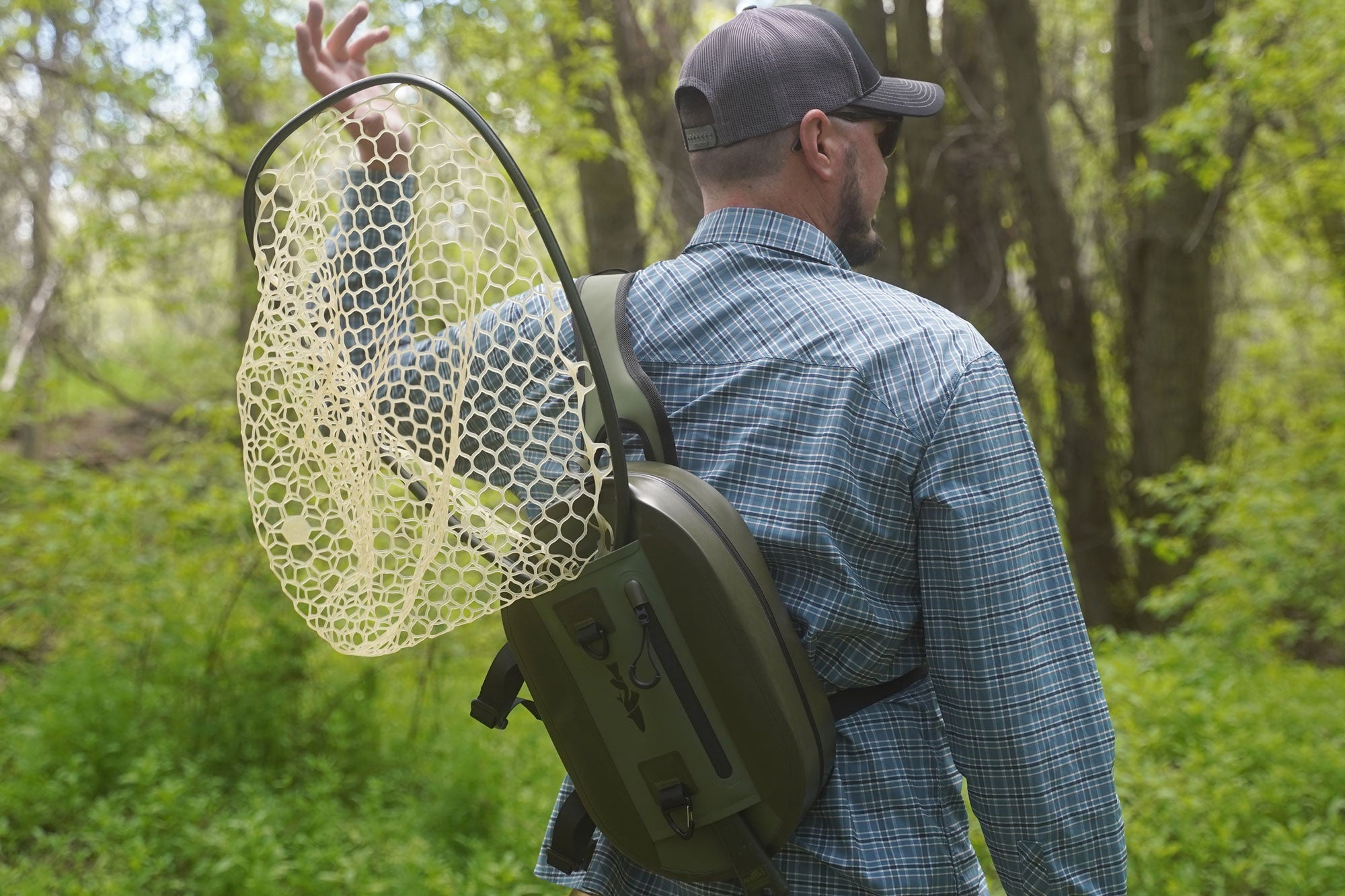
The cheapest insurance against high-sticking is a net you can actually reach the fish with. The 10-inch Brookie starts at $159.00 and the larger bags run $189.00, and the rubberized mesh is easier on a fish and on your flies than knotted nylon. If you only fix one habit after reading this, make it netting fish instead of lifting them.
The keep-fishing kit
- Risen Fly Genesis Fly Rod — $129.99
- NIRVANA PhoenixGLASS Fiberglass Fly Rod with case — $299.99
- Rising Brookie Net — $159.00 (10-inch bag)
Total: $588.98. If you are building from scratch rather than replacing, our guide to the best fly fishing rods by budget covers what each price tier actually buys you, and travel fly rods covers the packable four- and six-piece question.
A broken rod feels like a disaster for about ten minutes. Then it becomes a form, a fee and a shipping label, and a month or two later you are fishing the same rod again. Register it, photograph it, net your fish, and keep something in the truck. That is the whole game.
Go on a fly fishing trip you'll never forget
We partnered with Frontiers International Travel to put you on water that's worth the flight. Tell them where you want to go. Don't wait.
Book a TripFly Fishing Insider Podcast has a referral partnership with Frontiers International Travel. If you book after being introduced through us, we may receive compensation at no additional cost to you.
Tight lines, everyone!
Broken a rod in a way I did not cover? Tell me about it, because the stories are always better than the list. Join the FFIP Insiders for gear deals, trip intel and tactics to help you catch any fish, any time, and anywhere.
Join freeBrowse the episodesTag your setup on Instagram @flyfishinginsiderpodcast
Prices and stock were checked against the FFIP shop on September 24, 2026, and can change. Warranty coverage, fees and turnaround times come from each manufacturer's own published policy on that date; rod warranty programs change without notice and vary by model, purchase date and country, so confirm the current terms with the manufacturer before relying on any figure here.