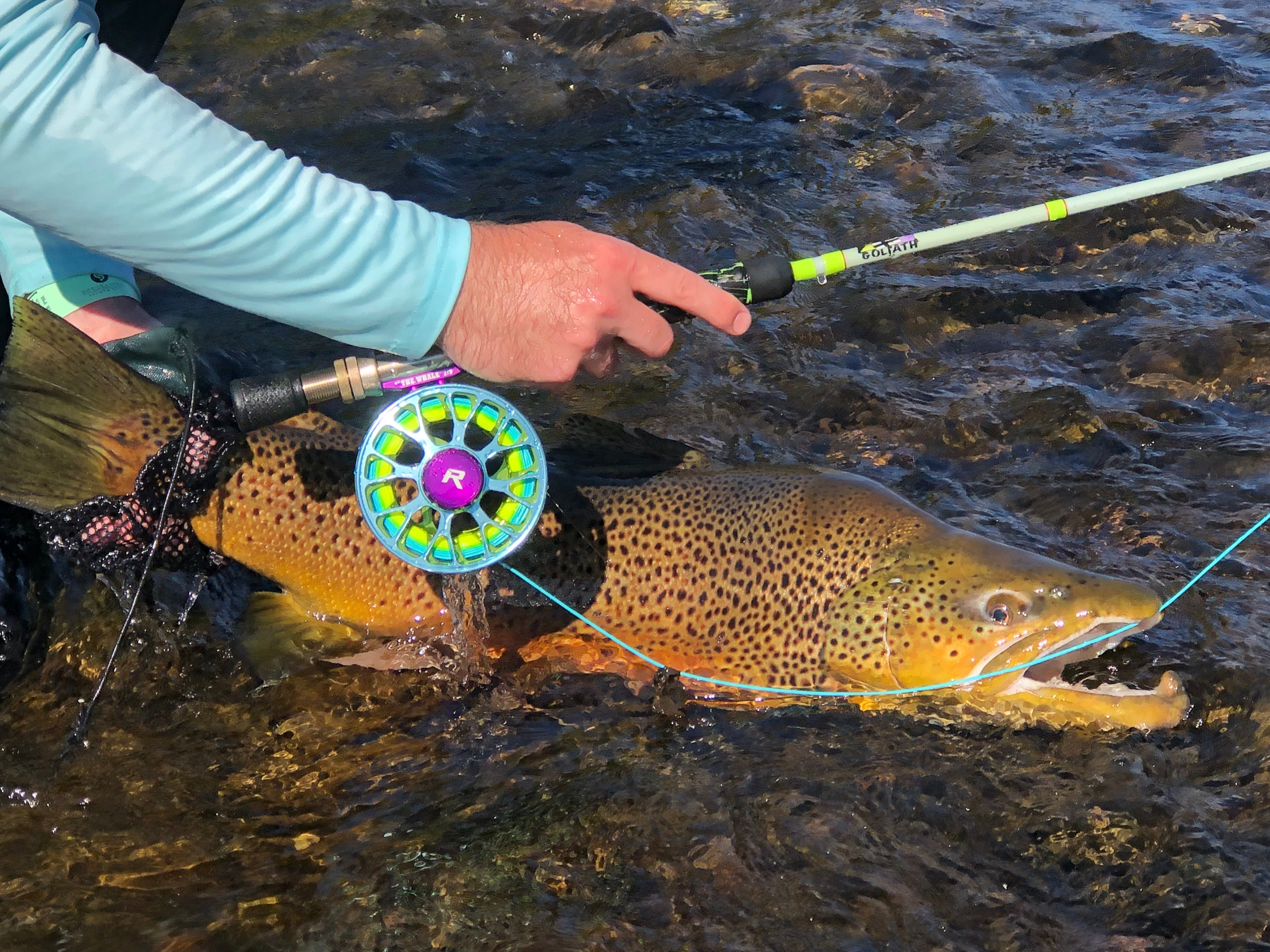

Some anglers collect flies. Some collect rods. Our guest on this episode collects species. He's a trout guide based in Georgia who set out to catch every salmonid species on the planet, and when we recorded he had roughly 40 of the 50-plus on his list. That goal has taken him from Gila trout in the American Southwest to the mountain streams of Japan, Turkey and Morocco, with a Mexican golden trout trip on deck. What makes the conversation useful for the rest of us is that the same approach he uses to find a rare trout halfway around the world works on your home water too.
When in Doubt, Go Up
If there was one rule he came back to again and again, it was this: native fish are almost always pushed to the top of the system. Out West, pure cutthroat populations hang on in the highest reaches of their streams. In the Southeast, native brook trout live in the same kind of headwater pockets above the reach of stocked and non-native fish. Overseas, he found the same pattern, with many rare trout and char limited to small, high, cold water.
So when you're hunting a native fish, don't start at the bridge pool. Look at a map, find where the stream gets small and steep, and keep walking. He told us he learned this the hard way, time and time again, on early trips where he fished too low. Barriers like waterfalls often mark the line where the natives begin, and on migratory rivers, fish will push upstream until they physically can't go any farther.

Keep the Rig Simple
You might expect someone chasing rare species to carry an elaborate arsenal. It's the opposite. In small water, his first move is almost always a dry-dropper, and he told us he rarely needs an indicator rig when he's traveling. Small headwater fish see little pressure and eat readily if you get a clean drift, and a dry-dropper lets you cover the top and just under it in one cast while reading the water as you go.
The exception is the big predatory salmonids, taimen and large char, where he switches to streamers. His other observation about bugs overseas was interesting: many of the rivers he's fished don't have one blanket hatch the way a famous Western tailwater might. Instead, there's a little of everything. That's another argument for a general-purpose attractor dry and a simple nymph dropper over a box of exact imitations.
Research Is Half the Fishing
For rare and threatened species, information online is thin, and some of it is deliberately vague to protect fragile populations. His approach is to do a ton of research before any trip, use whatever scientific survey data and range maps exist to narrow down drainages, and connect with local anglers and guides who know the water. The research tells you where to start. Going upstream until you find fish tells you the rest.
He also shared some of his favorites from Japan, where the native yamame and the white-spotted char, locally called iwana, live side by side. He described the iwana as behaving a lot like a brook trout, which will make any Appalachian angler feel right at home.

Catch Them Without Wrecking Them
The part of his philosophy I appreciated most was his attitude toward the fish themselves. When he's chasing a rare species, the goal is one good fish and a photo, not a numbers day. He told us that when he books a trip in places like Morocco, he makes that clear up front: he's not there to hammer a fragile population. Keep the fish wet, keep handling time short, pinch your barbs, and move on once you've got your fish. If you want to chase natives, the least we can do is leave them better off than we found them.
Gear
Headwater native fishing rewards light, simple gear: a short 3 or 4 weight, a handful of high-floating attractor dries, a few beadhead droppers, and barbless hooks. Your local fly shop can point you toward the patterns that work on your nearest native trout water. If you want to tighten up the dry-dropper rigging and knots that this whole approach depends on, our Tips and Tricks for Fly Fishing eBook is a good place to start, and for the long hikes up to the headwaters on cold mornings, the Brown Trout Hoodie is the layer I reach for.