
Here's a claim that gets me argued with at every fly shop counter in Utah: on flat, clear water, casting upstream to a rising trout is usually the worst thing you can do. Not because the cast is bad. Because of the order in which the fish sees things.
A downstream dry fly presentation means positioning yourself above a rising trout and delivering the fly so it arrives ahead of your tippet, leader, and fly line. Because current carries the fly to the fish first, the trout sees only the fly — not the hardware — which is why a downstream dry fly presentation fools spooky, heavily pressured trout that refuse a standard upstream cast.
Key takeaways
- A downstream dry fly presentation shows the trout the fly first and the leader last, which is the single biggest reason it beats an upstream cast on flat, clear water.
- The cast is only half the job. You have to build slack into the drift on purpose — with a parachute cast, a pile cast, or a rod-tip wiggle — or drag sets in within a foot or two.
- Hook sets change completely. Setting straight up pulls the fly out of the trout's mouth. You set downstream and low, or you delay the set by a full beat.
- Approach matters more than casting skill here. You are wading above the fish, and the pressure wave off your boots gets to them long before your fly does.
- Downstream presentations are a specialist tool, not a replacement. In broken pocket water and tight brush, an upstream cast is still the better play.
The Provo River refusal that rewired how I fish dry flies
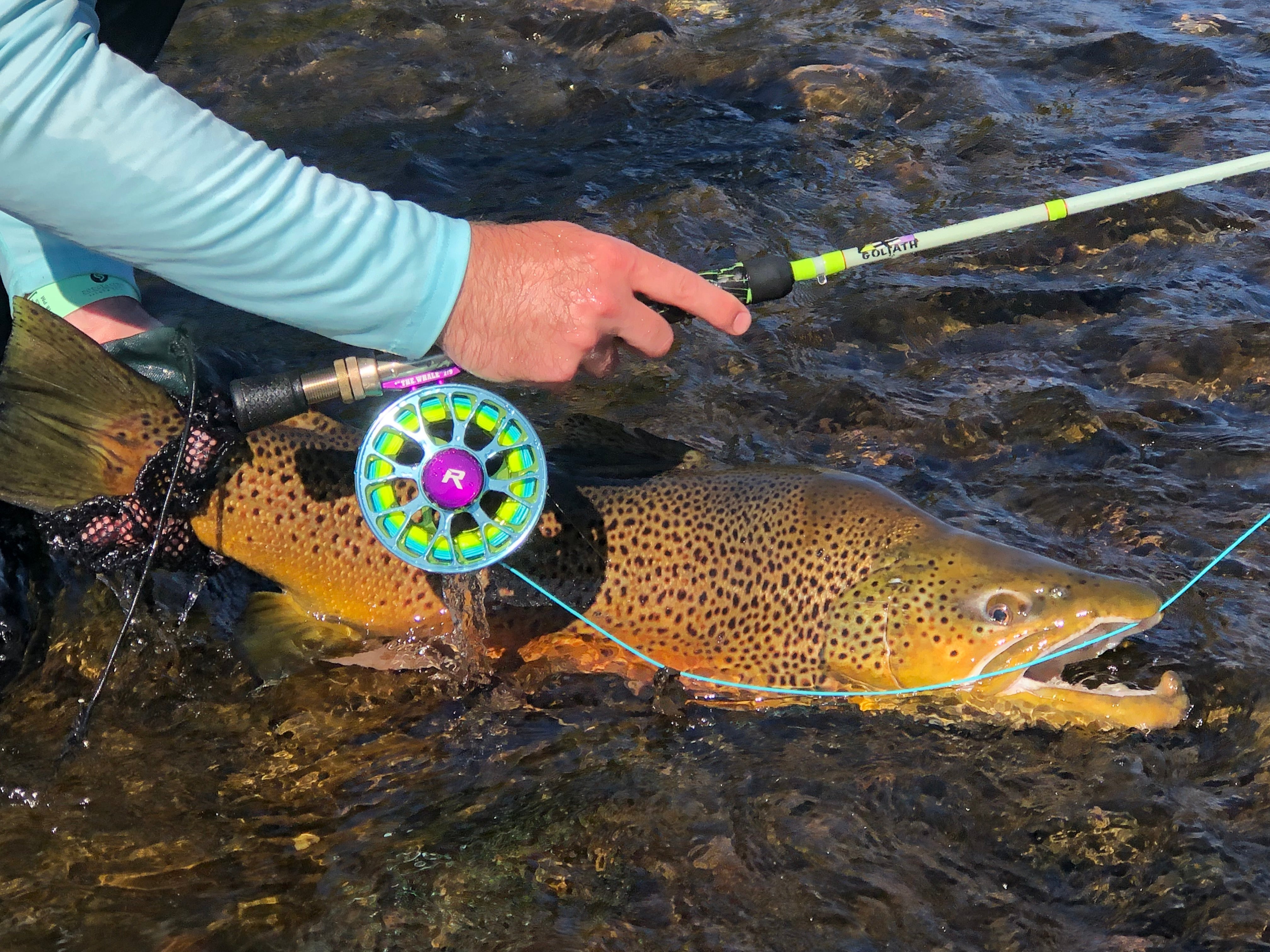
A few Julys ago I was on the middle Provo River here in Utah with my buddy Todd, and we found a bank-feeding brown trout that was doing everything right. Steady, metronomic rises in about fourteen inches of water, tight to a grass edge, sipping pale morning duns on a seam you could have measured with a ruler. That fish was, generously, twenty inches long and completely unbothered by us.
Todd went first. He waded into position below the trout, made a beautiful upstream reach cast, and dropped a size 16 PMD comparadun about three feet above the fish. Perfect drift. The trout rose — and ate a natural two inches to the left of his fly. He did it again. Same result. On the fourth cast, the trout stopped rising entirely and eased back under the grass.
We sat on the bank and worked through it. The drift wasn't dragging. The fly was the right size and close enough on color. The tippet was 5X, thicker than I'd like on the Provo in July but not absurd. What actually happened was simpler: the leader crossed the trout's window before the fly did. Every cast, that brown trout watched a gray line float over its head a half-second before a mayfly showed up. Trout on hard-fished tailwaters learn that pattern the way you learn a bad smell.
Twenty minutes later we found a second fish on the same grass bank. This time I climbed out, walked a wide loop up and around through the willows, and got into position roughly thirty feet above the trout. One parachute cast, aimed high and stopped hard so the leader collapsed into loose S-curves on the water, and the fly came down the seam ahead of everything else. The brown ate it on the first drift. That's the whole article in one paragraph, but the details are where people get tripped up, so let's get into them.
Why does an upstream cast spook trout on flat water?
An upstream cast spooks trout on flat water because the fly line, leader, and tippet all enter the trout's field of view before the fly does. A trout facing into the current sees whatever is drifting down at it, in order. Cast from below and the order is line first, leader second, fly third. On broken water the fish can't resolve that detail. On smooth, glassy water — a tailwater flat, a spring creek, the tail-out of a long pool — the fish sees it all in high definition.
There's a second problem that gets less attention. A 5-weight fly line is roughly 0.040 to 0.045 inches in diameter at the belly; that's a rope compared to the insects on the surface, and even a soft delivery pushes a small pressure wave. When a trout has been cast to forty times in a weekend on the Green River below Flaming Gorge, that wave becomes a learned warning.
The third issue is the leader shadow. On a bright afternoon with the sun high, monofilament throws a shadow on the streambed that is far more visible than the mono itself. A trout holding in two feet of gin-clear water sees a dark line slide across the gravel ahead of the fly. Watch it once from a high bank in polarized glasses and you can't unsee it.
None of this makes the upstream cast wrong. I still fish upstream most days, because most days I'm fishing riffles and pocket water where the surface is busy and the fish have less time to inspect anything. But when the water goes flat and the trout gets picky, the upstream cast is fighting a structural problem, not a technique problem. You can't mend your way out of the fish seeing your leader first.
What is a downstream dry fly presentation, exactly?
A downstream dry fly presentation is any delivery where you stand above the fish and the current carries your dry fly to the trout ahead of your tippet and leader. Anglers also call it "feeding the fly," because functionally that's what you're doing — you're paying out slack and letting the river hand the fly to the trout while you stay out of the picture entirely.
The term covers a family of approaches, not one cast:
- Fly-first delivery from directly above. You're upstream and in line with the fish. The fly lands three to six feet above the trout and drifts straight down the pipe.
- Down-and-across. You're upstream and off to one side, feeding the fly into a seam at an angle. This is the most common real-world version because it keeps your silhouette off the fish's lane.
- The slide-and-feed. The fly lands short and you feed slack line through the guides, sliding the fly progressively further down the run without ever recasting.
All three share the same non-negotiable requirement: slack. A downstream cast with a tight line drags instantly, because the current is pulling the fly away from you rather than toward you. On an upstream cast you have time — the fly drifts toward you and the line goes slack on its own before it goes tight. Downstream, the clock starts the moment the fly lands, and it runs fast. Feeding slack is not an optional refinement here. It is the technique.
The four casts that feed a dry fly downstream
You don't need a tournament caster's arsenal. You need four casts, and honestly, two of them will cover eighty percent of what you'll run into.
The parachute cast (the one I use most)
The parachute cast — sometimes called the check cast — is a high, hard stop on the forward delivery followed by immediately dropping the rod tip toward the water. The line unrolls above the surface, and as you lower the tip, the leader and line "parachute" down into loose curves instead of straightening.
The analogy I use on the water: it's like handing somebody a garden hose instead of throwing it. Same distance, completely different arrival. The line arrives with all its coils intact.
The practical version: aim the forward cast about four feet above the surface, stop the rod hard and high around 10 o'clock, let the loop unroll, then drop the rod tip smoothly to knee height as the leader turns over. That downward motion is what dumps the slack. Done right you'll get six to twelve feet of usable dead drift on flat water — plenty, because a trout in a defined feeding lane takes in the first three feet or not at all.
The pile cast
The pile cast is the blunt instrument of downstream work, and there's no shame in it. Over-power the forward stroke, aim high, and let the whole leader collapse in a heap of curves upstream of the fly. Accuracy suffers. Slack is abundant. On a broad tail-out where the fish has room to move to the fly, I'll take the slack and give up the precision every time.
The wiggle cast
Also called the serpentine or S-cast. As the forward loop is unrolling, you wiggle the rod tip side to side — three or four quick, small movements, not violent shakes. The line lands in S-curves. What makes the wiggle cast especially useful downstream is that you can bias it: more wiggle near the rod tip, less near the fly, which puts your slack where you want it and still lets the fly land where you aimed.
The reach cast, run backwards
Most anglers learn the reach cast for upstream mending. Downstream, you run it in reverse: during the forward cast, you reach the rod tip upstream, laying the line above the fly's lane instead of below it. This buys you a drag-free window on a down-and-across angle, and it's the cast that makes cross-current downstream presentations work at all. I'll often combine it — reach upstream first, then drop the tip to parachute in extra slack.
If you want more presentation tools once these four are comfortable, we went deep on the small adjustments that separate guides from everyone else in 5 Dry Fly Presentation Tricks Pro Guides Use. A lot of those tricks stack neatly on top of a downstream approach.
How I actually set up a downstream dry fly drift
Here's my real sequence, the one I run on the Provo River and on the Green, in the order I run it. It's not glamorous, and most of it happens before I make a cast.
Step one: find the fish, then find your exit. Before I move a single step, I figure out where I need to end up. For a downstream presentation, that's typically twenty-five to forty feet above the trout and a few feet off to one side. Then I plan the route to get there that keeps me out of the fish's window — usually up and out of the water entirely, through the streamside grass or willows, and back in well above.
Step two: get in shallow and stay low. When I re-enter above the fish I want ankle-deep water and slow feet. Every inch of me in the water is another inch pushing a wake downstream toward a trout that's staring right at it.
Step three: measure the cast on the grass, not on the fish. I false cast off to the side — never over the fish's lane — and get my distance dialed on a patch of bank or a rock. Then one delivery, aimed at a landing zone three to five feet above the trout's position.
Step four: land the fly and immediately feed. The moment the fly touches down, I'm either dropping the rod tip (if I used a parachute cast) or shaking slack out through the guides with my line hand. I keep the rod tip low and pointed down the seam. The fly should look like it's traveling on its own.
Step five: end the drift on purpose. When the drift is done, do not rip the line off the water — that's the cast that ends the session. Let the fly swing quietly to the near bank, let it hang, then lift gently and recast off to the side. On a lot of days that quiet swing gets eaten anyway, especially during a caddis emergence.
For reading water on this kind of technical flat before you commit to an approach, our breakdown of identifying a pale morning dun hatch will help you figure out whether those steady risers are on duns, cripples, or spinners — because that changes your landing zone by a couple of feet.
Your approach is part of your presentation — maybe the bigger part. Livingston, Montana spring creek guide Jan Axtell made a point on his episode about spring creeks and spot fishing around Livingston that stuck with me: on small, clear water the vibration of your footfalls and the pressure waves you shove ahead of you get to the fish long before your fly does. His fix is to move like you're hunting — slow steps, watch for your own ripples, and stand still until they die out before you move or cast again. That advice matters double on a downstream presentation, because you're standing upstream and every wave you make is headed straight at the trout you want.
Dry Fly Tactics for Selective Trout (free eBook)
The full playbook for picky risers — rise-form reading, leader setups, and the presentations that turn refusals into eats. Grab it free and keep it on your phone for the next flat-water standoff.
Get the free eBook →How do you set the hook on a downstream dry fly take?
You set the hook on a downstream dry fly take by pausing a beat and then setting low and toward the near bank — never straight up. On a downstream presentation the fly is below you and the line runs downstream from the rod tip, so an upward strike pulls the hook back out through the front of the trout's mouth before the fish has closed on it. This is the single most common way anglers blow a downstream drift they worked hard to earn.
Three adjustments fix it.
Delay the set. The old dry fly advice about saying "God save the Queen" before you strike is corny, but the physiology behind it is real: a trout rises, takes the fly, and turns down before it closes its jaws. Upstream, your slack absorbs that delay for you. Downstream, you have to build the pause in yourself. I count a full beat — a half-second — after the fly disappears.
Set low and across. Drop the rod tip toward the water and sweep it sideways toward your own bank. That pulls the hook point into the corner of the trout's jaw rather than out through its lips. A sweep set is also gentler on light tippet; I fish 5X and 6X on the Provo in summer, and a hard vertical strike on 6X with twenty-five feet of line out is a break-off waiting to happen.
Let the fish do some of the work. On a genuine downstream feed, the trout has to turn to take the fly, which means it often hooks itself against a tight line as it returns to its lie. If you've fed all your slack and the fly is hanging below you, sometimes the best "set" is just tightening up smoothly and letting the current set the hook for you.
One more wrinkle: after you hook a fish downstream, you're fighting a trout that has the whole river helping it. Get below it if you can, or at minimum move to the bank and put side pressure on. A big brown hooked below you and fought from directly above will use the current like a sail.
Advanced downstream tactics that earn extra fish
Feed line to extend one drift into three
The most underrated skill here is feeding line without recasting. Strip four or five feet off the reel, hold it in loose coils in your line hand, and shake it out through the guides in small increments as the fly drifts away. Done smoothly, a twelve-foot drift becomes a thirty-foot drift — and on a seam with three or four risers stacked along it, one cast covers all of them without ever lifting line in front of a fish.
The deliberate drag at the end
Once you're confident the dead drift isn't getting eaten, use drag on purpose. Let the fly come tight and skate an inch or two, then stop it. A skating caddis is a real thing a real insect does, and on Utah rivers in late summer an egg-laying caddis skittering across a flat gets crushed. Downstream, you already have the angle — you just stop feeding.
Downstream dry-dropper
A dry-dropper fished downstream behaves differently than one fished upstream — the nymph trails behind and below the dry rather than getting pulled ahead of it, which is honestly more natural. I like an 18-inch dropper off the bend of a size 12 foam attractor, with a size 16 or 18 beadless nymph so the rig doesn't sink the dry. The mid-drift lift-and-lower reset works here too, and it draws strikes on the rise.
Work the pool from the top down
Fishing downstream lets you cover a pool in order, head to tail, without ever putting yourself in front of unfished water. Start at the top, take three steps, cast again — the same methodical discipline swing anglers use for steelhead, applied to a dry fly.
Match the depth, not just the bug
When a downstream drift gets refused with a good pattern and clean slack, the usual culprit is feeding depth. Fish sipping in the film want an emerger or a cripple, not a high-floating dun. That's a whole subject of its own, and we covered it thoroughly in Emerger Fishing Mastery. If you want to understand why those film-feeders are so abundant in the first place, Utah State University Extension has a solid primer on the aquatic macroinvertebrates that live in Utah's rivers and streams.
When a downstream dry fly presentation is the wrong call
I'd be doing you a disservice if I pretended this technique wins everywhere. It doesn't. Here's where I don't use it.
Broken pocket water. In a boulder garden with a churned surface, trout have a fraction of a second to decide and almost no ability to inspect your leader. Fish upstream, get close, make short casts. The downstream approach buys you nothing and costs you drift length.
Tight brushy creeks. A downstream presentation requires room to feed slack. On a small stream where you're bow-and-arrow casting under alders, you don't have that room. Get low and fish up.
Fast, heavy current. The faster the water, the shorter your drag-free window. In genuinely fast water your downstream drift might last two feet before the fly skates. Some days that's enough for one shot at one fish. Usually it isn't.
When you can't get above the fish without wrecking the run. If the only route above a riser walks you through the middle of the pool, don't. A downstream cast from a spooked position is worse than an upstream cast from a good one.
One honest limitation about hookup rate. Even done well, downstream presentations convert a lower percentage of takes than upstream casts do. You'll get more eats and land a smaller share of them. I take that trade on hard fish, because the alternative on flat water is zero eats.
Gear that makes downstream dry fly presentations easier
Nothing here is exotic. Downstream work rewards a soft delivery, a long fine leader, and a fly you can actually see at thirty feet with slack in the line.
Rod and line. A 9-foot 5-weight with a moderate action is the workhorse, and a 4-weight is better if your water is genuinely flat and small. A stiff, fast rod fights you on parachute and pile casts because it wants to straighten everything out. If you're shopping, the fly rods and fly lines collections at the FFIP shop are where I'd start — a true-to-weight line that loads at twenty-five feet matters more than the rod for this kind of fishing.
Leaders and tippet. This is where downstream presentations are won. I run 12 feet total on flat water: a 9-foot leader tapered to 4X or 5X, plus 3 feet of 5X or 6X tippet. That long, limp end section is your slack reservoir — it collapses on the parachute cast instead of straightening. Browse the leaders collection for the base, and keep spools of Stone Creek™ Mono Tippet ($11.00) in the pack for rebuilding the tip.
Flies you can see. A downstream drift with slack means you're tracking a small fly at a distance. Give yourself a fighting chance: a visible post, a parachute hackle, or a small foam indicator fly above the real bug. Sizes 14 through 18 cover most western mayfly and caddis situations. The fly patterns collection at the shop runs deep enough that you can build a real dry box in one order.
Floatant, and using it right. Dry your fly and dress it before it gets wet, not after. Once cellulose fibers and hackle absorb water, gel floatant traps it. One dressing before the first cast plus a desiccant shake between fish is the routine.


A quick comparison: upstream versus downstream dry fly presentation
| Factor | Upstream presentation | Downstream presentation |
|---|---|---|
| What the trout sees first | Fly line, then leader, then fly | Fly, then tippet, then leader |
| Best water type | Riffles, pocket water, broken current | Flats, tail-outs, spring creeks, tailwaters |
| Drag-free window | Long; slack builds naturally | Short; slack must be built on purpose |
| Hook set | Lift up and back, works fine | Delay a beat, then set low and across |
| Hookup rate | Higher | Lower, but more takes on spooky fish |
| Approach difficulty | Easy — you're behind the fish | Hard — you're above and visible |
| Fighting the fish | Fish runs toward you | Fish uses current against you |
Frequently asked questions
Is a downstream dry fly presentation better than fishing upstream?
A downstream dry fly presentation is better on flat, clear, heavily fished water where trout have time to inspect a leader; an upstream presentation is better in riffles and pocket water. Neither is universally superior. My own fishing runs roughly seventy percent upstream — but that other thirty percent accounts for most of the hardest fish I land in a season.
How much slack do I need in a downstream drift?
Enough to get the fly three to six feet of drag-free travel, which usually means six to ten feet of loose line and leader on the water. More slack than that and you lose any ability to set the hook. Less and the fly starts skating almost immediately. The parachute cast is the most repeatable way to dial that amount in.
What leader do you use for a downstream dry fly presentation?
Twelve feet total on flat water: a 9-foot tapered leader ending in 4X or 5X, plus about 3 feet of 5X or 6X tippet. The long, fine tip section is doing the real work — it collapses into curves on delivery and keeps the heavier butt section well away from the fish.
Why do I miss so many fish on downstream takes?
Most missed downstream takes come from setting the hook straight up, which pulls the fly forward out of the trout's mouth, and from setting too fast. Pause a half-second after the fly disappears, then sweep the rod tip low and toward your own bank. That one change fixes the majority of the misses.
Can I fish a downstream dry fly presentation from a drift boat?
Yes, and it's a natural fit — a boat is always above the fish it's approaching. Feed line faster, because the boat is moving with the current, and have the oarsman slow the boat while you feed. Close-range bank shots from a slowed boat are some of the best downstream opportunities you'll get all year.
Does a downstream presentation work for fish other than trout?
It works anywhere current carries a fly to a fish that faces into it. Smallmouth bass on a summer flat, grayling in a shallow tail-out, and mountain whitefish holding in a slick all respond to the same fly-first logic. The species changes; the geometry of what the fish sees first does not.
How do I know when the water is flat enough to bother?
My rule of thumb: if you can see individual insects drifting on the surface from twenty feet away, the trout can see your leader from the same distance. If the surface is busy enough that you'd struggle to spot a size 18 mayfly floating past, fish upstream and quit overthinking it. Real-time flow data helps too — on the Provo River you can pull up the USGS gauge near Woodland, Utah before you leave the house and know whether you're walking into a flat-water day or a pushy one.
Go feed a fly to a fish that has seen everything
The thing I love about downstream presentations is that they're a fix you can apply the same afternoon you learn them. No new rod. No secret pattern. Walk a wide loop around the fish, get above it, stop the rod high, drop the tip, and let the river hand it your fly. The first time a trout that refused you four times from below eats on the first drift from above, it changes what you think is possible on hard water.
That's the whole mission at the Fly Fishing Insider Podcast — helping you catch any fish, any time, and anywhere, by giving you the small mechanical fixes that actually move the needle. If you try this on your home water, I want to hear about it. Tag us on Instagram at @flyfishinginsiderpodcast with the fish, and tell me which cast you used.
Join the FFIP Insiders
Get gear deals, trip intel, and tactics to help you catch any fish, any time, and anywhere — straight to your inbox. Start with our free dry fly playbook.
Get the free eBook →Tight lines, everyone!