
Everyone repeats the same line about not fishing the spawn. Fewer people talk about the fish in transit — and about the thirty seconds that decide whether it swims off strong.

September showed up cold and pushy, and I spent the first two weeks of it fishing like it was still August.
That's the honest version. I know the calendar. I know what browns do in the fall. But knowing a thing and changing what you do about it are different problems, and I kept walking into my local river and working the same seams I'd worked all summer, just with a heavier fly and an extra layer under my waders.

I was moving fish. That part wasn't the problem — a handful most days, which in streamer terms is a good day. What bothered me was where they were coming from. They weren't sitting where I expected them to sit. I'd swing through a good deep slot, the kind of water that holds fish in July, and get nothing. Then I'd get a hard eat in eighteen inches of moving water on a stretch I'd normally walk straight past on my way somewhere better.
The other thing bothering me was the conversation around all of it.
Every fall the same argument comes back around, and it collapses into one sentence: don't fish the redds. Which is correct. It's also the easiest possible thing to say. Anyone can nod at it. Don't fish over spawning gravel, don't wade through it, don't stand on it — that's not ethics, that's the floor. It's the price of admission. And somewhere in repeating it every October we've all quietly agreed that saying the sentence is the same as being careful, which it isn't.

Because here's what nobody had told me plainly, and what I hadn't worked out on my own: the fish I was catching weren't on redds. They were between them.
I got there sideways, listening to my own show.
The turn
How to Streamer Fish for Migratory Fish — with Kodie Kowitz
Kodie was talking about steelhead and salmon — Michigan and Alaska, fish I don't chase — and the tip he came on to give was about fly changes. Don't change flies, change fish. His argument is that every swap costs you casts, that the only guaranteed way to catch nothing is to have your fly out of the water while you dig through a box. I'd heard versions of that before and mostly nodded at it. Kodie guided me in Alaska at Katmai Trophy Lodge, so I've watched him do this in person, which is probably why it finally stuck.
What I hadn't heard was his reasoning about where those fish actually sit.
Inside bends and slack seams, he said, and the logic is almost insultingly simple once someone says it out loud: if a fish is moving upstream, why would it sit in the rushing water? It runs the soft edge. Then he said the thing that reorganized my whole month. People don't connect the dots between fall spots and winter spots, and the reason is that in the fall those fish aren't holding yet — they're just moving. By winter they've settled into the deep holes and staged up, and you fish them slow and heavy. Same river. Two completely different animals, four weeks apart.
And then the line I actually wrote down: if you see a fish in a run and turn around to fish it again, that fish has probably already kept going.
He was describing steelhead. But a fall brown headed for gravel is doing the same job, and I'd been reading my local river like it was still July — hunting the seam that holds the fish, working the deep slot, standing in one spot changing flies because the fly felt like the variable I controlled. The eighteen inches of moving water I kept getting eaten in wasn't a fluke. It was the soft edge, and there were fish walking up it all day while I stared at the bucket.
And it changes the ethics question in a way I hadn't thought through.
If most of the fish you move in the fall are in transit — not on gravel, not paired up, just travelling — then the redd conversation, while still true, is answering a question that mostly isn't the one in front of you. You avoid the gravel. Obviously. You learn to see it: the clean bright patches where the silt's been fanned off, usually in the tail of a pool, in water shallower than you'd think. You don't cast there and you sure don't walk there. Done.
But a fish moving up the soft edge in late September is roughly two weeks out from spawning, carrying everything it needs to do it, and you just made it fight. That's the part I'd been under-thinking. Not whether to catch it. How to give it back.
So I quit changing flies. I picked one, tied it on, and made myself fish it until dark, which was harder than it sounds. I fished inside bends and soft seams and stopped re-fishing runs where I'd already moved something. And I went up in tippet, which felt wrong and worked fine — these fish were not being selective about a streamer, and every extra pound of tippet is a shorter fight. I stopped playing fish soft. I put real pressure on and moved them in hard, which cost me nothing because I used a heavier tippet and got the ones I landed to the net in a fraction of the time. I got the net wet before the fish went in it. I unhooked fish in the water, in the net, without lifting them, and when I wanted a photo I got the camera ready first and then lifted, and I counted the seconds out loud like an idiot standing in a river by myself.

Most of them I didn't photograph at all. That was the biggest change and it wasn't a technique change.

Did it work?
About the same, honestly. Still a handful most days. If you charted it, you would not be able to tell the back half of the season from the front, and I spent a couple of evenings irritated about exactly that.
But the number was never really the thing I'd changed. What changed is that I stopped being surprised. I knew why the fish were where they were instead of discovering it fresh every afternoon, and the ones I did land went back faster and cleaner than any fish I handled the year before. That's a worse story than a breakthrough. It's a better season.
What I'll carry into next fall isn't a fly or a retrieve. It's that I'd spent years being confident about the one rule everybody says out loud and careless about the thirty seconds nobody talks about. The gravel was never the hard part. Not stepping on it is easy. Getting a heavy, tired, gravid fish back into moving water quickly enough that it kicks off under its own power — that takes actual attention, and I hadn't been giving it.

The fish were moving the whole time. I was the one standing still.
What I'd tell someone fishing fall browns
- Most fall browns you hook on a streamer are travelling between spawning sites, not holding on them.
- Read the river for travel lanes — inside bends and slack seams — not for the deep summer lies.
- Never cast to, wade through, or stand on a redd: clean bright gravel, often in the tail of a pool, in shallower water than you'd expect.
- Heavier tippet shortens the fight, which matters more in fall than fly choice does.
- Unhook in the water, wet the net first, have the camera ready before you lift — or skip the photo.
Common questions
Is it okay to fish for brown trout during the fall spawn?
Fishing near the spawn is legal on most waters, but check local regulations first — some rivers close specific sections seasonally. The near-universal ethic is that you never fish to, wade through, or stand on a redd. Fish in transit between spawning sites are a different situation, and the responsibility there is handling: short fights and fast releases.
How do you recognize a redd?
A redd is an oval patch of gravel that looks conspicuously cleaner and brighter than the streambed around it, because the fish has fanned the silt off it. They're usually in the tail-outs of pools and in shallower water than most anglers expect. Once you've seen a few, they're hard to miss. Walk around them, always.
What's the fastest way to release a big brown trout?
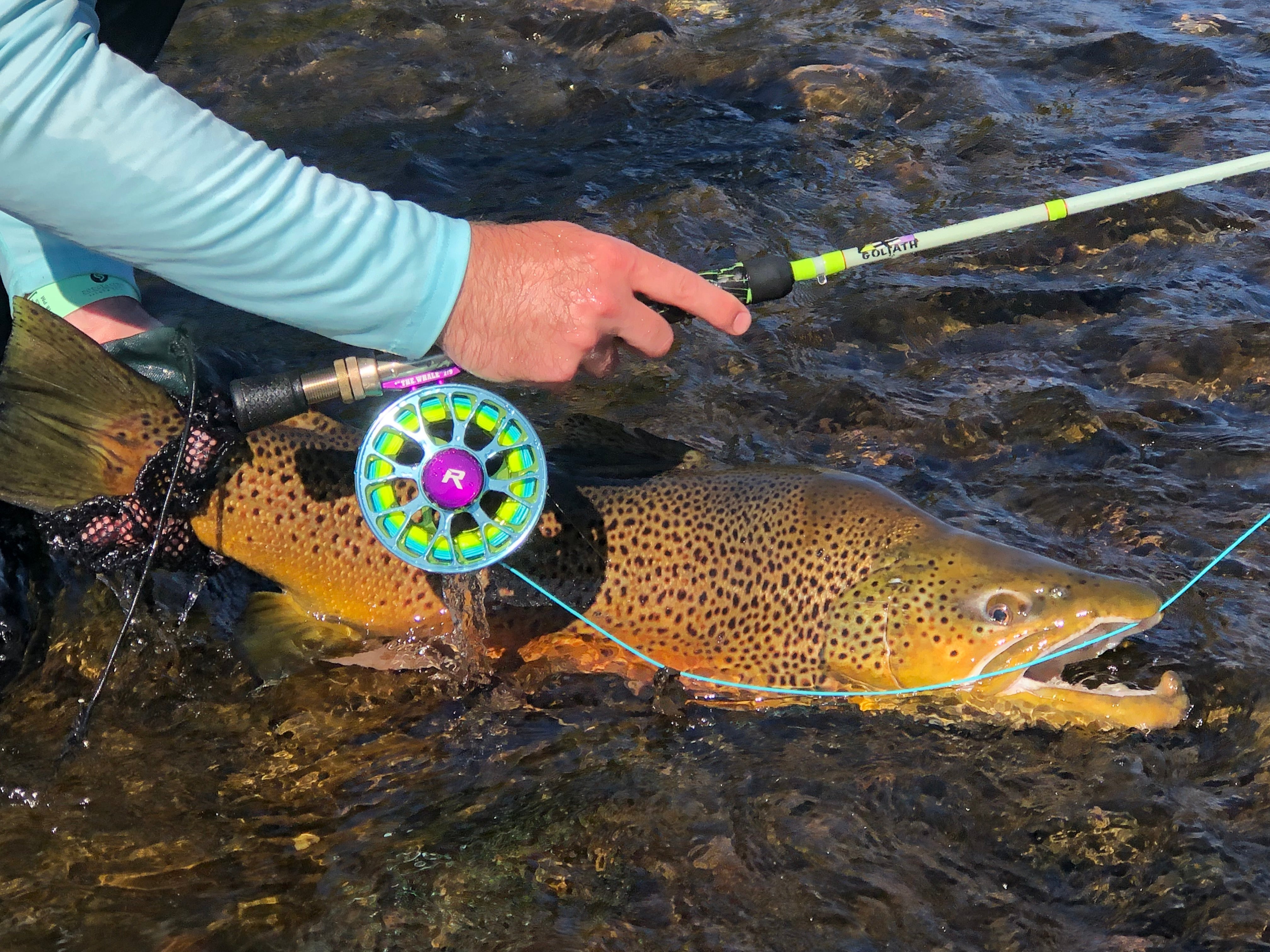
Use heavier tippet than you think you need so you can apply real pressure and end the fight sooner. Wet your net before the fish goes in, unhook it in the water without lifting it, and if you want a photo, have the camera on and ready before the fish leaves the water. Hold it facing into current until it kicks away on its own.
Do fall browns hold in the same places as summer browns?
Often not. A migrating fish is moving through water rather than holding in it, so the deep summer lies can go quiet while shallow, moving transitional water produces. Reading for travel lanes instead of feeding lies is usually the adjustment that matters.
Go on a fly fishing trip you'll never forget
We partnered with Frontiers Travel to put you on water that's worth the flight. Tell them where you want to go. Don't wait.
Book a TripFly Fishing Insider Podcast has a referral partnership with Frontiers International Travel. If you book after being introduced through us, we may receive compensation at no additional cost to you.