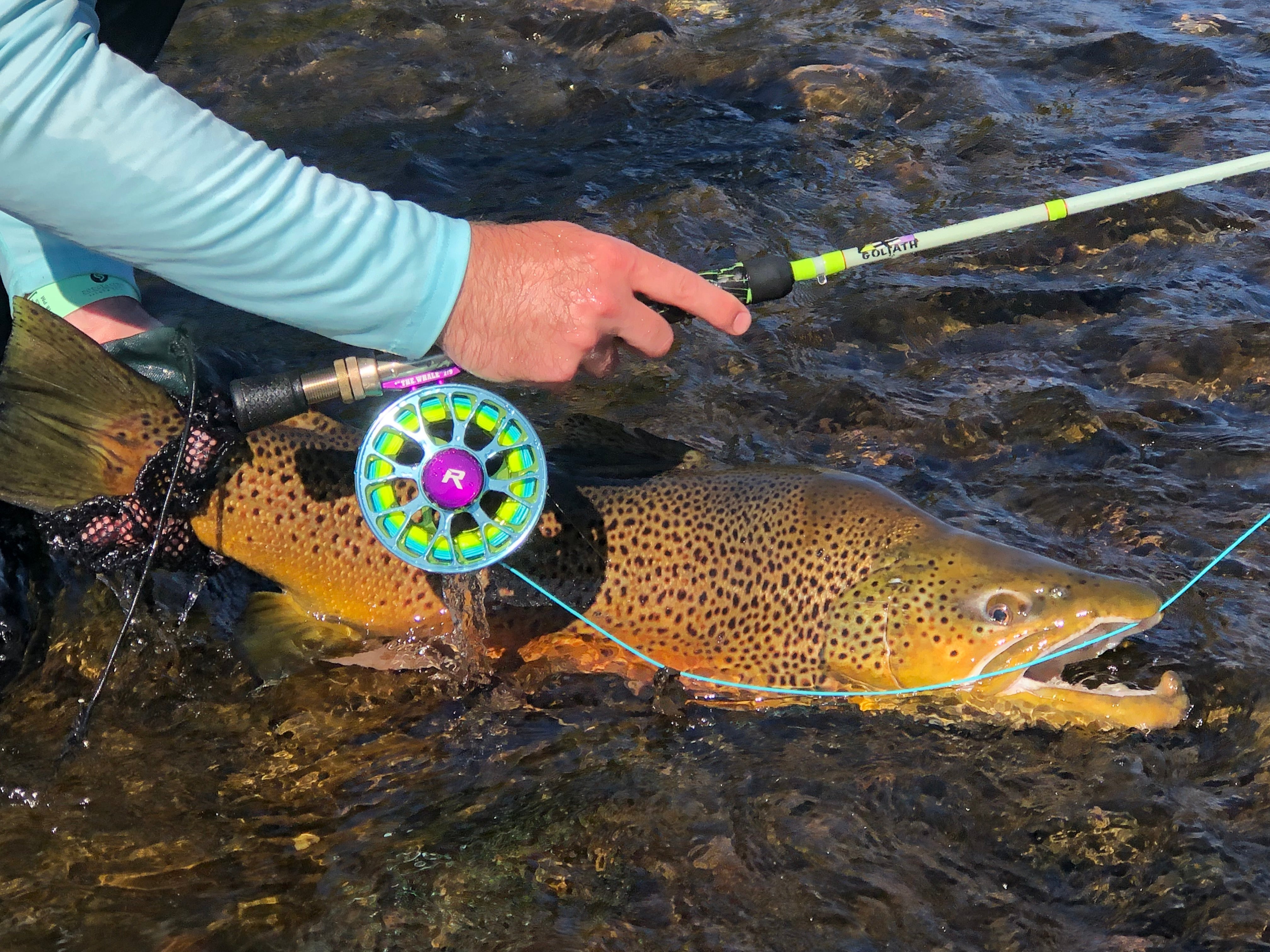

Todd had a fish working the far seam on the Green River below Flaming Gorge — a good brown, maybe eighteen inches, sipping something tiny in the slick where the current folded over a submerged ledge. He was about sixty feet away. I watched him make nine false casts, each one a little harder than the last, each one ending with his rod tip tracking down toward that fish like he was pointing at it. Every cast piled up ten feet short. On the tenth try he grunted audibly, the loop collapsed, and the leader landed in a heap. The brown kept eating.
Here's the thing I told him when he waded back over, dripping and annoyed: the fish is the single worst place to aim a long cast. Not because the fish doesn't matter, but because aiming at it drags your rod tip down, opens your loop, and kills the cast before the line ever has a chance to unroll. Fly casting distance is built in the air, not on the water. Once Todd started aiming his forward stop at a spot in the sky above that brown instead of at the brown itself, he picked up fifteen feet in about ten minutes.
The short answer: To add fly casting distance, stop aiming at the fish and aim your forward stop about ten feet above the water at roughly a 30- to 45-degree angle upward. A high, crisp stop keeps the loop tight and the line unrolling above the surface, which lets shot line run freely. Distance comes from line speed and a clean stop — not from casting harder at your target.
Key Takeaways
- Target fixation — staring at the trout and following it with your rod tip — is the most common cause of short casts among intermediate anglers.
- Line speed plus a high, abrupt stop produces a tight loop; a tight loop is what carries shot line. Muscle does not.
- Most river trout are caught inside 45 feet. Distance is a tool you need occasionally, not a default setting.
- The double haul adds line speed without adding arm effort, but only if the hauls are timed to the rod's stops.
- Releasing shot line a half-second too early dumps your loop; a half-second too late costs you the shoot entirely.
The Green River lesson: why your cast dies ten feet short
Todd is a good caster — that's what made the afternoon instructive. He can lay a dry fly under a willow at thirty feet all day long. But every angler I know, myself absolutely included, has a version of the same glitch, and it shows up the instant the fish gets far away. You lock onto the target, your shoulders square to it, and your rod hand — which is a lot more obedient than you'd like — follows your eyes straight down toward the water.
On a short cast that barely matters — a thirty-foot cast has so much margin that a sloppy trajectory still lands the fly in the feeding lane. At sixty feet there is no margin. If the loop starts unrolling on a downward path, it runs out of altitude before it runs out of line, the front taper slaps the surface, and everything behind it stops dead. That's the cast that piles up ten feet short, and to the angler making it, it looks like a power problem. So he adds power. Adding power to a bad trajectory just makes a bigger tailing loop. I've watched it happen on the Provo River, on the Logan, and on a dozen Utah lakes where fish cruise just outside comfortable range.
Why does aiming at the fish shorten your fly cast?
Aiming at the fish shortens your fly cast because your rod tip follows your eyes, and a rod tip that travels downward on the forward stroke sends the loop on a downward path. The fly line unrolls in the direction the rod tip was moving when it stopped. Point that stop at a trout forty feet away and the loop is aimed at the water, not through the air above it.
Think about throwing a baseball to a cutoff man across the infield. Nobody throws a flat line drive at his chest — you put a little arc on it, because the ball has to cover ground and gravity takes its cut along the way. A fly line is the same, except it's also unrolling as it travels, so it needs vertical room to do its job. When I coach a distance cast I tell people to pick a spot in the sky roughly ten feet above the target and stop the rod there.
There's a second, sneakier piece. When your eyes lock on a trout, your tempo goes with them — anglers who target-fixate speed up as the target gets farther away, which shortens the back cast pause. A short pause means the back cast never straightens, the rod never fully loads, and the forward cast starts from a slack, dead line. That's the "working so hard and getting nowhere" feeling, and it's the same root problem I dug into in Stop Punching Your Cast.
How far do you actually need to cast for trout?
Most trout in moving water are caught between 25 and 45 feet, and a good angler who can reliably hit 50 feet will out-fish a distance specialist who can't manage a drag-free drift. I want to say that plainly before the rest of this article teaches you to throw farther, because the number of fish lost to bad drifts dwarfs the number lost to short casts.
That said, there are real situations where fly casting distance is the whole ballgame. Stillwater is the obvious one — on the Strawberry Pinnacles or any Utah reservoir, cruising fish don't come to you, and the gap between a 45-foot cast and a 65-foot cast is the gap between showing a fly to three fish an hour and showing it to ten. Flats fishing is another: a bonefish at seventy feet gives you one shot and about four seconds to take it. And on big western rivers at low, clear flows, the fish still eating are often sitting in the one soft slot you can't wade within forty feet of. Check flows before you go through the USGS gauge network — the Provo River near Hailstone gauge is the one I look at before a Middle Provo day, because when it drops toward 150 cfs the fish get spooky and my casts get longer whether I want them to or not.
So the honest framing: distance is an insurance policy. You build it on the lawn so that when the twenty-inch brown is eating at sixty feet, you're not making nine false casts while he finishes his meal.
The three things that actually add distance
Strip away every casting article you've read and three variables put more fly line in the air: line speed, trajectory, and how cleanly you release shot line. Everything else — grip, stance, arm position, rod choice — serves one of those three.
1. Line speed, and where it really comes from
Line speed is the velocity of the fly line as it leaves the rod tip, and it's generated by how quickly you accelerate the rod to a stop — not by how far or how hard you swing it. The analogy I use constantly: it's a hammer strike, not a shovel scoop. When you drive a nail, the power is in the last four inches of the swing, and you stop the hammer on the nail head. Your casting stroke is the same shape. A long, slow, even push moves a lot of air and very little line.
The drill is embarrassingly simple. Strip out forty feet, make one back cast, count "one-one-thousand," then make a forward stroke where 80 percent of the acceleration happens in the final foot of rod travel — and freeze. Your loop should be under two feet tall from top leg to bottom leg. Four feet tall means you're applying power too early and too evenly. Michael Rebholz, the Irish instructor we had on the podcast, has genuinely challenging ideas about what's happening inside that loop, in Fly Casting the Art and Science.
2. Trajectory: aim high, land low
Here's the fix that gave Todd fifteen feet. Pick your target, then lift your gaze about ten feet above it and pick a second, imaginary target in the sky — a branch tip, a cloud edge, the top of a far-bank cottonwood. Stop your rod at that. On a 60-foot cast I want my forward stop somewhere around 30 to 45 degrees above horizontal, with the back cast angled down behind me by a corresponding amount, so the whole casting plane is tilted like a seesaw rather than level.
That tilted plane does two useful things: it gives the loop room to unroll over distance, and it keeps the back cast out of the water and brush behind you — which for most of us is the real limit on how much line we can carry. Go throw twenty casts with an exaggerated version of it and aim absurdly high. You'll feel the line hang at the end of the stroke instead of diving, and that hang is where shot line goes.
3. Releasing shot line at the right instant
You can generate beautiful line speed and a perfect trajectory and still lose twenty feet by fumbling the release. The rule I use: release the loop of line in your line hand just after the rod stops and the loop turns over the tip — not during the stroke, not when the line lands. Early release dumps slack into the loop and kills it. Late release means the line is already decelerating when you finally let go, and the shoot is weak and short.
The way I teach it: pinch the shot line against the cork with the index finger of your rod hand, make the forward stroke, and pop that finger open the instant you feel the rod stop. It's the same instinct as a bow release — you're not throwing the arrow, you're getting out of its way at exactly the right moment.
One stroke, forty feet of line — the sight-fishing shoot. On the podcast, Ontario pike and smallmouth guide Matt Marin described a version of this that I now use on cruising trout too: hold the fly with only about a rod-and-a-half of line outside the tip, then release thirty to forty feet of slack on a single forward stroke. He makes the point that a sight-fishing shot lasts seconds, and false casting to build distance burns the whole window. If you can shoot in one stroke, you get the fly in front of a moving fish while the fish is still there to see it. Hear how he uses it on his home water in this Fly Fishing Insider Podcast episode.
The double haul, explained the way it finally clicked for me
The double haul is a short, sharp tug on the fly line with your line hand, timed to each stroke of the rod. It increases line speed by momentarily increasing the load on the rod — you're bending the rod deeper without swinging it harder. For years I thought of it as "pulling line to make the cast go farther," which is why mine was mediocre for years. It isn't a pull. It's a snap, and then an immediate give-back.
The analogy that fixed it for me came from a buddy who grew up racing bikes. He described the haul as the bottom of a pedal stroke: a sharp application of force at one precise point in a circle, followed by relaxing so the other leg can work. If you push through the whole circle you just fight yourself. Same with the haul — a crisp six-to-twelve-inch tug that ends exactly when the rod stops, then your line hand drifts back up toward the stripping guide so it's in position for the next one.
The timing, spelled out:
- Back cast: as the rod accelerates back, haul down. The haul ends the instant the rod stops.
- Drift: line hand floats back up toward the reel while the back cast unrolls. Don't rush this. This "give-back" is what most people skip.
- Forward cast: as the rod accelerates forward, haul down again, ending on the stop.
- Release: open your fingers just after the stop and let the loop pull line out of your hand.
One caution that doesn't get said enough: a haul applied to a bad cast makes a worse cast, faster. Hauling a wide, downward loop just delivers it harder. Get the stop and the trajectory right first — the haul is an amplifier, and an amplifier makes whatever you feed it louder.
Dry Fly Tactics for Selective Trout (free eBook)
The presentation half of the puzzle — once your cast reaches the fish, this is how you get it eaten. Grab the PDF free, no strings.
Get the free eBook →How do you cast farther into the wind without hauling harder?
You cast farther into wind by lowering your casting plane and increasing line speed, not by increasing effort. A headwind punishes wide loops and high trajectories, so the adjustment is a narrower loop delivered on a flatter path, with the forward stop aimed lower — sometimes only a few feet above the water — so the line cuts under the worst of the wind instead of ballooning up into it.
The version I use on Utah reservoirs when the afternoon canyon wind kicks up is a tilted-over stroke: rod canted maybe 20 degrees off vertical, back cast thrown high behind me, forward cast driven low and hard. It feels lopsided, and it works. For a crosswind, the fix is the backhand cast — turn your body and cast over the opposite shoulder so the line always travels downwind of you. Same stroke, relocated, and worth owning before a size 4 streamer sticks in your ear.
Distance without hauling at all
Not every long cast needs a haul. If you can carry 45 feet of line comfortably and your loops are clean, you can add fifteen to twenty feet with nothing but a slightly longer stroke and a well-timed release. Longer line in the air requires a longer casting arc — that's the one place where "bigger" genuinely helps, because a longer line bends the rod deeper and needs more room to straighten. Think of it as a door: a short cast is a narrow door, a long cast is a wide one, and you open each one only as far as it needs to go.
How much line should you carry before you shoot?
Carry the least amount of fly line you can and still load the rod — for most 5-weight setups that's somewhere between 30 and 40 feet outside the tip — then let shot line do the rest of the work. Carrying more line than the rod wants is the most common reason a distance cast collapses: the rod is overloaded, the loop widens, and the cast becomes a wrestling match.
The other piece is overhang — the thin running line between your rod tip and the back of the head on a weight-forward line. Too much and the running line can't transmit the head's energy, so the cast hinges and dies; too little and you're not using the head's full mass. On a standard weight-forward trout taper I want one to three feet of running line past the tip at the delivery stroke. Mark your line with a permanent marker and watch which mark sits at the tip on your best casts.
| Situation | Realistic target distance | What to change |
|---|---|---|
| Freestone pocket water | 15–30 ft | Nothing — distance is irrelevant, drift is everything |
| Tailwater flats, low flows | 40–55 ft | Higher stop, longer leader, one false cast maximum |
| Stillwater cruisers | 50–70 ft | Double haul, shoot from the stripping basket or a clean deck |
| Headwind on a reservoir | 35–50 ft | Lower plane, tighter loop, heavier line or a shorter leader |
| Saltwater flats shot | 50–70 ft | One-stroke shoot, line stripped and stacked before the shot |
Line management: the boring part that costs the most distance
Let's be honest — most blown distance casts in real fishing aren't blown by the stroke. They're blown by line lying on the bottom under your boots, wrapped around a wading staff, or stacked in the wrong order in a boat. The single biggest improvement most anglers can make to their practical casting range is managing the shot line before the shot happens.
Wading moving water, I hold the line I plan to shoot in large loose coils in my line hand rather than letting it float downstream, because a downstream belly creates drag the instant you shoot through it. Deep water gets a stripping basket — unglamorous, extremely effective. In a boat, strip onto a clean deck and check for cleats, straps and dog paws first.
Gear that actually helps you cast farther
I'm a gearhead, so let me be careful here: no rod and no line will fix a downward stop. But once your mechanics are reasonable, equipment absolutely moves the needle, and the two pieces that matter most are the fly line and the rod's recovery speed — in that order.
Fly line first, always. A longer head carries more line in the air and shoots farther for a good caster; a short, aggressive head loads fast and is friendlier when you only have room for one back cast. For long casts on stillwater, a weight-forward floating taper in a slick, low-memory coating is the best upgrade money buys. Our fly lines collection has the spread, and the lines, leaders and backing collection covers the connections behind it.
Then the rod. A faster-recovering rod dampens quicker after the stop, which means less residual wobble shaking your loop apart. That's the real mechanism behind "fast rods cast farther" — it's not stiffness, it's recovery. But a rod you can't feel load is a rod you'll cast badly, so if you're between two, take the one you can feel. Browse rods, reels and combos and match the line weight to the water you actually fish, not the water you dream about.
One more note: if you're chasing distance with a sinking or sink-tip line, grain weight matters more than the printed line number. We broke that down in Grain Weights for Fly Lines, and it'll save you from over- or under-loading a rod by accident.


A practice session that actually changes your casting
Twenty minutes on grass, once a week, beats three hours of flailing on the river. Here's the session I give people who tell me they want more fly casting distance, and it works whether you're on a school field in Salt Lake or a park in Pennsylvania.
Start with forty feet of line out and no shooting. Ten casts aiming at a high imaginary target, counting the back cast pause out loud. Ten more where you watch nothing but your loop — turn sideways to your casting plane, because you can't fix what you can't see. Ten hauls with no shoot, feeling the snap-and-give rhythm. Then ten full casts with shot line, measuring the best one. Write the number down and do it again next week.
The measuring part matters more than it sounds. Anglers are terrible at judging their own distance — I've had guys swear they were casting eighty feet on water where eighty feet would have put the fly in the parking lot. A tape measure is humbling and honest, and it turns "I think I'm getting better" into "I picked up nine feet in a month." If you want a structured starting point for the fundamentals underneath all of this, our 8 Step Guide to Better Beginner Fly Casting lays out the base stroke I build everything else on.
Frequently asked questions about fly casting distance
How far can the average fly angler cast?
Most recreational fly anglers can comfortably deliver a fishable cast between 35 and 50 feet with a 9-foot 5-weight. Intermediate anglers who practice a double haul typically reach 60 to 70 feet on grass, though real-world distances on the water are usually shorter because of wind, wading position, and line management. Competitive distance casters throw well past 100 feet, but that's a specialized skill with specialized tackle and has almost nothing to do with catching trout.
Does a longer fly rod cast farther?
A longer fly rod gives you a longer lever and a higher rod tip, both of which can help distance — but the effect is smaller than most anglers assume, and a 10-foot rod is harder to cast accurately and more tiring over a full day. For trout, I'd rather see an angler with a well-matched 9-foot rod and clean mechanics than a 10-footer and a downward stop. Rod length pays off much more clearly in nymphing reach than in casting distance.
Should I overline my rod to cast farther?
Overlining by one line weight makes a rod load sooner and feel more alive at short range, which helps many casters, but it generally reduces maximum distance because the heavier head overloads the rod when you carry a lot of line. Montana guide Michael Mathews makes the case for overlining as a learning tool, and I agree with him there — use it to feel the load while you're developing, then try the matched line again once your timing is solid.
Why does my fly line pile up at the end of the cast?
Fly line piles up when the loop runs out of energy or altitude before it runs out of line. The usual causes are a downward-aimed forward stop, a loop that's too wide to carry shot line, a back cast that never straightened, or slack in the system at the moment you released. Fix the trajectory and the stop first; piling almost always traces back to one of those two.
Is the double haul necessary for trout fishing?
No. You can have a long, successful trout fishing life without ever double hauling, because most river trout are within 45 feet. But the haul is genuinely useful in wind, on stillwater, and any time you need to make one fast, long delivery — and it's the foundation of saltwater casting if you ever chase bonefish, redfish, or tarpon. Learn it when you have time to learn it properly, not on the flats with a guide yelling at you.
What's the fastest way to add ten feet to my cast this weekend?
Aim your forward stop ten feet above the water instead of at the fish, extend your back cast pause by a half-count, and release your shot line the instant the rod stops. Those three changes cost nothing and, in my experience coaching anglers on Utah water, add between eight and fifteen feet for most intermediate casters inside a single session.
Go aim at the sky
Todd caught that brown, by the way. Not on the tenth cast, and not that afternoon — the fish quit eating around four. But two weeks later on the same stretch, with his stop aimed at a cottonwood branch instead of a trout's nose, he put a size 18 Pheasant Tail exactly where he wanted it at what I'd guess was sixty-two feet, and I got to stand there and say absolutely nothing while he hooked it. That's the good version of being right.
Fly casting distance isn't a gift and it isn't a gear purchase. It's a stop, a trajectory, and a release — three things you can practice on a lawn in your sneakers. Get those right and everything else in this sport opens up a little wider, which is really the whole point of what we do here at the Fly Fishing Insider Podcast: helping you catch any fish, any time, and anywhere. If you're fishing Utah water this season, check the current regulations through the Utah Division of Wildlife Resources before you go, and if you're heading somewhere new, look up the flows first.
Join the FFIP Insiders
Get gear deals, trip intel, and tactics to help you catch any fish, any time, and anywhere — straight to your inbox.
Join free →Tag us in your distance-practice videos — @flyfishinginsiderpodcast — and tell me what your tape measure says. And if you want the rest of what our podcast guests have said about casting, the Fly Casting Tips from Guides, Instructors and Rod Designers roundup is where I'd start.
Tight lines, everyone!