
Short answer: the features that matter most on a fly fishing paddle board are a clean deck for line management, secure paddle storage, and stability — in that order. Everything else is a nice-to-have. Here's how to judge each one, plus the gear that makes a board genuinely fishable.
What should a fly angler look for in a paddle board?
Line management
A clean board surface is pivotal. The deck should be free from obstructions, or offer room for a stripping bucket, so your line stays clear and snag-free.
Why it matters more for fly anglers: we're continuously casting and retrieving with line exposed and lying on the deck. Every cleat, handle, and D-ring is something that line will find. Conventional anglers simply don't have loose line underfoot, so this barely registers for them and is the single biggest factor for us.
Paddle storage
Transitioning from paddling to fishing has to be quick. Look for paddle clips, slots, or ample storage. You need the paddle secured so it doesn't slap the water and spook a target — and so you're not literally up the river without one.
Why it matters more for fly anglers: casting needs both hands, and a stowed paddle is one less thing for line to wrap around. A conventional angler can target one-handed and doesn't have this problem.
Stability
A stable board keeps you upright through every phase — spotting, casting, and fighting a fish.
Why it matters more for fly anglers: if you're new to boards, casting is the moment you'll notice every wobble. Conventional anglers are often more accustomed to balancing on small unstable craft.
Portability
The main advantage of an inflatable is that it deflates, rolls, and packs into a backpack or carry bag — ideal for remote water or limited storage. A wheeled cart makes the walk from vehicle to water far easier.
Why it matters more for fly anglers: we tend to seek out untouched, quiet water. Easy transport means you can reach places a bulkier boat can't.
Durability
Good inflatables use robust material that survives rocks, logs, and coral. Honest note: there's no real fly-specific advantage here. Both styles of angler face the same abuse.
Elevated viewpoint
Standing gives you a far better view of fish and structure than sitting at water level in a kayak.
Why it matters more for fly anglers: spotting fish enables targeted casting, and casting a fly rod from a low or seated position is much harder than working a spinning rod. The height is doing double duty.
Bonus features worth considering
- Anchor spears — hold a stationary position, and useful as a push pole too.
- Pedal drives — cover bigger water without burning energy.
- Electric pumps — don't exhaust yourself with a hand pump before you've even started.
- Wheeled carts — easy transport to and from the water.
- Coolers — critical for staying fed and hydrated.
- Magnetic holders — stabilise drinks and fly boxes on deck.
- Carrying slings — for terrain too rough for a cart.
- Rod holders — a second rod, and the ability to go hands-free while paddling.
- Board socks — sounds silly, but UV exposure will eat a board. Cheap insurance.
- Car rack pads — I often rack mine inflated and ready to go for water close to home.
- Extra fins — everyone breaks one eventually. A spare keeps you in control instead of being pushed around by wind and current all day.
Gear that makes a board fishable
We don't sell paddle boards, but a board on its own isn't a fishing platform. These are the things I'd add to make a day on one actually work:
Keep everything dry
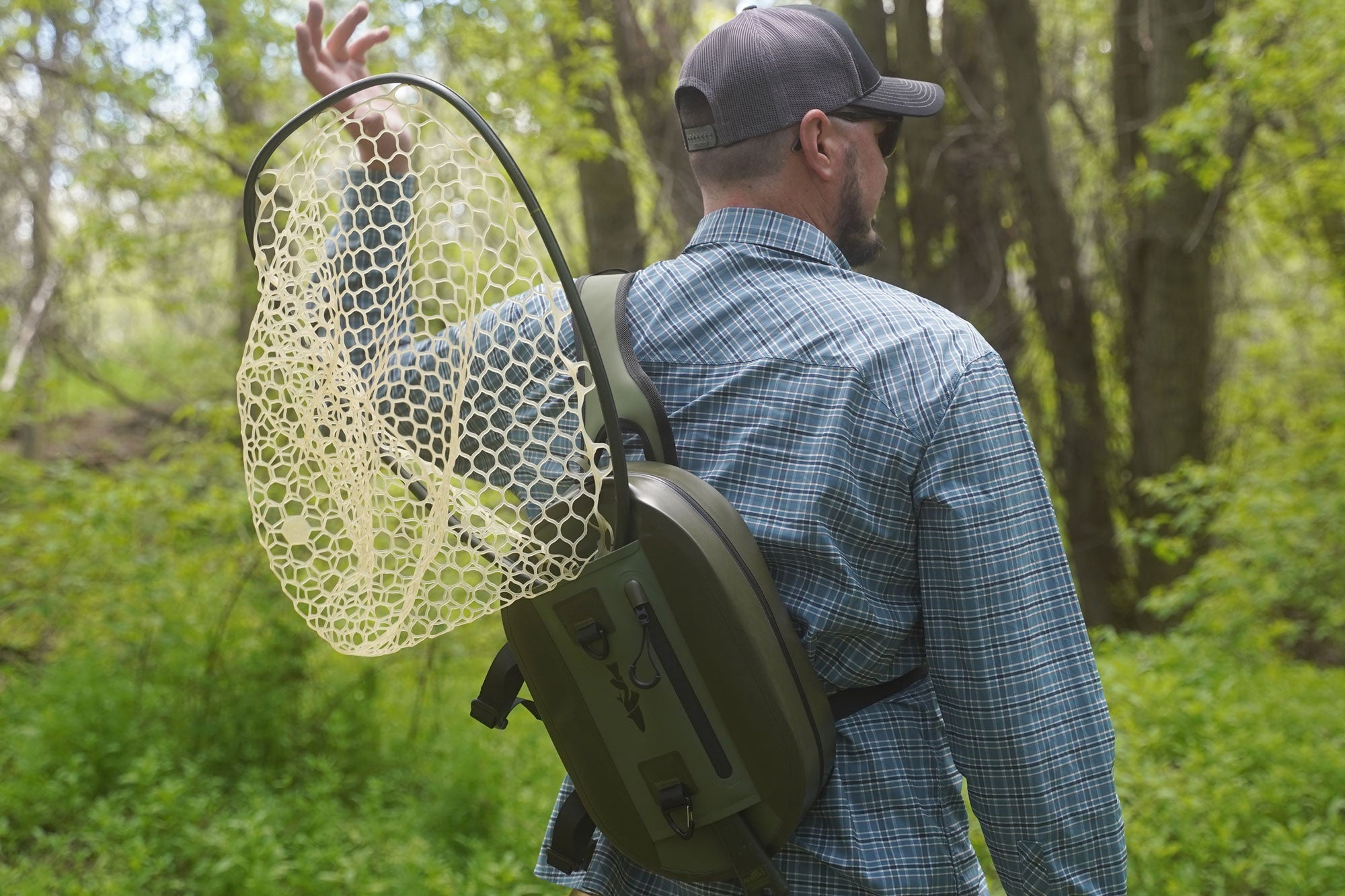
This is non-negotiable on a board, where there's no dry hatch and everything sits in the open. A HaliBorealis Backpack Dry Bag or the 30L Dry Bag Waterproof Backpack carries in on your back and then straps to the deck. For a day trip the 1-Day Overnight Dry Bag Backpack is the right size, and the Boat Bag Dry Bag is built to sit in standing water. See all dry bags.
Sun protection
You're standing on a reflective surface with no shade whatsoever, which is about the harshest sun exposure in fishing. A hooded sun shirt beats sunscreen because you never have to remember to reapply it — look at the FORLOH SolAir Hooded LS Shirt, the Teton Comet Sun Protective Hoodie, or the Yosemite Hoodie. There's a Women's Sun Protective Fishing Shirt too. Browse warm weather clothing.
Add a wide-brimmed hat — the Tarpon Straw Sun Hat or Dorado for salt, the Brown Trout for fresh — and a neck gaiter like the FFIP Logo Neck Gaiter for the back of your neck, which is where boards burn you.
Hydration and the small stuff
An STLHD 32oz Oasis keeps water cold through a full day in open sun. Keep your tools tethered with a zinger or lanyard — anything you drop off a board is gone, so tethering matters far more here than it does on a bank. A Slim J Magnetic Fly Box fits a shirt pocket and won't blow open in the wind.
Landing fish from a board
Reaching down from a standing position is awkward, so net length matters more than usual. The Lunker Net gives you the reach, and the Brookie Net works if you're mostly on small water. See all nets.
Buy the package or build it yourself?
Package deals are advantageous if you want a harmonised system. Buying components independently can look cheaper, but retrofitting often produces an incompatible setup. Packages designed for the board ensure everything works together.
That said, if you're a tinkerer who enjoys the specifics, hand-selecting parts lets you make excellent adjustments. Just go in knowing you'll spend the time.
Good luck with the selection. If a board isn't quite right for you, a pedal kayak solves the same problem differently — you sit lower and lose the sight-fishing height, but you gain hands-free propulsion and far more storage.
Go on a fly fishing trip you'll never forget
We partnered with Frontiers Travel to put you on water that's worth the flight. Tell them where you want to go. Don't wait.
Book a TripTight lines, everyone!

By Christian Bacasa
Host of the Fly Fishing Insider Podcast
Fly Fishing Insider Podcast Official Website
Instagram Fly Fishing Insider Podcast
Instagram Dupeafish
Facebook
Pinterest
Twitter
LinkedIn
Watch on YouTube
Fly Fishing Insider Podcast has a referral partnership with Frontiers International Travel. If you book after being introduced through us, we may receive compensation at no additional cost to you.