
The best brook trout on that little Uinta creek was sitting exactly where you'd expect: at the tail of a plunge pool about the size of a kitchen table, under a willow that hung so low the leaves were dragging in the current. Behind me was a wall of alder. Above me was a spruce limb. In front of me was maybe fifteen feet of water. There was no room for an overhead cast, no room for a back cast, and honestly not much room for me.
I pinched the fly, drew the rod back like a bow, and let go. The size 14 Elk Hair Caddis skidded under the willow, landed six inches above the fish, and disappeared in a splashy rise. That is small stream casting in one sentence: the cast you can't make is the one you need, and the overhead cast you practiced on the lawn is usually the least useful tool you own.
The short answer: Small stream casting comes down to four casts chosen by where the obstructions are. Use the bow-and-arrow cast when brush surrounds you, the roll cast when there's no room behind you, the sidearm cast to slide under overhanging branches, and the water-loaded cast to flip a fly back upstream without ever lifting it into the trees.
Key Takeaways
- Map the obstructions before you cast: behind you, above you, or both. That map picks the cast, not habit.
- The bow-and-arrow cast is a precision tool for tunnels and willow pockets, not a beginner's crutch.
- A roll cast needs water tension and a clean D-loop, not a back cast, which makes it the workhorse on brushy creeks.
- Rod length is a trade: 6 to 7.5 feet slips through brush, 8 to 9 feet reaches over pocket water, and tenkara adds reach but hates tunnels.
- Approach and position solve half your casting problems before you ever move the rod.
Rachel's willow problem
Rachel came into small streams the way most of us do, from bigger water. She's a genuinely good caster on the Provo, with tight loops and a nice drift, and the first time we fished a brushy tributary up Logan Canyon she lost four flies in the first half hour. Every one of them went into the willows behind her on the back cast. She was doing exactly what she'd trained herself to do, and on that creek it was precisely the wrong thing.
By lunch she was muttering about switching to a spinning rod. So we sat on a log and I asked her to point out every obstruction around the next pool: the branch above, the bushes behind, the log on the left bank. Once she saw the pool as a map of what she couldn't hit, the cast choice got obvious. She roll cast the first run, bow-and-arrowed the undercut, and by the end of the day she was sidearming flies under an overhanging alder like she'd been doing it for years. She caught more Bonneville cutthroat that afternoon than in the entire morning.
The fix wasn't a new skill so much as a new question. Big-river anglers ask, "where's the fish?" Small-stream anglers have to ask, "where's the fish, and where can my line actually travel to get there?"
Why the overhead cast fails on small streams
The overhead cast needs clear space behind you roughly equal to the distance you're casting forward, plus clear air above your rod tip. On a meadow creek that's no problem. On the typical Utah mountain stream, the kind that runs through willow and alder bottoms or under a spruce canopy, you almost never have both. Something is always behind you, above you, or both.
The second problem is line. Anglers who grew up on bigger rivers tend to carry too much fly line on small water. Twenty feet of line in the air on a creek that's fifteen feet wide is a liability. It catches branches, it lands on the far bank, and it drags the fly the instant it hits the water because the current has three different speeds between you and the fish. On most small streams the fishing happens with the leader and maybe six to twelve feet of line outside the rod tip. The rest stays on the reel.
Think of it like driving a pickup through a narrow mountain two-track versus cruising the interstate. Same truck, completely different driving. You slow down, you shorten everything up, and you pick your line through the obstacles before you hit the gas.
What is the best cast for small streams?
The best cast for a small stream is the one that fits the obstructions around you at that specific pool. There isn't a single answer, which is why I teach small stream casting as a decision, not a technique. Look at the space behind you and above you, then pick from four casts. Here's the quick map I run through at every pool:
| What's blocking you | Best cast | Why it works |
|---|---|---|
| Brush behind, open above | Roll cast | No back cast needed; the D-loop stays beside you |
| Branches overhead, open behind | Sidearm cast | The loop travels horizontally under the canopy |
| Brush everywhere (a tunnel) | Bow-and-arrow cast | No line in the air at all until the release |
| Fishing upstream, fly already on the water | Water-loaded cast | The current loads the rod; the fly never rises into the trees |
You'll notice the overhead cast isn't on that list. It still has a place on open meadow sections, but on a true brushy creek it's the exception.
The bow-and-arrow cast: precision for tunnels
The bow-and-arrow cast is exactly what it sounds like. You hold the fly by the bend of the hook, pull it back to bend the rod, aim the rod tip at the target, and let go. The rod springs forward and slings the fly and leader into the spot. There's no loop in the air, so the cast works in places where you literally couldn't move the rod more than a foot in any direction.
Here's how I set it up:
- Line length: about a rod's length of leader and line outside the tip. Too much and you can't bend the rod enough; too little and the fly won't reach.
- The grip: hold the fly by the bend with the point facing away from your fingers. Pinch lightly. Hooks in thumbs are a rite of passage, but only once.
- The draw: pull straight back along the line you want the fly to travel, bending the rod into a gentle arc. Keep a few loops of slack in your line hand so the line can extend if you want a bit more distance.
- The aim and release: point the rod tip slightly above the target, then open your fingers. Don't flick the rod. Just let it unbend.
The accuracy on this cast surprises people. Within about fifteen feet I can land a fly in a coffee-cup-sized pocket more consistently with a bow-and-arrow than with any aerial cast, because there's no loop to misjudge. I've written before about the misconceptions around the bow-and-arrow cast, the biggest being that it's something you graduate out of. I still use it on every small stream trip.
The limits are real, though. The bow-and-arrow cast tops out around fifteen to twenty feet, it works best with lighter flies, and a heavily weighted nymph tends to swing and tangle on release. Dries, soft hackles and small beadheads are its sweet spot.
The roll cast: the small stream workhorse
If I could only take one cast to a brushy creek, it would be the roll cast. The roll cast delivers the fly without a back cast, because the line never travels behind you. Instead you drag it into a D-shaped loop hanging beside and slightly behind your casting shoulder, then fire it forward. The water's grip on the line anchors the cast, and the rod does the rest.
The mechanics, simply: with the line on the water in front of you, slowly raise the rod and tilt it slightly outward until the tip is around one o'clock and the line hangs in a curve from the tip down to the water beside you. Pause a beat so that "D-loop" forms. Then make a crisp forward stroke, accelerating to a firm stop at about ten o'clock, aimed slightly above the target. The loop rolls out across the water and turns the fly over.
The most common mistakes on small water are rushing the setup, so the D-loop never forms, and stopping too low, so the loop rolls into the water instead of over it. A slow lift and a crisp, high stop fix both. The other thing that trips people up: the roll cast needs some line on the water to load against. On tiny creeks with only a few feet of line out, you may need to strip a little extra onto the water first so the cast has something to pull against.
One more roll cast trick for tight cover: the roll cast pickup. Instead of ripping the line off the water to recast, make a small roll cast that lifts the line and fly off the surface, then go straight into your next delivery. It keeps the fly low and out of the trees, and it doesn't spook a pool the way a noisy pickup does.
Dry Fly Tactics for Selective Trout (free eBook)
Small-stream trout eat dries all summer. Here's how to present them so wary fish commit. Grab the PDF free.
Get the free eBook →The sidearm cast: sliding under the canopy
The sidearm cast is a normal casting stroke tipped over on its side. Instead of the rod traveling up and down in a vertical plane, it travels parallel to the water, and the loop unrolls horizontally just a foot or two above the surface. That puts the whole cast underneath overhanging branches that would snag a vertical loop.
On small streams the sidearm cast earns its keep in the classic "willow roof" lies: undercut banks with brush hanging over them, where trout sit in the shade and eat whatever drops off the leaves. Tanner, who fishes more high-country creeks than anybody I know, has a habit of skipping his sidearm casts. He deliberately lets the fly touch the water a few feet short so it skips the last stretch under the branches like a flat stone on a pond. It looks reckless and it's deadly on brook trout.
The key detail is the stop. A sidearm cast still needs a firm, crisp stop, and the rod tip has to travel in a straight horizontal line. If your tip dips as you come forward, the loop will drive into the water before it reaches the brush. Practice with a target on the lawn, like a hula hoop or a paper plate, and a line strung between two chairs about three feet off the ground. Cast under the line without hitting it. It's a humbling five minutes.
The sidearm plane also makes it easy to throw a curve. Overpower the stroke slightly and stop abruptly, and the leader will hook around at the end, which lets you drop a fly behind a rock or around a root wad instead of casting straight over the top of the fish.
The water-loaded cast: the lazy angler's secret
The fourth cast is the one almost nobody names, and it might be the one I use most often going upstream on a creek. When the fly finishes drifting downstream past you, don't pick it up at all. Let the line straighten below you in the current, feel the water pull and bend the rod, then sweep the rod forward and flip the fly back upstream. The drag of the water on the line loads the rod the same way a back cast would, without the fly ever rising into the brush behind you.
I talked about how much this changed my fishing in When I Started Water Loading My Casts, and on small streams it's even more valuable than on big water. It's quiet, it keeps the fly low, and it lets you make the next cast almost instantly. When you're moving pool to pool fast, and on small streams you should be, that speed adds up to a lot more drifts per hour.
The limitation is that water loading works best with a bit of current and a fly that isn't too heavily weighted. In slow, glassy pools there isn't enough tension, and a roll cast is the better choice.
How long should a fly rod be for small stream casting?
For most brushy small streams, a fly rod between 6.5 and 7.5 feet in a 2- to 4-weight is the easiest to cast in tight cover, because a shorter rod needs less clearance and fits through gaps in the brush. Longer rods of 8 to 9 feet trade that maneuverability for reach, which matters more on open pocket water where you're holding line off competing currents.
There's a real trade-off here, and I've gone back and forth on it for years. A short rod is fantastic in a willow tunnel and miserable when you need to hold line off a fast seam in pocket water. A 9-footer is the reverse. Here's how I think about it:
| Rod | Where it shines | Where it struggles |
|---|---|---|
| 6'–7' fiberglass, 2–3 wt | Brush tunnels, bow-and-arrow casts, tiny brook trout water | Mending, reaching over fast pocket water |
| 7'6"–8' graphite or glass, 3–4 wt | The all-around small-stream choice for mixed cover | Very tight tunnels |
| 8'6"–9' graphite, 4–5 wt | Open meadow creeks, pocket water, high-sticking nymphs | Overhanging brush and tight canopies |
| Tenkara, roughly 8'–12' | Open canopy, plunge pools, holding a fly in one seam | Dense tunnels, reaching past about 20 feet |
Fiberglass deserves a special mention for small streams. Glass rods bend deep and load with very little line out, which is exactly what you need when there are only eight feet of line past the tip. A slow glass rod also makes a gentle, forgiving roll cast, and the bow-and-arrow cast feels natural on a rod that loves to bend.
Tenkara is its own conversation. The long fixed-line rod gives incredible reach and drag-free drifts in plunge pools, which is why so many Utah anglers carry one into the Uintas. But a 12-foot rod in a willow tunnel is like carrying a ladder through a crowded room. Shorter tenkara rods help, and I dug into the trade-offs in All About Tenkara.
Approach angles: position solves half the problem
Here's the part of small stream casting that isn't casting at all. Where you stand determines which casts are even possible, and a step to the left often turns an impossible cast into an easy one. Before I move the rod, I scan the pool, pick the fish's likely lie, and ask where I can stand so the obstructions are beside me rather than behind or above.
On most small streams I fish upstream. Trout face into the current, so approaching from below keeps you in their blind spot, and your drifts come back toward you, which makes line management easier. I also stay low. Kneeling in the gravel isn't dignified, but a trout in a fifteen-foot pool can see a standing angler from a long way off, and it's often the difference between a take and a shadow darting under the bank.
Angle matters too. Casting straight upstream over a fish lines it, and the leader lands on top of it. Casting from a quartering angle, off to the side and slightly below, lets the fly land above the fish while the line lands off to one side. On brushy creeks that side angle also tends to open up a casting lane that doesn't exist from directly below.
Watch first, then choose the fly and the cast. Colorado angler and glass artist Martin Gerdin made the case on the podcast that blind-casting unfamiliar water wastes the best information you have, which is what the fish are already doing. He watches from a vantage point for rises and cruisers and checks the grass for beetles and hoppers before he picks a fly and a presentation. On a brushy creek that pause also shows you where the fish is holding, and from there which of the four casts can reach it without spooking the pool. Hear the whole conversation on this Fly Fishing Insider Podcast episode.
Advanced small-stream tactics
Once the four casts feel comfortable, a few refinements make a big difference. First, shorten your leader. On brushy creeks I run a 6- to 7.5-foot leader tapered to 4X or 5X. A 9-foot leader on a 7-foot rod is a lot of monofilament to control with almost no fly line out, and it makes the bow-and-arrow and roll casts sloppy. Browse the leaders collection for shorter tapers.
Second, learn to cast with either hand, or at least learn the backhand. On a creek the brush is always on the wrong side of you at some point. A backhand roll cast or sidearm cast over your off shoulder saves a lot of wading around a pool to set up.
Third, fish the dap. Sometimes the right cast is no cast. On a pocket right below your feet, just lower the fly onto the water with a few inches of tippet, let it drift, and lift. It's the oldest trick in small stream fishing, and brook trout in the Uintas have never read a casting manual.
Practice all four casts before the trip, not on the creek. A backyard with a fence, a hedge or a clothesline works as a stand-in for brush. Set a paper plate twelve to fifteen feet away, stand with your back a few feet from the hedge, and cycle through the casts: five roll casts, five sidearm casts under the clothesline, five bow-and-arrow shots, then five water-loaded flips on a pond or a slow stretch of any local creek. Ten minutes, a few evenings a week, and by the time the high-country creeks drop into shape in July, the choice between casts will feel automatic instead of like a quiz you're taking with a trout watching.
And finally, move. Small streams reward covering water. Two or three good drifts in each pocket, then the next one. Josh, who's one of the most efficient small-water anglers I know, has a rule: if he hasn't moved in five minutes, he's probably fishing water the trout have already seen him in.
Gear for tight cover
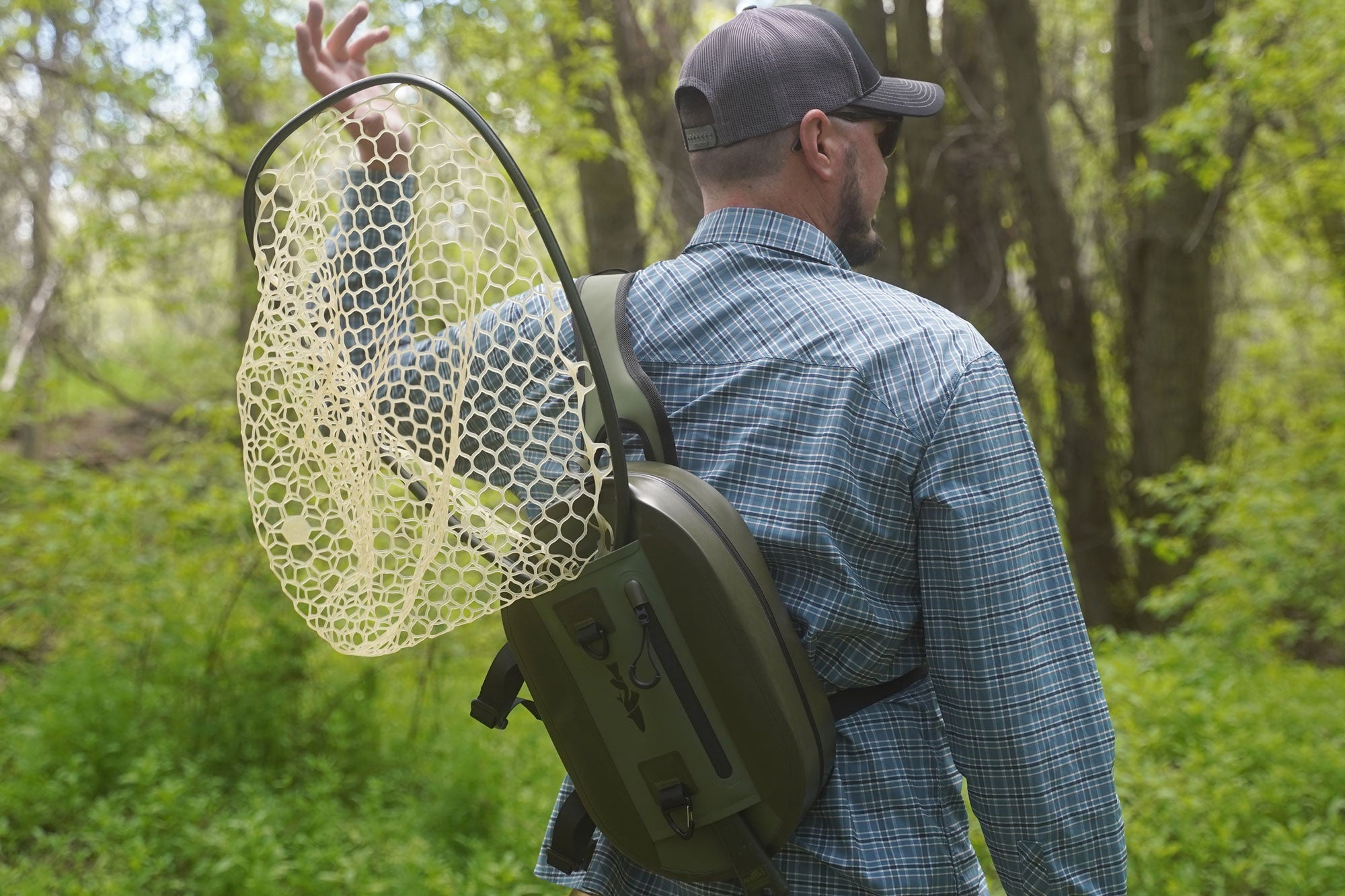
You don't need much for small streams, and that's part of the joy. A short, soft rod, a floating line, a short leader, a small box of dries and beadheads, and a landing net you won't mind carrying through the brush. Keep it light, because you'll be climbing around boulders and crawling under deadfall. The backcountry fly fishing gear collection is built around exactly that kind of day.
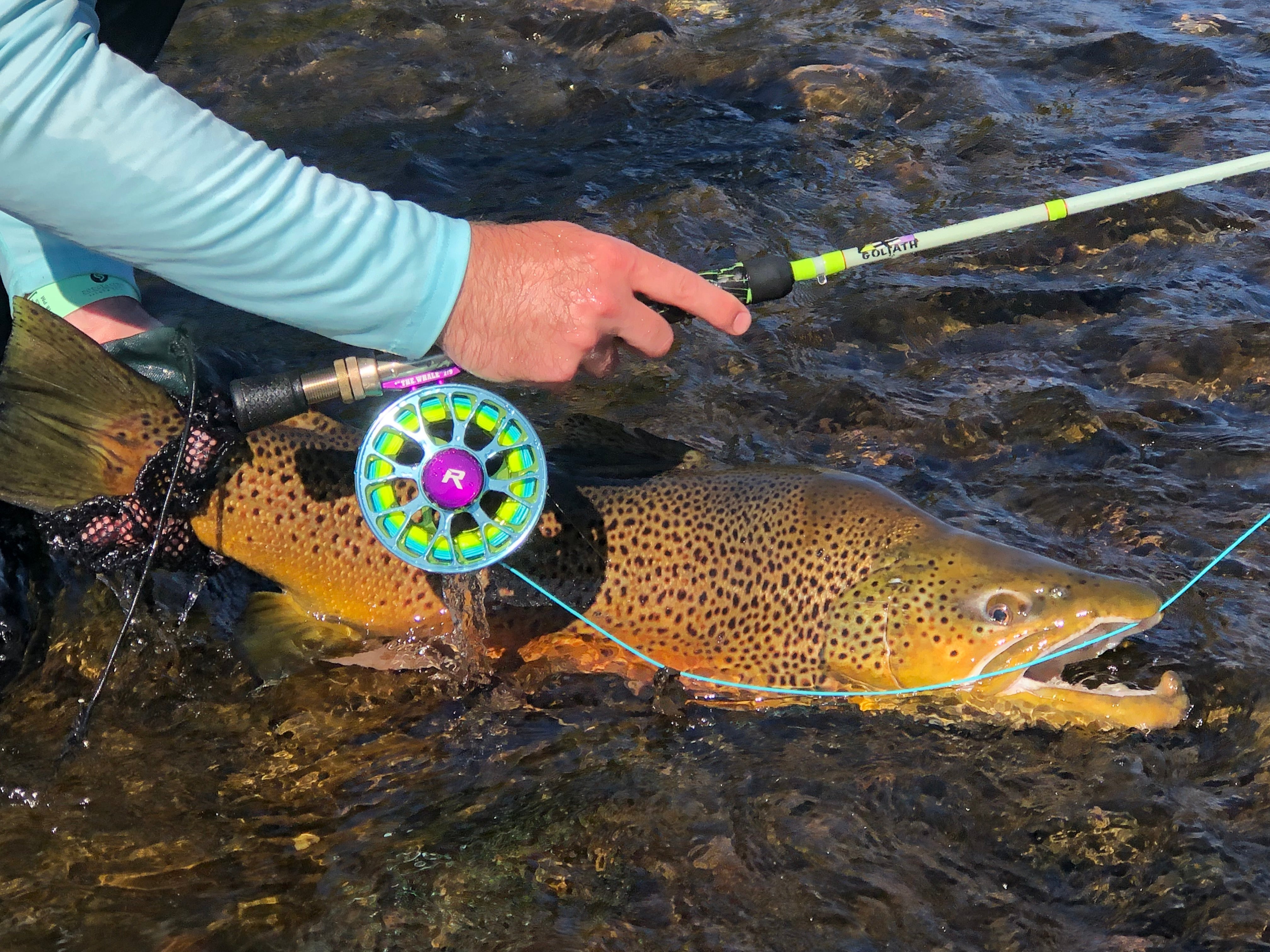
For rods, my honest recommendation is a short fiberglass rod in a 2- to 4-weight if most of your water is brushy, or a tenkara rod if you fish plunge-pool water with an open canopy. You can see the full range of rods, reels and combos and the tenkara collection, but these are the ones I'd point a friend toward.


Frequently asked questions about small stream casting
What weight fly rod is best for small streams?
A 2- to 4-weight fly rod is best for most small streams. The lighter line weight lands softly on skinny water, protects light tippet, and makes the 6- to 12-inch trout typical of small creeks fun to fight. A 3-weight in 7 to 7.5 feet is the most versatile single choice if you fish a mix of brushy and open water.
Is the bow-and-arrow cast only for beginners?
No. The bow-and-arrow cast is a precision tool that experienced small-stream anglers use constantly. It's often the only cast that works in brush tunnels, and within about fifteen feet it can be more accurate than an aerial cast because there's no loop to misjudge. It's limited in range and works best with lighter flies.
How do you roll cast with very little line out?
To roll cast with very little line out, strip a few extra feet of line onto the water first so the cast has something to load against. Raise the rod slowly to form the D-loop, pause, then make a crisp forward stroke with a high stop. A soft fiberglass rod makes short roll casts noticeably easier because it bends deeply with minimal line.
Should I use tenkara on small streams?
Tenkara is excellent on small streams with an open canopy and plunge pools, where the long rod gives you reach and drag-free drifts. It's less effective in dense brush tunnels, where a long rod is hard to maneuver. Many Utah anglers carry a shorter tenkara rod for mountain creeks and a short fly rod for brushier water.
How long should my leader be for small stream fishing?
For brushy small streams, a 6- to 7.5-foot leader tapered to 4X or 5X is ideal. A shorter leader turns over reliably with very little fly line out and is easier to control on bow-and-arrow and roll casts. On clear, slow meadow sections with spooky fish, stepping up to 9 feet can help.
Why do I keep snagging trees behind me?
You keep snagging trees behind you because the overhead cast needs clear space behind roughly equal to your forward cast. On small streams, switch to a roll cast or water-loaded cast when brush is behind you, shorten the line you're carrying, and reposition so obstructions sit beside you instead of directly behind.
Go find a brushy creek
There's something about small streams that brings me back to why I started fly fishing in the first place. No crowds, no drift boats, just you, a short rod, and a string of little pools where every cast is a puzzle. The trout aren't huge, but a 12-inch Bonneville cutthroat pulled out from under a willow on a cast you honestly weren't sure you could make is as satisfying as anything in this sport.
Learn the four casts, look at the obstructions before you look at the fish, and don't be afraid to kneel in the gravel. That's the whole game. If you're heading out on Utah creeks this summer, check regulations through the Utah Division of Wildlife Resources and the current Utah fishing guidebook, since some small streams have special limits for native cutthroat. And if you want a bigger-water destination nearby, our Logan River guide covers the main stem and the brushy tributaries that feed it.
Join the FFIP Insiders
Get gear deals, trip intel, and tactics to help you catch any fish, any time, and anywhere, straight to your inbox.
Join free →Here at the Fly Fishing Insider Podcast, the goal is always the same: helping you catch any fish, any time, and anywhere, and that includes the fish hiding under the willows. Tag your small-stream catches with @flyfishinginsiderpodcast, and if you want more tips from our guests on tight, technical water, the Tailwater, Spring Creek and Small Stream Tips roundup is a great next stop.
Tight lines, everyone!