
Most anglers pack a streamer box for big rivers and leave it in the truck when they hike up a creek you can jump across. I think that's exactly backwards. The biggest trout in a small stream is almost always a predator living under the one log nobody can drift a dry fly beneath, and it has not seen a streamer all summer.
Small stream streamer fishing works best with short casts of 15 to 30 feet, streamers in sizes 8 to 12, and upstream or up-and-across presentations that bring the fly back with the current into cover. A stealthy approach matters more than fly choice, because in small water the first cast to each pocket is usually the only good one.
Key takeaways
- In small water, the streamer is a big-fish tool. It pulls the one or two dominant trout out of a pool that would otherwise ignore your dry and your nymph.
- Fish upstream more than you think you should. Swinging and stripping downstream pushes your shadow, your wake, and your silt ahead of you into every pocket you haven't fished yet.
- Go smaller. A size 8 to 12 Woolly Bugger, Muddler Minnow, or small sculpin is the right-size meal for small-stream brook trout and browns, and it lands quietly enough not to empty the pool.
- The first cast is the whole game. Plan it before you're in range, make it count, and move on sooner than feels natural.
- Short rods, short leaders, and short casts — 7½ to 8½ feet, 3- to 5-weight, 6 to 7½ feet of leader — make tight-cover streamer fishing possible instead of miserable.
The creek Rachel almost walked past
Rachel and I were fishing a tributary of the Logan River in northern Utah a couple of Augusts ago — the kind of creek where the whole stream is five feet wide, braided around willows, and so clear you can count pebbles in three feet of water. We'd been fishing small dries all morning and catching brook trout (Salvelinus fontinalis) and the occasional cutthroat in the six- to nine-inch range. Beautiful fish, happy morning.
Around noon we came to a pool that looked different. A spruce had fallen across the head of it years ago, and the current had carved a deep, dark undercut under the root wad. Rachel drifted a hopper along the edge of that shadow three times and nothing moved. She was ready to walk past.
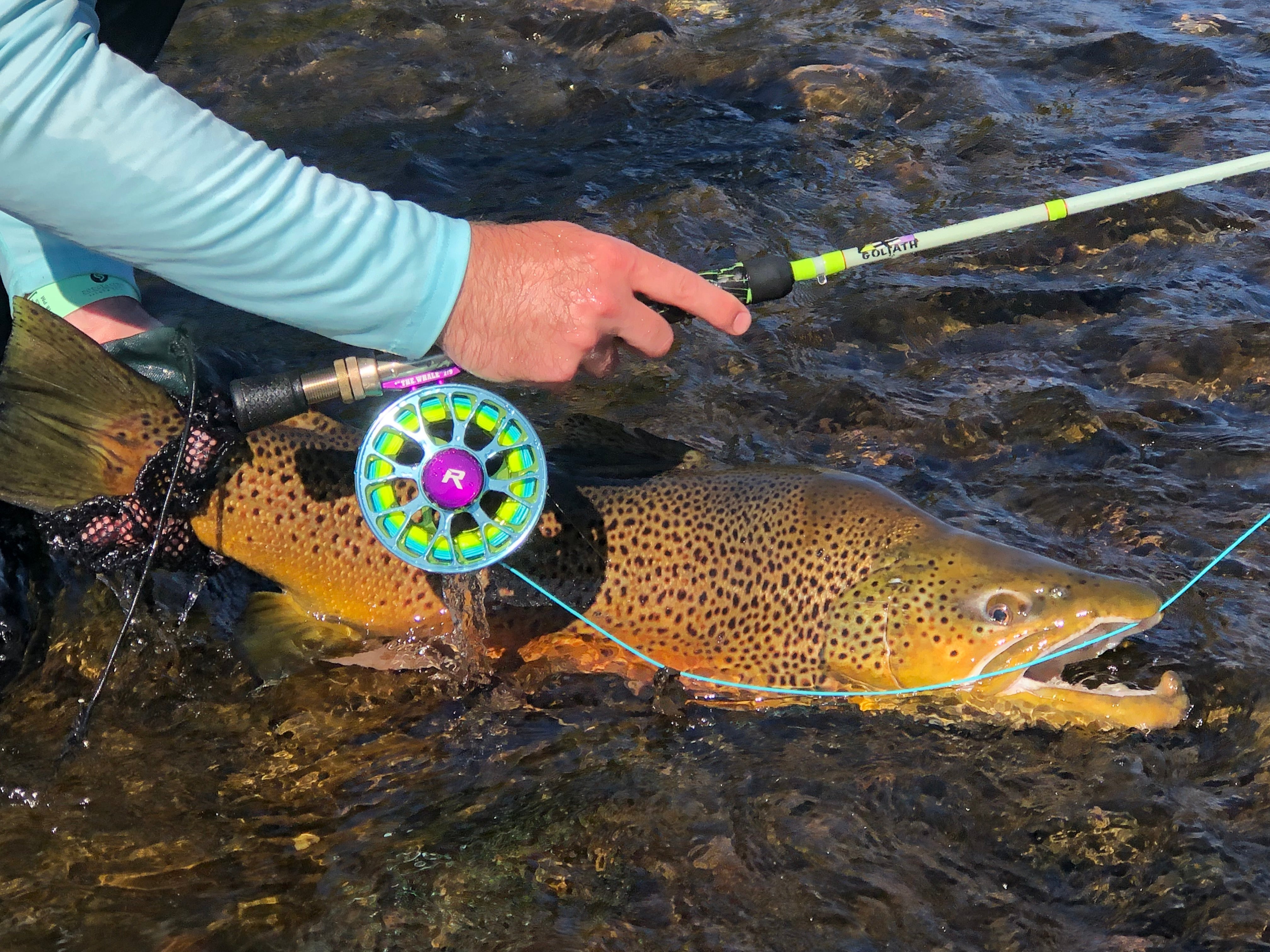
I handed her a rod rigged with a size 10 olive Woolly Bugger on a short 3X leader and asked her to do one thing: stay kneeling where she was, flip the fly upstream into the bubble line at the head of the pool, let it sink for a two-count, and strip it back down along the root wad in short, twitchy pulls. On the second strip a brown trout came out from under the log that was longer than any fish we'd seen all day put together. Fifteen inches, maybe sixteen, in a creek where a ten-incher is a trophy.
That fish had been watching our dries float by all morning without the slightest interest. It wanted a meal that moved like something alive and vulnerable, and nothing else we'd shown it came close.
The misconception: that streamers are for big water and big casts
Here's the thing most people get wrong about small stream streamer fishing. They picture streamer fishing as a drift boat, a 7-weight, a sink tip, and a heavy articulated fly thrown hard at the bank. Then they look at a creek with a three-foot-wide channel and a canopy of willows and decide streamers just don't apply.
The truth is closer to the opposite. Streamer fishing on a small stream is the same idea — imitate a baitfish, a sculpin, a crayfish, or a leech and trigger a predatory response — just scaled down in every dimension. Smaller fly, shorter cast, shorter leader, shorter retrieve. It's the difference between hunting elk across a canyon and hunting grouse in the timber. Same instincts, completely different distances.
The second misconception is about direction. Most anglers learn streamer fishing as a down-and-across swing, and on a big river that works beautifully. On a small stream it's usually a mistake, and we'll get to why in a moment.
Why fish streamers on small streams at all?
Fish streamers on small streams because the largest trout in small water usually feed on other fish and larger prey, and a streamer is the only fly that imitates that food. A brook trout or brown trout that reaches twelve inches or more in a small stream has typically shifted its diet toward sculpins, dace, small trout, and crayfish.
Small streams are nutrient-poor compared to a tailwater. Insect hatches are sparse, the growing season in the high country is short, and a trout that wants to grow past the average size has to eat something bigger than a mayfly. That's why the dominant fish in a small pool is so often holding in the deepest, darkest, most protected spot — the undercut, the logjam, the plunge pool below a boulder — rather than out in the feeding lane where the smaller fish sip dries. The U.S. Geological Survey's species profile for brook trout notes their broad diet and their preference for cold, clean headwater habitat, which is exactly the kind of water we're talking about.
A streamer also solves a practical problem: it lets you fish the places a dry fly can't reach. You can't float a dry under a root wad or down into a six-foot plunge pool. You can swim a small streamer into both.
That said, I want to be honest about the limits. Streamers on small water usually catch fewer fish than a dry-dropper does. What they catch is the right fish. If your goal is numbers, keep the dry-dropper on. If your goal is to meet the biggest trout in the creek, tie on a bugger.
Approach and stealth come before any fly
On a small stream, the fish can see you long before you can see them. The water is shallow, clear, and close, and every trout in it has survived herons, mink, kingfishers, and ospreys by bolting at the first shadow. If you walk up to a pool standing tall and wade in to get a better casting angle, that pool is finished before your fly ever touches the water.
Here's how I approach a small stream pool when I'm planning to fish a streamer:
- Stop fifteen feet short of where you want to cast from. Look at the pool. Find the deepest water, the overhead cover, and the current that feeds into it.
- Get low. Crouch or kneel for the last few steps and for the casts themselves. Your silhouette against the sky is the single loudest thing on a small stream.
- Stay out of the water when you can. Every step in a small stream sends pressure waves and silt downstream. Fish from the bank, from behind a rock, or from the tail of the pool below.
- Watch the sun. Keep your shadow and your rod's shadow off the water you're about to fish. On a narrow creek that sometimes means crossing to the other bank before you start.
- Move slowly and quietly. Heavy footsteps on a gravel bank carry into the water. Walk like the fish can hear you, because they can feel you.
A buddy of mine who hunts whitetails says small stream fishing reminds him of still-hunting in thick timber: you take three steps, stop, look, take three more. That rhythm is exactly right. The angler who catches the big fish in a small stream is usually the one who moved the slowest to get there.
That Mossy Creek Fly Fishing video is a good look at the scale of small-water streamer fishing for brook trout: short casts, small flies, and a lot of attention on where the fish are likely to be holding before the first cast goes out.
Grid the pool with your eyes before the rod ever moves. Livingston, Montana spring creek guide Jan Axtell explained on the FFIP episode on spring creeks and spot fishing around Livingston that trout in clear water blend in so well that an angler hunting for a fish-shaped outline walks right past them. Axtell's fix is a systematic scan: surface activity first, then the bottom, looking hardest for depressions in the streambed, because that is where fish hold most of the time. It translates straight to small stream streamer fishing. Find the dark slot or the scoured-out pocket from fifteen feet back, then set up below it so your first cast swims the fly right through that lie.
Should you fish streamers upstream or downstream on small streams?
On most small streams, fish streamers upstream or up-and-across rather than downstream. Casting upstream keeps you behind the trout, where they can't see you, and brings the streamer back toward you with the current the way a dislodged sculpin or a small fish would naturally travel.
A trout faces into the current. When you approach from downstream, you're coming up behind it, in its blind spot. When you fish downstream, you're walking into its field of view, pushing your silt and wading pressure ahead of you, and letting the current carry your line and leader into the pool before your fly. In big water there's enough space to get away with it. In a five-foot-wide creek you usually can't.
The mechanics of an upstream streamer presentation take a little adjusting to. Because the fly is coming toward you with the current, you have to strip faster than you'd expect just to stay in contact and keep the fly swimming. I usually cast a few feet above the pocket I want to fish, let the fly sink for a one- or two-count, then strip it back in short, sharp, six-inch pulls with a pause every third or fourth strip. The pause is where many eats happen, because a small fly tumbling helplessly in the current for half a second looks like the easiest meal in the stream.
There are exceptions, and I fish them happily:
- Undercut banks at the tail of a pool often fish better with a short downstream presentation, dropping the fly in above the cut and letting the current carry it under the bank before you twitch it.
- Plunge pools below a small waterfall or boulder step can sometimes only be reached from above. Drop the fly into the white water and let the current pull it down into the pool.
- Brushy corridors where you physically can't cast upstream sometimes leave the downstream dangle as the only option. Feed line, let the fly swing into the cover, and strip it back slowly.
The rule isn't "never fish downstream." It's that upstream should be your default and downstream should be a deliberate choice for a specific piece of water.
Downsize the fly and the rig
The streamer that works on the Green River below Flaming Gorge is usually too big for a small stream. Not because a small-stream trout won't eat a big meal — they absolutely will — but because a big fly lands like a brick, spooks every fish in a small pool, and is nearly impossible to cast accurately under overhanging brush.
My small-stream streamer box holds mostly sizes 8 through 12. The core patterns are simple:
| Situation | Fly | Leader |
|---|---|---|
| General searching, clear water | Size 10 olive or black Woolly Bugger, light bead | 6–7½ ft, 3X fluorocarbon |
| Rocky freestone with sculpins | Size 8–10 Muddler Minnow or small sculpin | 6 ft, 3X |
| Deep plunge pools | Size 8 bead-head bugger or cone-head Muddler | 6 ft, 2X–3X |
| Low, gin-clear late summer water | Size 12 soft-hackle streamer, unweighted | 7½ ft, 4X |
| Stained water after rain | Size 8 black or dark olive bugger with a little flash | 6 ft, 2X |
Weight is a balancing act. You need enough to get the fly down quickly in a short pool, because on a small stream the fly may only be in the strike zone for a few feet. But too much weight makes the fly plunk, snag, and cast poorly. I prefer a small bead or light cone to split shot, and I carry the same pattern in weighted and unweighted versions so I can match the depth of the pool rather than guessing.
For deeper pools with real current, a slightly heavier fly swims deeper on a short line more cleanly than a light fly with shot pinched above it. The shot creates a hinge, and a hinged streamer in a small pool looks unnatural.
Dry Fly Tactics for Selective Trout (free eBook)
When the streamer has done its work in the deep pools, the rest of a small stream is dry fly water. This free eBook covers the presentations that fool fussy trout in clear, skinny water.
Get the free eBook →Short casts and tight-cover placement
The distances on a small stream are almost comically short. Most of my streamer casts on creeks are fifteen to thirty feet, and plenty are under fifteen. The challenge isn't distance. It's getting the fly into a very small target without hanging it in a willow on the way there.
Three casts cover almost every situation:
The roll cast. When there's brush behind you, the roll cast is your default. A small streamer on a short leader roll-casts well, especially with a slightly heavier fly that anchors in the water and loads the rod. Practice it until you can put the fly on a dinner plate at twenty feet.
The bow-and-arrow cast. When there's brush everywhere and you just need to get the fly six or eight feet into a hole, hold the fly by the bend, pull back to load the rod tip, aim, and let go. It's one of the most underrated techniques in small-stream fishing, and it's perfect for flipping a streamer under an overhanging branch. Our write-up on the bow and arrow cast and its misconceptions covers the mechanics in more detail. Just be careful with a weighted fly and keep the hook point away from your fingers.
The side-arm cast. When the overhead canopy is low, drop the rod parallel to the water and cast side-arm. It skips the fly under the branches and puts it tight to the far bank, which is often exactly where the fish live.
Accuracy matters more than anything. On a small stream, the difference between a fly landing two inches from an undercut bank and one landing a foot away is often the difference between a fish and nothing. The trout under that bank isn't going to swim a foot out into open water in bright sun to chase a fly. It might dart two inches to grab one that swam right past its nose.
How I actually fish a small stream pool with a streamer
Here's the sequence I use on a typical small-stream pool, the way I'd walk you through it if we were standing on the bank together.
Start at the tail. Before I fish the obvious deep water, I make one or two short casts to the tail of the pool. Trout often slide back to the tail to feed, and if you walk up and spook a fish there, it'll bolt upstream and warn everything in the pool.
Fish the near side before the far side. Work the water closest to you first, then extend to the middle, then the far bank. Every cast to the far side drags line over the near water, and you want to have fished it before you do that.
Save the best cast for the best spot. The undercut, the root wad, the deepest slot at the head of the pool — I plan my approach so my first cast to that spot is my best cast. I know exactly where the fly will land, how long it'll sink, and which way I'll strip it before I ever make the cast.
Give each spot three or four casts, then move. This is where a lot of anglers go wrong on small water. On a big river, you might fish a run for an hour. On a small stream, if the fish in a pool haven't reacted to three or four good presentations, they're either not there or not interested. Move to the next pool. There are more fish around the next bend.
Change the retrieve before you change the fly. If I get a follow without an eat, I'll try the same fly with a longer pause, or a dead drift followed by a single twitch, before I switch patterns. Small-stream trout often want a slower, more vulnerable presentation than big-river fish.
Our deeper dive on small stream streamer mastery and tight-water techniques goes further into technical water, and it pairs well with this sequence.
Advanced tactics for small-water streamers
Once the basics are working, a few refinements will help you catch more of the big fish in small water.
Dead-drift, then twitch. Cast the streamer upstream and let it drift naturally for a few feet like a nymph, then give it one or two sharp twitches as it reaches the cover. A sculpin knocked loose from the bottom drifts helplessly before it tries to swim for safety, and that transition from drift to darting is a powerful trigger. This is my go-to presentation in the deeper plunge pools of Utah's Uinta Mountain streams.
High-stick a streamer in pocket water. In fast pocket water, you can fish a small weighted streamer almost like a tight-line nymph rig: short cast, rod high, leader off the water, fly swimming and ticking through the pocket. When it reaches the bottom of the pocket, give it a couple of short strips. It's a very efficient way to cover dozens of small pockets in a short stretch.
Fish the low light. Early morning, late evening, and overcast days are prime small-stream streamer windows. The bigger trout are more willing to leave cover when the light is low, and you're harder to see. A cloudy afternoon after a summer rain, with a little color in the water, is about as good as small-stream streamer fishing gets.
Match the local forage. Turn over a few rocks in the riffle. If you find sculpins, fish a sculpin-shaped fly with a broad head. If you see small dace or trout fry in the shallows, a slimmer baitfish pattern is a good bet. Crayfish in the stream? Fish a brown or olive bugger slowly along the bottom.
That Fish Hawk video shows the kind of small mountain water where these tactics shine: tight pools, overhanging cover, and native brook trout that hold in the spots you have to work to reach.
Regulations, ethics, and taking care of small-stream fish
Small streams are fragile. Fish populations are small, growth is slow, and a single big trout may be the dominant fish in a pool for years. Handle them with care. Pinch your barbs, keep fish wet, use a net with a rubber bag, and release them quickly into slow water near where you caught them.
Check regulations before you fish. Many small streams have special rules, from artificial flies and lures only to catch-and-release for native cutthroat trout. In Utah, the Division of Wildlife Resources fishing guidebook lists the current statewide rules and special regulations for specific waters. Other states handle it differently, so check the rules for the exact stretch you plan to fish.
And respect access. Many great small streams flow through private land. Know where public access begins and ends, and stay on the right side of the line.
Gear for small stream streamer fishing
You don't need a special rod for small stream streamer fishing, but the right setup makes it more fun and a lot less frustrating. A 7½- to 8½-foot rod in a 3- to 5-weight is ideal. It's short enough to maneuver under trees and in tight quarters, but it still has enough backbone to cast a small weighted streamer and handle a surprise sixteen-inch brown. I'd pick a 4-weight if I had to choose just one. A floating line is all you need on water this size.
Keep the leader short: six to seven and a half feet, finishing in 3X or 4X fluorocarbon. A short leader turns over a weighted fly better, is easier to control in tight quarters, and gives you more direct contact for the strip-set. A short furled leader is a great option because it turns over beautifully on short casts and makes tippet changes simple.
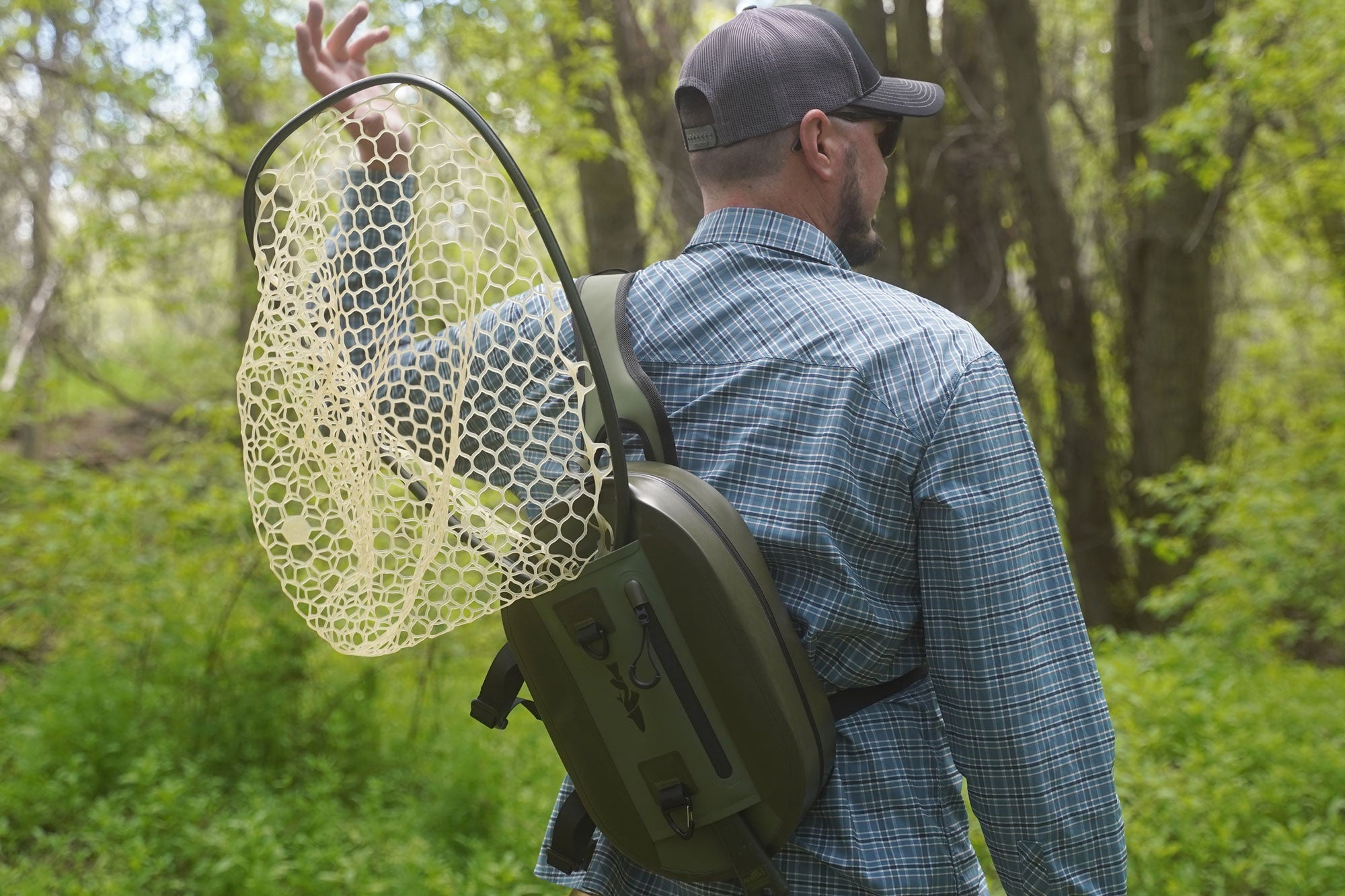
For flies, our streamer fishing collection has plenty of small buggers and Muddlers, and the broader fly pattern selection covers everything else you'll want in a small-stream box. If you're hiking in to remote water, check out our backcountry fly fishing gear for lightweight packs and essentials.


For more advice on technical small water, the guest tips collected in our tailwater, spring creek and small stream tips roundup are well worth a read before your next hike up a creek.
Frequently Asked Questions
What size streamer should I use on a small stream?
Use streamers in sizes 8 to 12 on most small streams. A size 10 Woolly Bugger or Muddler Minnow is a reliable starting point. Go to a size 8 in deeper plunge pools or stained water, and drop to a size 12 soft-hackle streamer in low, clear late-summer conditions when trout are spooky.
Should I fish streamers upstream or downstream on a small stream?
Fish upstream or up-and-across in most situations. Approaching from downstream keeps you in the trout's blind spot and brings the fly back with the current naturally. Downstream presentations still work for undercut banks at the tail of a pool, plunge pools reached from above, and brushy corridors where an upstream cast isn't possible.
What rod is best for small stream streamer fishing?
A 7½- to 8½-foot rod in a 3- to 5-weight is ideal for small stream streamer fishing. A 4-weight is the best single choice: short enough to fish under trees, but with enough backbone to cast a small weighted streamer and control a larger brown trout in tight cover. A floating line is all you need.
How long should my leader be for small stream streamers?
Use a short leader of six to seven and a half feet, finishing in 3X or 4X fluorocarbon. A short leader turns over a weighted streamer on short casts, is easier to control in tight quarters, and keeps you in direct contact with the fly for a quick strip-set when a trout eats.
Do brook trout eat streamers?
Yes. Brook trout are aggressive, opportunistic feeders and readily eat small streamers, especially Woolly Buggers, Muddler Minnows, and small sculpin patterns. Larger brook trout in small streams often feed heavily on small fish and other large prey, which makes a streamer one of the best ways to catch the biggest brookie in a pool.
How many casts should I make to one spot on a small stream?
Make three or four good casts to each spot, then move on. Small streams hold fewer fish per pool, and trout that haven't responded to a few accurate presentations are either absent or not interested. Covering more water with careful first casts usually catches more and bigger fish than working one pool for a long time.
When is the best time to fish streamers on small streams?
Low-light periods are best: early morning, late evening, and overcast days. A cloudy afternoon after a summer rain, with a little color in the water, is excellent. Bigger trout leave cover more readily when light is low, and anglers are harder for fish to see in the dim conditions.
Take a streamer up the creek
Next time you hike into a small stream, bring a handful of small streamers along with your dries and nymphs. Stay low, move slowly, cast upstream, and put the fly tight to the cover. You'll probably catch fewer fish than you would with a dry-dropper, but you might just meet the biggest trout in the creek — the one that has been watching everyone else's dry flies drift by all summer.
If you get one, show us. Tag us on Instagram at @flyfishinginsiderpodcast. Christian Bacasa and the Fly Fishing Insider Podcast crew love seeing small-stream trophies, and helping you catch any fish, any time, and anywhere is exactly why we do this.
Join the FFIP Insiders
Get gear deals, trip intel, and tactics to help you catch any fish, any time, and anywhere — starting with our free eBook.
Get the free eBook →Tight lines, everyone!