
Fly Fishing Insider Podcast
North Kill Tackle builds wooden landing nets by steaming three 1/8-inch hardwood strips for about 15 minutes, wrapping them around a mold under tension from cut car inner tubes, and letting them dry a full day before glue-up. Hoops are sanded to roughly 3/4 inch, then fitted with small-hole rubber bags.
Chris Ritter is the owner of North Kill Tackle, a one-man Pennsylvania shop building handmade wooden landing nets, plus custom fly rods and vintage tackle.
Also on Apple Podcasts · Spotify · YouTube
How is a wooden landing net hoop steam bent?
The hoop starts as hardwood ripped into strips about 1/8 inch thick and roughly six feet long. Three strips go into the steam chamber at once and heat for about 15 minutes, at just over 200 degrees, close to but not quite boiling. They come out hot and get wrapped straight onto the mold and held with a clamp at what will become the handle, purely to set the shape. That preliminary bend dries fully for a day before any glue is applied, and steam bending was the single hardest process to learn in the whole build.
Why use inner tube strips instead of clamps on a net mold?
Many net builders clamp the glue-up with C-clamps and sliding clamps. North Kill Tackle instead cuts car inner tubes into long rubber strips and wraps those around the mold, which spreads tension evenly around the whole hoop rather than concentrating it at a few points. The result is a hoop with no gaps and glue lines so fine they are invisible unless someone is hunting for them. A foot-actuated clamp holds the work during glue-up so both hands stay free to lay the strips.
What happens after the hoop comes off the mold?
The raw hoop out of the mold is rough-edged with squeezed-out glue all over it. It goes through a drum sander, which replaced a planer after a planer blade chipped and threw razor-sharp metal across the shop. Hand nets get sanded down to about 3/4 inch thick. Once the hoop is smooth, the holes for the net bag are drilled and a channel is routed for the cord that holds the bag to the frame.
Why do small holes in a rubber net bag matter?
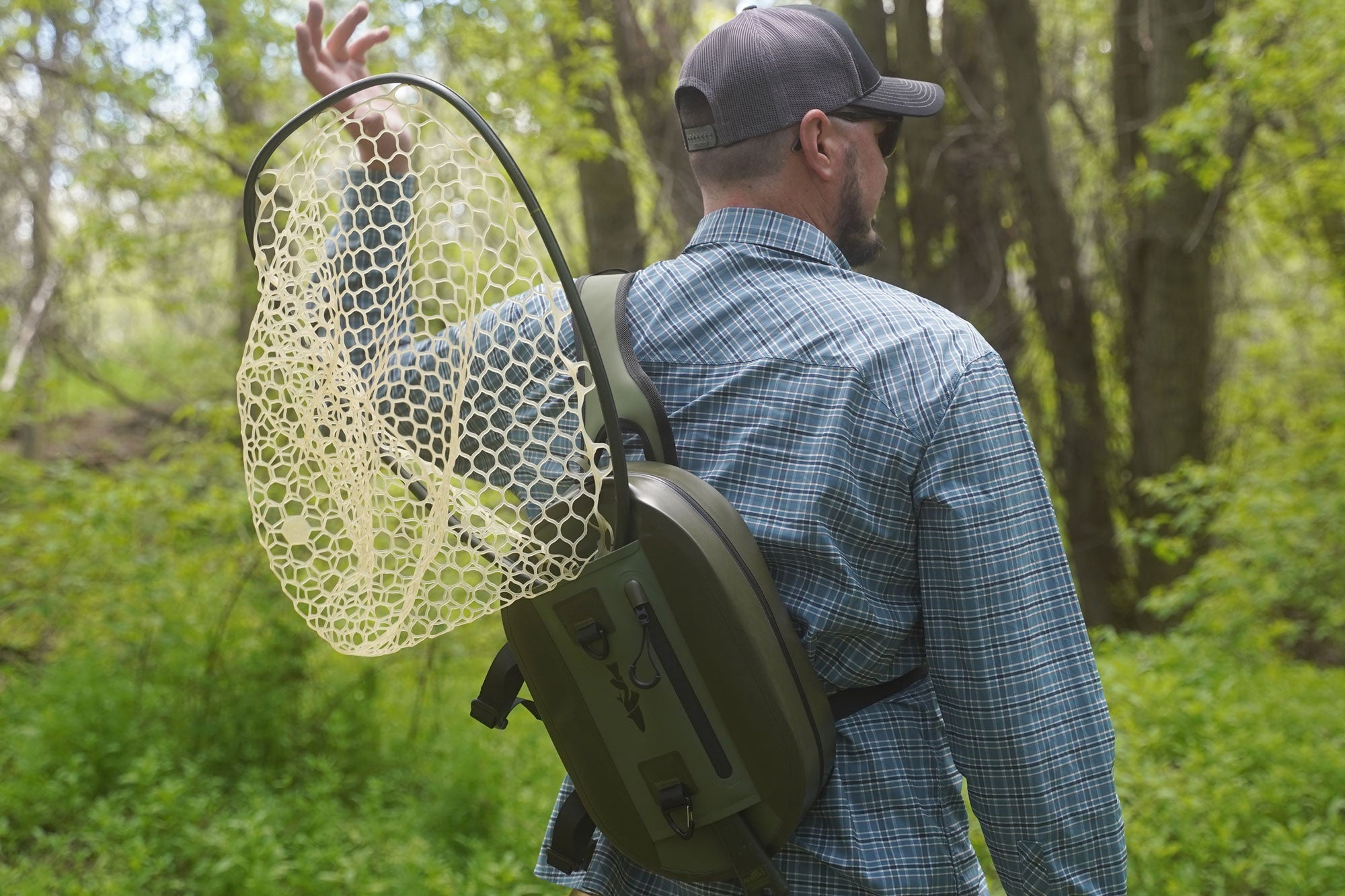
North Kill Tackle uses rubber net bags with holes ranging from about 1/2 inch up to 5/8 inch, deliberately smaller than many bags on the market. With larger holes, a small fish can slide partway through the bottom of the bag and the fly line can pass through it as well, which turns into a tangle to clear. Beyond the inconvenience, working a fish and a line back out of a bag it has slipped through puts extra strain on the fish.
What sizes of landing net does North Kill Tackle build?
Three shapes anchor the line. The Scout is the flagship traditional net, with an 8-inch handle and a 16 by 8.5-inch hoop, weighing 13 ounces and selling for $85 to $95 depending on the wood. The Guide net is the same net with a 19-inch handle, built in hard maple, ash and walnut at $105, and the extra reach suits kayak fishing and netting for a partner. The largest is the boat and steelhead net at 49 inches overall, with a 20 by 17-inch hoop and a 14-inch deep bag, at $125. Woods in rotation include walnut, ash, sycamore and bird's eye maple.
What separates a handmade net from a store-bought one?
Not every finished net leaves the North Kill Tackle shop. Nets that fail inspection get pulled aside and used for destructive testing, including being slammed into the ground repeatedly to find the breaking point. Field testers drive changes too: they reported the big boat net handle got slippery when wet, so a soft grip wrap was added that improves purchase and adds color. The shop will also build a net from wood that means something to the customer, whether that is a grandparent's mantel or a tree that came down in the yard.
What is the hardest part of starting a net-building business?
Finding customers, not building nets. The original plan was to post good photographs on Instagram and be overwhelmed with orders, and that did not happen. What actually sells a net is putting it in someone's hands so they can compare it directly against the net already in their gear bag or the one they saw at a big box store. The other advice for anyone starting out is to find a mentor, ask questions the right way, and accept that the relationship takes time to build before anyone opens their bag of tricks.
Key takeaways
- Steam bend net hoops from 1/8-inch hardwood strips about six feet long, three at a time, for roughly 15 minutes at just over 200 degrees.
- Let a steam-bent hoop dry a full day on the mold before starting the glue-up, or the shape will not hold.
- Strips cut from car inner tubes distribute clamping tension around a net mold more evenly than C-clamps, closing glue lines to almost nothing.
- Use a drum sander rather than a planer on a glued net hoop; hand net hoops finish at about 3/4 inch thick.
- Rubber net bags with 1/2 to 5/8-inch holes keep small fish and fly line from slipping through the bottom and reduce handling stress on the fish.
- The North Kill Tackle Scout net runs an 8-inch handle and a 16 by 8.5-inch hoop at 13 ounces, with longer-handled and boat versions above it.