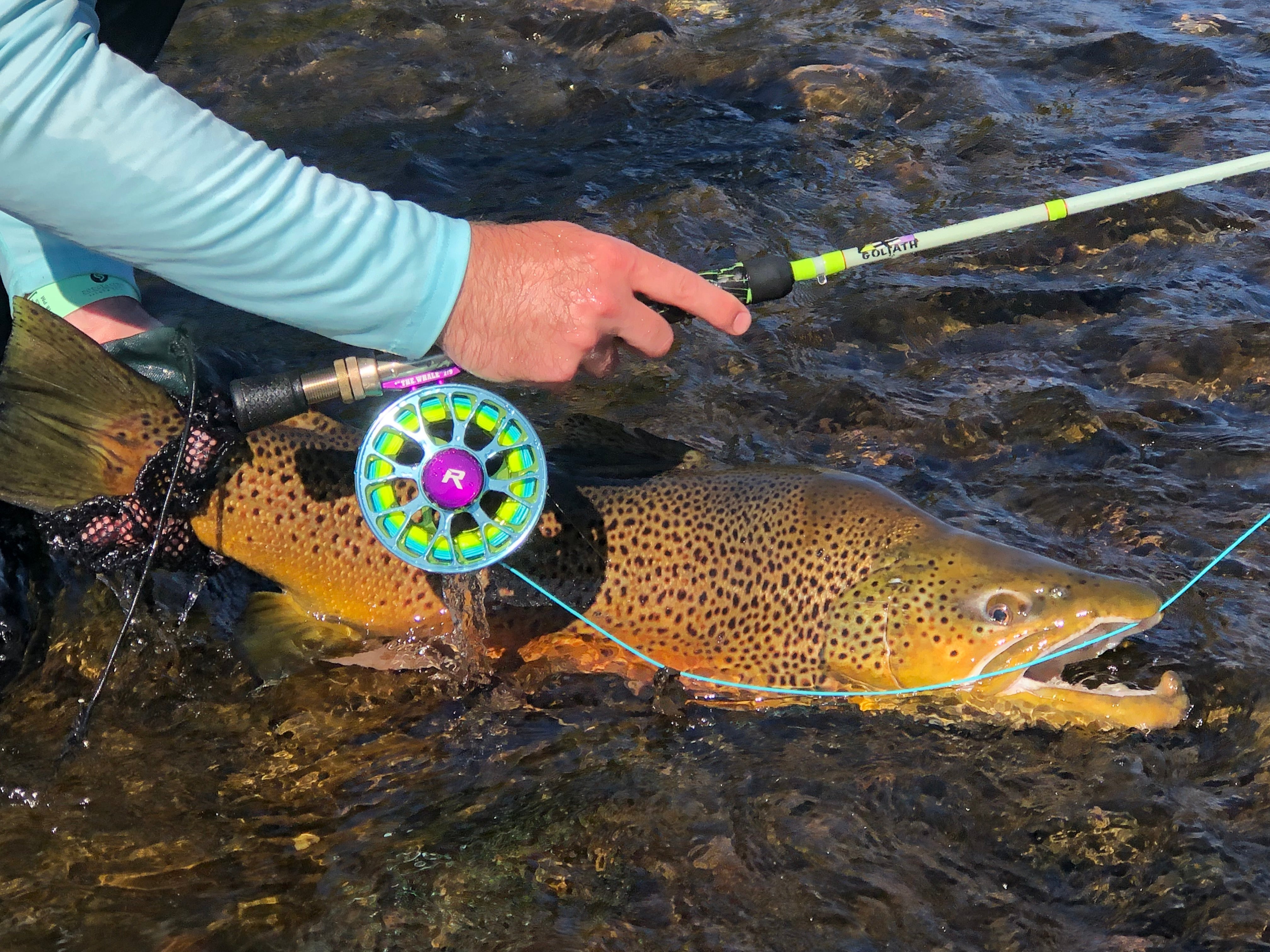

Last October on the middle Provo River, my buddy Todd threw the best drift I'd seen out of him all season. Long reach cast, one soft mend, indicator riding the inside seam like it was on rails. No drag, no wake, nothing. Four trout were sitting in that slot eating something, and not one of them so much as turned. So I told him to ruin it. Right at the end of the float, before the rig swung out, lift the rod tip about a foot and let the flies climb toward the surface. Third cast, a 17-inch brown trout ate on the rise so hard it yanked the slack line right out of his fingers. That's the whole argument about active drift vs dead drift, settled in one cast: the perfect dead drift isn't always the right presentation. Sometimes the fly has to move.
Short answer: A dead drift means the fly travels at the exact speed of the current with no tension on it. An active drift means you deliberately add movement — a lift, a twitch, a swing, a short strip. Dead drift wins when trout are eating food that is helplessly drifting. Active drift wins when trout are eating food that swims: emergers, caddis pupae, baitfish, leeches and crayfish.
Key takeaways
- A dead drift imitates a helpless bug in the current; an active drift imitates a bug or baitfish that is escaping, rising or swimming.
- Trout eating emergers during a mayfly or caddis hatch are keyed on vertical movement, which is exactly what a dead-drifted nymph never gives them.
- The Leisenring lift, the induced take twitch, the end-of-drift swing and the dry-dropper lift-and-lower are the four ways I animate a fly on a trout river.
- Movement is a tie-breaker, not a starting point. Fish the dead drift first, then add motion at the end of the same cast so you test both on one pass.
- Refusals, short strikes and flashes under the fly are your clearest evidence that trout want a different presentation, not a different pattern.
The Refusal That Made Me Stop Trusting the Perfect Drift
I spent my first five or six serious years of nymphing chasing one thing: a drag-free drift. Kill the drag. Move the fly at the speed of the bubbles. Anything else is unnatural. That advice built me into a competent angler, and I still teach it first to every client I take out on Utah water, because a fly dragging sideways across a feeding lane is the fastest way to empty a run.
But somewhere around year six I started keeping honest notes, and the notes didn't agree with the dogma. Some of my best fish came on drifts I'd technically botched — the swing at the end of a cast I'd given up on, the accidental twitch when I stumbled on a slick rock. Then Jay pointed out something I couldn't unsee. We were on the Weber River in June, mountain whitefish and rainbow trout stacked in a long riffle, and he'd caught six fish to my one on a soft hackle he wasn't dead-drifting at all. He was leading it, letting it swing up into the shallow tailout, and eating fish on the rise every time.
"You're presenting a dead bug," he said. "They're eating live ones."
That's the misconception I want to take apart. Fly anglers treat the dead drift as a moral standard instead of one tool among several. The real question isn't "did I get a perfect drift?" It's "did I show the trout the behavior of the thing they're actually eating?" During a hatch, those are very often different answers.
What Is a Dead Drift, and What Is an Active Drift?
A dead drift is a presentation where the fly moves at the same speed and in the same direction as the water carrying it, with no tension from the leader or fly line pulling it off that path. On the surface, a dead-drifted dry fly rides the current seam with no wake behind it. Subsurface, a dead-drifted nymph tumbles along at the speed of the water layer it's riding in — and that's an important detail, because the water near the streambed moves noticeably slower than the water at the top of the column. A nymph "dead drifting" three feet down should be traveling slower than your indicator, not the same speed.
An active drift is any presentation where you deliberately put the fly on a path or a speed the current alone wouldn't give it: a two-inch twitch, a slow rod-tip lift at the end of the float, a full swing across the current, a short strip-and-pause. "Active" doesn't mean violent. Most of the movement I add on a trout river is smaller than anglers expect — an inch or two, delivered at the right instant.
Active drift and dead drift aren't opposites so much as two ends of a dial, and every cast you make sits somewhere on it whether you meant it to or not. Getting good at nymph presentation mostly means choosing that setting instead of letting the current choose for you. Our breakdown of nymph depth and presentation is the companion piece to this one.
When Does an Active Drift Beat a Dead Drift?
An active drift beats a dead drift any time trout are feeding on organisms that move under their own power. That's the whole rule, and it's more useful than any list of conditions, because it sends you looking at the bugs instead of the weather. Here's how that plays out on real water.
During an emergence, movement is the trigger
This is the big one, and it's grounded in insect biology rather than angling folklore. Most of the mayflies (order Ephemeroptera) a trout eats in a Western river spend their nymphal lives clinging to rock and gravel, then leave the streambed and travel up through the water column to hatch at the surface. Penn State Extension's overview of stoneflies and mayflies as indicator insects lays out the contrast nicely: stoneflies typically crawl out onto streamside rocks to molt into adults, while mayflies emerge from the open water, often in synchronized waves when day length and temperature line up.
Read that again with a fly rod in your hand. During a mayfly hatch, the most common thing a trout sees is a nymph climbing. Not tumbling. Climbing. A dead-drifted Pheasant Tail, no matter how flawless the float, is imitating the one thing in the drift that isn't behaving like the food the trout has locked onto. That's why you'll get hatch days where fish are flashing and bulging six inches under the film and you can't buy a take on a perfectly presented nymph — then you lift the rod at the end of the drift and it's instant.
Caddis (order Trichoptera) make the case harder still. Caddis pupae don't just drift upward, they swim, sometimes fast enough that trout come clear out of the water on the take. Our write-up on emerger fishing for selective trout goes further into reading those rise forms.
When the food itself is a swimmer
Leeches, scuds, sculpin and crayfish don't drift. They move, and trout know exactly how each one moves. A leech pattern dead-drifted through a deep bend looks like debris; the same fly given a slow, rhythmic pulse looks like dinner. I keep a size 10 black leech in my nymph box specifically so I have something to animate when the dead drift has gone cold.
When you've already had a refusal
If a trout has come up, looked, and gone back down, the dead drift already failed its audition. Repeating it usually just teaches the fish faster. Change something, and movement is the cheapest change you can make — it costs you nothing but a rod-tip lift, where a fly change costs three minutes and a knot.
The Four Ways I Animate a Fly on a Trout River
Here's how I actually do it. These four moves cover 95 percent of my active-drift fishing, and they're listed roughly in order of how subtle they are.
1. The Leisenring lift
The Leisenring lift is the classic, named for the Pennsylvania wet-fly angler Jim Leisenring, and it's the move I taught Todd on the Provo that evening. You cast far enough upstream that your fly sinks to the trout's level before it reaches the fish, you track the drift with the rod tip, and then — just as the fly arrives at the fish — you stop the rod and let the line come tight so the fly climbs toward the surface right in the trout's window. The take usually happens on the way up and it is rarely subtle.
Two details make or break it. The lift has to happen at the fish, not ten feet short, so you need a decent idea where the trout is holding. And resist the urge to rip the rod up — you're not setting the hook, you're letting the current do the lifting while you stop feeding line. A deliberate stop looks like an insect swimming; a fast jerk looks like something yanked on a string, which is exactly what it is.
2. The induced take twitch
Smaller and sneakier than the lift. Mid-drift, with the fly deep and the line under light tension, you give the rod tip a one- or two-inch bump and then immediately give it back. The fly darts forward maybe an inch and then resumes drifting. Trout that were studying the fly — and on clear tailwaters there are a lot more of those than you'd guess — often react before they think about it.
The induced take shines on spring creeks and tailwaters, where fish get a long, well-lit look at your bug. I use it most with slim, sparse patterns: size 18 to 20 Pheasant Tails, RS2-style emergers, small soft hackles.
3. The end-of-drift swing
Instead of picking up when the drift goes past you, let it keep going. Point the rod at the fly, let the line come tight, and allow the flies to swing up and across into the shallow water on the inside of the seam. Then hold them there in the hang for a solid three-count before you pick up. Trout follow a swinging fly far more often than most people realize, and a lot of them eat at the very end when the fly stops rising and just hovers.
This is the highest-value habit I've added to my nymphing in a decade, and it costs nothing — you were going to pick up anyway.
4. The dry-dropper lift-and-lower
My favorite version of the active drift, because you get two presentations from one cast. You're fishing a buoyant dry with a nymph hung 18 to 30 inches below. Partway down the float, before drag wakes the dry, you lift the rod tip and draw the rig back toward you a foot or two — the dropper swings up like an emerger leaving the bottom. Then you lower the tip, feed the slack out, and the rig settles into a second drag-free drift on the same cast. Induced take on the lift, clean dead drift on the reset, no false casting over a fish you haven't caught yet. We break the rig down in our piece on the dry-dropper nymphing trick for technical water.
Reset the dry-dropper mid-drift and you get the induced take for free. This one comes from my own solo tips-and-tricks segment on the Fly Fishing Insider Podcast, and it's the cleanest example of active drifting I know. Before drag sets in, lift the rod tip so the rig draws back toward you — the dropper climbs like an emerger and frequently gets eaten on that rise — then lower the tip, feed the slack, and take a second clean drift on the same cast. You double your presentations per cast and you never have to false cast over a fish that hasn't eaten yet. I walked through the whole move in this tips-and-tricks episode.
Dry Fly Tactics for Selective Trout (free eBook)
The presentation playbook for trout that have already refused you once — including how to read a refusal before you change flies. Grab it free, plus gear deals and tactics from the FFIP crew.
Get the free eBook →Active Drift vs Dead Drift: A Side-by-Side Comparison
When I'm deciding which way to fish a run, these are the factors I'm weighing. Use the table as a decision grid rather than a scorecard — most good days on the water use both columns.
| Factor | Dead drift | Active drift |
|---|---|---|
| What it imitates | Dislodged nymphs, spent adults, drifting eggs, helpless food in the current | Emerging mayflies and caddis pupae, swimming leeches, fleeing baitfish and crayfish |
| Best water | Riffles, seams, deep buckets, any lane with steady conveyor-belt food | Tailouts, shallow shelves at the back of a run, soft edges of fast water, flat spring-creek glides |
| Best timing | Before and after a hatch; high or off-color flows; winter midge fishing | The middle of an emergence; last light; after a refusal; cold-water slumps |
| Strike detection | Indicator hesitation, sighter tick, line stall — easy to miss | Usually felt in the hand; the fly is already under tension |
| Hookup rate per take | Lower — slack in the system costs you fish | Higher — tight line means the hook finds purchase |
| Biggest failure mode | Micro-drag you can't see, and a fly riding above the fish | Moving too much, too fast; spooking fish in shallow, clear water |
| Fly styles that fit | Perdigons, tungsten jigs, small beadheads, slim mayfly nymphs | Soft hackles, wets, emergers with trailing shucks, leeches, small streamers |
How Do You Know If Trout Want Movement?
Trout tell you they want movement through four specific signals, and once you start cataloging them you stop guessing. Here's my checklist, roughly in order of how reliable I find each one.
Signal one: the refusal. A trout rises to your fly, follows it, and declines. Nine times out of ten that's a behavior problem, not a fly-selection problem — the fish committed on silhouette, then something about how your bug was moving broke the illusion.
Signal two: flashes with no takes. If trout are turning and flashing near the bottom of the run you're drifting and your indicator never moves, they're eating something you aren't showing them. During a hatch that's almost always emergers on the climb.
Signal three: aggressive, splashy rise forms. Sipping rises say spent bugs in the film, dead drift them. Slashing, showy rises say the food is escaping and the trout is in a hurry. Caddis emergences produce the second kind constantly.
Signal four: takes at the end of your drift. If two or three trout in a row eat as your rig swings out below you, that isn't luck. That's the fish telling you a rising fly is what they want, and you should start delivering it on purpose earlier in the drift.
Advanced Tactics: Depth, Speed and Tension Are One System
The mistake I see most often once anglers buy into active drifting is treating movement as an independent variable. It isn't. Depth, speed and tension are welded together, and changing one changes the others whether you meant it to or not.
Every lift costs you depth. Lift a size 16 tungsten jig that's riding four feet down and it's now three feet down, then two, and it never returns to the bottom on that cast. So the lift has to be timed for when the fly is already at the fish. In practice I add a touch more weight than a pure dead drift needs — one bead size heavier, or a single BB shot 10 inches above the top fly — so I can afford to give depth back at the end.
Line angle controls how the fly moves. A cast made 45 degrees upstream and tracked with a high rod tip gives you a long dead drift and a gentle, vertical lift at the end. A cast made straight across gives you a short drift and a hard, horizontal swing. If your fly is coming across too fast, change your casting angle rather than your retrieve — angle is the bigger lever.
Tension is what you're really managing. A dead drift is zero tension; a swing is constant tension. Everything interesting happens in between, in the light-contact zone — enough tension to feel a take in your fingers, not so much that the fly is being towed. If you've fished a tight-line setup like the one in our micro-leader nymphing guide, you already have the feel for this.
Here's the analogy that finally made it click for one of my clients. Your drift is a stick shift on a mountain road. Dead drift is coasting in neutral — efficient, and no control if something jumps out at you. A full swing is riding the brakes the whole way down. Light contact is engine braking: connected to the drivetrain, feeling every grade change, able to respond instantly. That middle gear is where the good fishing lives.
Water types where I lead with movement
Certain water is so consistently better on an active drift that I skip the dead-drift audition. The shallow tailout at the back of a pool, where water speeds up over cobble before dumping into the next riffle, is the best swing water on any trout river I've fished — the Provo, the Green below Flaming Gorge, the Madison in Montana. So is the soft cushion at the head of a run, and any shelf where the bottom drops from two feet to five.
Conversely, I almost never lead with movement in deep, slow bend pools where big brown trout hold on the bottom. Those fish are there for maximum food and minimum effort, and they want a dead drift on their nose. Utah's Division of Wildlife Resources posts current fishing conditions and regulations for the waters I guide, and checking flow and season before you go tells you which of those two scenarios you're walking into.
Gear That Actually Helps You Animate a Fly
You don't need special equipment to animate a drift — you already own a rod tip. But a few choices make the active drift easier to pull off, and fly selection matters more than hardware.
Start with flies that look alive when they move. Soft hackles are the whole category in one word: partridge or hen fibers pulse the instant there's water pushing past them, and look like debris sitting still. That's why they're a mediocre dead-drift fly and a phenomenal active-drift fly. Our fly patterns collection runs deep on these, and I'd start with a Soft Hackle Pheasant Tail in sizes 14 through 18.
Second, carry real emerger profiles, not just standard nymphs. A Pheasant Tail Emerger-Beadhead has a shorter, buggier silhouette that sells the climbing-insect story better than a slim competition nymph. The tandem rigs in our fly pattern assortments are built around this dry-and-dropper approach.
Third, think about tippet. Fluorocarbon sinks and stretches less than nylon, so the fly answers a rod-tip lift immediately instead of a beat later. For induced takes on 5X and 6X I want that directness — browse the leaders collection to rebuild the front end of your rig.


Frequently Asked Questions
What is the difference between an active drift and a dead drift in fly fishing?
A dead drift moves the fly at the speed of the current with no tension on the leader, imitating helpless food. An active drift deliberately adds motion — a lift, twitch, swing or strip — to imitate food that swims. Dead drift is the default for nymphs and dry flies; active drift is the answer when trout are eating emergers, caddis pupae or baitfish.
What is a Leisenring lift and when should I use it?
The Leisenring lift is a wet-fly presentation where you stop feeding line at the end of a drift so the fly rises toward the surface right in front of a trout. Use the Leisenring lift during a mayfly or caddis emergence, in tailouts and shallow shelves, and any time a trout has already refused a dead-drifted nymph. The key is timing the lift so it happens at the fish rather than short of it.
Does moving the fly spook trout?
Moving the fly can spook trout in shallow, clear, low-flow water if the movement is large or fast. The problem is almost never that you moved the fly — it's that you moved it six inches when two would have done. Start with a one- to two-inch twitch, and save bigger movements for broken water, stained flows and low light.
Can you dead drift and active drift on the same cast?
Yes, and that's how I fish most runs. Take a clean dead drift through the primary lane, then let the rig swing out and hold it in the hang for a three-count before picking up. On a dry-dropper, lift mid-drift for an induced take, then lower the rod tip and feed slack for a second dead drift on the same cast.
What flies work best for an active drift?
Soft hackles and wet flies are the best active-drift patterns because their hackle pulses the moment water moves past it. Emergers with trailing shucks, size 10 leeches, and simple beadhead nymphs in sizes 14 to 18 all animate well. Heavily weighted competition perdigons are built for dead drifting and are the weakest choice when you want movement.
Do I need a different rod for active drifting?
No. A 9-foot 5-weight handles every technique in this article, and a 10-foot 3-weight gives a little more reach for holding a lift steady at distance. Rod length helps with line control, not with the movement itself. Spend on flies and fluorocarbon tippet first.
Is an active drift legal on fly-fishing-only water?
Yes. Lifting, swinging or twitching a fly is standard fly fishing technique and is permitted anywhere conventional fly fishing is. Regulations govern hooks, baits, seasons and harvest, not how you retrieve. Always check your state agency's current rules for the water you're fishing.
Go Ruin a Perfect Drift
The dead drift is still the foundation, and I'd never tell a newer angler to skip it. But treating it as the only acceptable presentation costs you fish every season, especially during the hatches when the river is most alive. Next time you get a refusal, don't reach for the fly box. Reach for the rod tip. Lift, twitch, swing, hang — give the trout the one thing a flawless drift can't, which is a fly trying to get away.
Keep experimenting, keep taking notes, and keep asking what the fish are actually eating. It's how you end up catching any fish, any time, and anywhere.
Join the FFIP Insiders
Get gear deals, trip intel, and tactics to help you catch any fish, any time, and anywhere — starting with our free eBook, Dry Fly Tactics for Selective Trout.
Get the free eBook →Tell me how the hang treats you — tag @flyfishinginsiderpodcast with your next fish that ate on the rise, and if you want deals on equipment, trips and a lot more tactics like this, join the FFIP Insiders email list.
Tight lines, everyone!