
A first backpacking fly fishing kit is smaller than you think: a 4-piece 9-foot 5-weight, a floating line, a 10-foot leader, 5X tippet, one box of terrestrials, a small net and a way to carry water. The heavier half of the job is camp craft and bear-country food storage, and that is the part worth getting right before you ever tie on a fly.
"So what do I actually need?" Luke asked, standing in my driveway with a pack that already looked heavier than mine. "I've backpacked plenty. I've just never fished. Ever."
"You need less than you think," I said. "You'll carry more than you need anyway. Everybody does the first time."
He had come to me with a version of a question I get constantly: someone who is completely comfortable in the backcountry, totally at home with a stove and a map and twelve miles of trail, and completely lost the second the conversation turns to fly rods. That is a nice problem to have. The hard skill is already in the bag.
The drive up
The drive into the Uinta Mountains does the thing that mountain drives do, where the aspens close in and the temperature drops four degrees every ten minutes and the conversation gets slower and better. We had the rods in the back, two packs, and a cooler that would not be coming with us past the trailhead.
Truck organization is not glamorous and it is the difference between leaving at four and leaving at four forty. Everything that has to stay in the vehicle — the cooler, the town clothes, the extra fuel canister — gets a home before you drive, because the trailhead is the worst possible place to figure out your system. I run a Seatback Organizer ($44.99) for the small stuff that always ends up loose: headlamp, keys, permits, the paper map I still carry because a phone is a battery with opinions.
Luke asked, somewhere around the last cattle guard, whether the fish up here were stocked. They are, and the how of it is worth knowing: the Utah Division of Wildlife Resources stocks remote high-country waters by aircraft, which is why lakes with no road and no trail-side parking lot hold brook trout, cutthroat, tiger trout, and in a few places arctic grayling. Somebody flew those fish in. It reframes a high lake entirely — it is not wild in the untouched sense, it is wild in the managed, deliberate, someone-decided-this sense.
What I actually put in his hands
At the trailhead I handed Luke a 9-foot 5-weight, 4-piece, with a floating line, a leader a little past ten feet and 5X tippet. Nothing exotic. That setup is the high-lake standard for a reason, and it is exactly what Colorado guide Tanner Barbeau described on the Fly Fishing Insider Podcast when he broke down his own alpine kit — a 9-foot 5-weight with floating line, a leader of at least ten feet so the fish never see the fly line, and 5X unless they get fussy.
The fly box was almost embarrassing. Beetles, ants, hoppers. Tanner's point about high lakes is that the bug life is thin, so trout cruise the banks eating whatever blows in — which means terrestrials do most of the work, and sight fishing beats blind casting all day long. You are not matching a hatch. You are watching for a fish and putting something buggy in front of it.
"That's it?" Luke said.
"That's most of it. The rest is walking."
The walk, and the part where I got outfished
It is five and a half miles to the lake I like, and the last mile is the one that costs you. We got there mid-afternoon with the wind up, which is the standard alpine deal: the water was riffled, the light was bad, and nothing was showing.
We split the shoreline. I worked the inlet because that is what I always do, and I caught two small brookies with the enthusiasm of fish that had not seen a hook in a while. Nothing worth bragging about.
Luke — who, again, had never held a fly rod — walked the far bank slowly, spotted a fish cruising six feet out, and did the one thing beginners almost never do: he waited. He let it come to him, dropped a beetle two feet ahead of its nose, and did not move the rod when it turned. The fish ate. He landed a cutthroat noticeably better than anything I touched that day, and then he looked up with the specific expression of a man realizing he has been missing something for thirty-five years.
This is the part of teaching someone to fish that nobody warns you about: the backpacker's patience is worth more than the fly fisher's technique. He was already good at sitting still and looking at things. That is the whole game on an alpine lake.
The miles are the tactic. Aquatic ecology researcher Donny Brenkendor told us on the podcast that the best fishing he found was not on the famous water — it was small lakes and drainages roughly five miles off a road, where the trout had seen so little pressure they were simply easier to catch. That is the entire argument for carrying a rod on a backpacking trip: you are trading technical difficulty for distance, and distance is the one thing a backpacker already has.
Colorado guide Tanner Barbeau on high alpine lakes — the rod, the leader, the terrestrials, and what he carries when a lake is fifteen miles one way.
Camp, and the conversation about bears
We made camp a few hundred feet from the water, cooked early, and had the talk. Luke's version of bear awareness was a shrug and a bear hang he had watched someone else rig once. That is roughly where most people are, including plenty of anglers who have camped for years.
Here is what changes when you add fishing to backpacking: you are now carrying and handling something that smells like food to a bear, and you are spending your day beside running water, which is exactly where surprise encounters happen. Glacier National Park says it plainly — be particularly careful near streams, against the wind, or in dense vegetation, because those are the conditions where a bear cannot see, hear, or smell you coming.
The rules I actually follow
- Make real noise, and skip the bells. Glacier's guidance is blunt: "Bear bells are not adequate or effective." Calling out and clapping at intervals works. So does a normal conversation, which is the easiest reason to hike with somebody.
- Hike in a group when you can. Glacier notes there have been no reported attacks in the park on groups of four or more.
- Give them room. Inside Glacier and Yellowstone it is illegal to approach within 100 yards (91 m) of a bear, and 25 yards of other wildlife. That is the floor, not a target.
- Carry bear spray where you can reach it. Grand Teton's instruction is to carry it somewhere immediately available, not buried in your pack, and to use it only on a charging or aggressive bear — wait until the bear is roughly 30 feet out, then hold the trigger one to two seconds. Never spray your tent or gear; a pre-sprayed object can attract bears instead.
- Store everything that smells. Food, cookware, trash, sunscreen, toothpaste. Utah's Division of Wildlife Resources says to secure it in a vehicle, a bear-safe container, or hung in a tree — never in your tent. Some backcountry areas require an approved bear-resistant canister, so check the rules for the specific place before you drive.
- Deal with fish waste deliberately. Yellowstone's fishing regulations tell anglers not to discard fish carcasses or entrails along stream banks or the lake shore because they attract bears; dispose of them in the water they came from, and not within 100 feet (30.5 m) of boat ramps, docks or backcountry campsites. Even where you are not in a park, that is the standard to hold yourself to.
- Know which bear you are dealing with, because the response differs. The National Park Service says to identify yourself by talking calmly, never run, and never climb. If a brown or grizzly makes contact in a defensive attack, play dead — flat on your stomach, hands clasped behind your neck, pack on. If it is a black bear, do not play dead; fight back, concentrating on the face and muzzle. And if any bear attacks your tent at night or stalks you, fight back regardless of species, because that is predatory behavior.
One honest wrinkle worth naming: the agencies do not word the encounter advice identically. NPS tells you to move away slowly, sideways, while a bear watches you. Utah's DWR, dealing with a state that has only black bears, tells you to stand your ground and never back up or play dead. They are answering slightly different questions in slightly different country. Read the guidance for the land you are actually standing on — park, forest, or state — and follow that one.
Five minutes that make the trip safer
- Tell one person where you are going and when you will be back. Tanner Barbeau does this before every solo hike into a lake he will not name — somebody always knows the drainage.
- Pack a satellite messenger if you have one. There is no cell service where the good lakes are.
- Check the fishing regulations for that specific water. In Utah, anyone 12 and older needs a license, and limits vary by lake.
- Throw in a spare leader and extra tippet. A broken leader ends a fishing trip five miles from the truck; a spare weighs nothing.
- Put the bear spray on your hip belt, not in the pack.
The beginner's backpacking fly fishing kit
This is the whole list. If you already backpack, you own most of the second half.
| Category | What to carry | Why |
|---|---|---|
| Rod | 9-foot 5-weight, 4-piece | Packs to about two feet, handles wind on an open lake, still delicate enough for a beetle on 5X. |
| Line & leader | Floating line, 10-foot leader, 5X tippet | The extra leader length keeps the fly line away from fish in water that is often gin clear. |
| Flies | One small box: beetles, ants, hoppers, a couple of small nymphs | High lakes are terrestrial fisheries. Fish cruise and eat what blows in. |
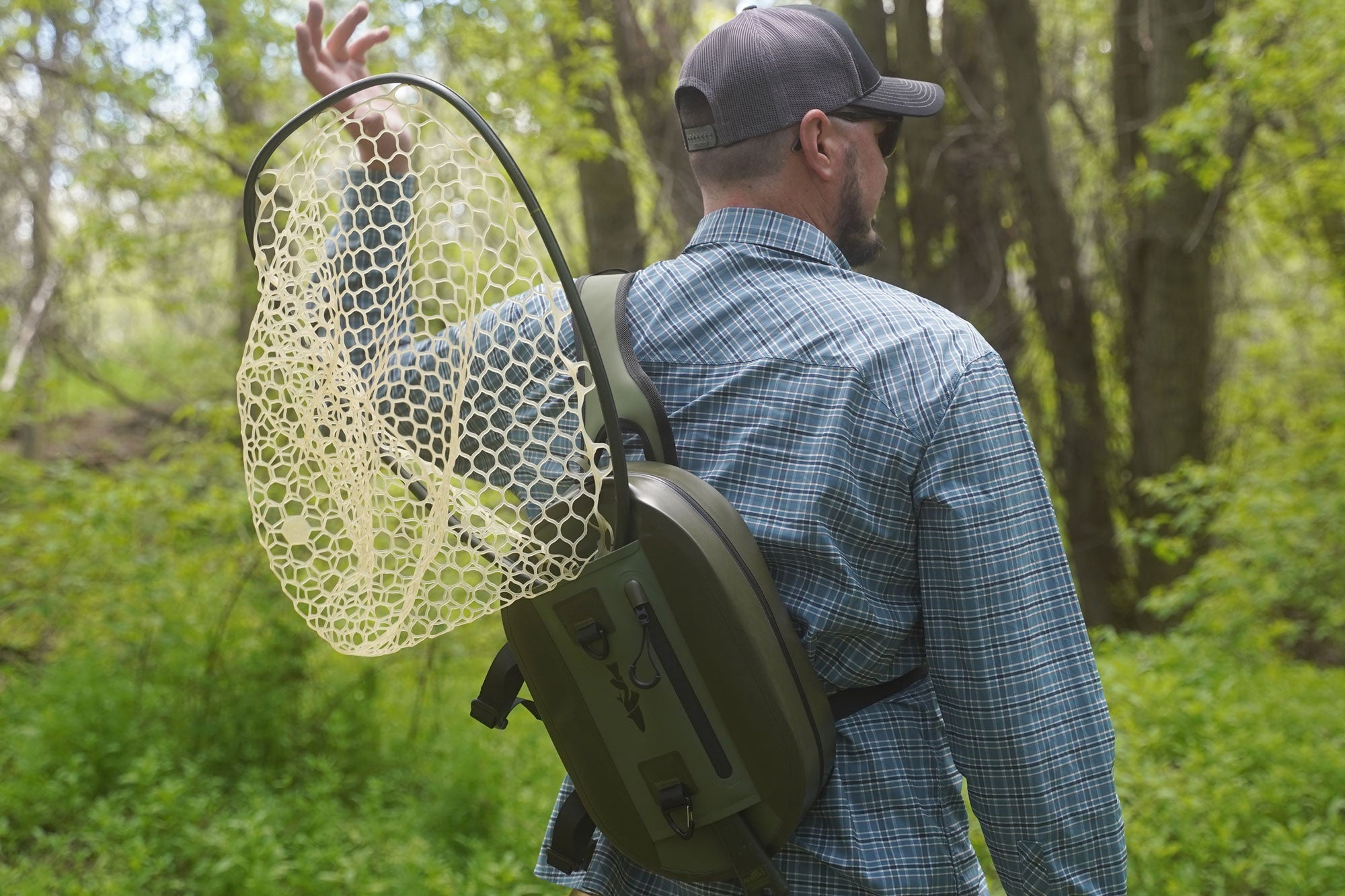
| Net | A small rubber-bag net | Faster releases, fewer fish on dry rocks, and it clips to a pack. |
| Shelter & sleep | 1-person tent, bag, pad | Weight is the whole game. A freestanding one-person tent pitches on rock shelves where stakes will not go. |
| Pack | ~60L with a real hip belt | Rod tube plus fishing kit plus overnight gear fills 50L fast. |
| Safety | First aid kit, water treatment, headlamp, lighter, whistle, bear spray | Non-negotiable. The whistle costs nothing and carries further than your voice. |
Gear that earned its place


More options live in the Backcountry Fly Fishing Gear for Hiking and Camping collection, and the vehicle side of the trip is in Off Road, Overlanding and Car Camping.
Trip notes
- Season. High-country lakes fish from ice-off into fall. Utah's own wildlife biologists point at autumn as a sweet spot for high-elevation lakes, right before the snow closes the door.
- Weather. Alpine storms build fast and the forecast is frequently wrong. Carry a layer you would be happy to spend a cold hour in, and get off high ground when it starts to build.
- Water. Treat everything. A filter or a UV treatment is a few ounces and the alternative ruins more than a trip.
- Licenses and rules. A Utah fishing license is required from age 12, and lake-by-lake limits vary — check the current Utah Fishing Guidebook before you go. Other states and every national park have their own rules, including where you may camp relative to water.
- Leave No Trace. Pack out everything, including line. Monofilament outlives all of us.
If you want the longer reference version of all of this — resupply, multi-day base camps, gear failure in the field, fishing technique in alpine water — we keep it in the Backpacking Fly Fishing FAQ. This piece is the trip; that one is the manual.
What Luke said on the way out
We hiked out early, before the light hit the water, which felt like a waste until it did not. About two miles down, Luke stopped, looked back at the drainage, and said he had walked past roughly four hundred lakes in his life without ever once wondering what was in them.
That is the thing a fly rod does to a backpacker. It does not make the country better. It makes you look harder at the country you were already walking through. Five and a half miles is not far. It is just far enough that most people stop, and the fish know it.
Book the season you actually want
The best weeks go first, and the difference between a good trip and a great one is usually timing. Tell us the season you want and we'll find the water that fishes then.
Book a TripFly Fishing Insider Podcast has a referral partnership with Frontiers International Travel. If you book after being introduced through us, we may receive compensation at no additional cost to you.
Join the FFIP Insiders
Backcountry gear, trip intel and tactics from the Fly Fishing Insider Podcast — straight to your inbox.
Join freeKeep reading
- Backpacking Fly Fishing FAQ
- Tailwater, Spring Creek and Small Stream Tips for Technical Water
- Stillwater and Lake Fly Fishing Tips That Change Your Odds
- Backcountry Fly Fishing Gear for Hiking and Camping
Tight lines, everyone!

By Christian Bacasa
Host of the Fly Fishing Insider Podcast
Fly Fishing Insider Podcast Official Website
Instagram Fly Fishing Insider Podcast
Watch on YouTube