
Welcome to the exhilarating realm of Bonefish — Albula vulpes — a species that has ensnared the hearts of fly fishing enthusiasts for generations. In this comprehensive guide we will delve into the history, science, and magnetic allure of Bonefish. Whether you are an experienced angler seeking to refine your skills or a curious novice eager to explore the world of fly fishing, this article is your portal to the mystique of the silver ghost.
History of Bonefish
The storied history of Bonefish is a testament to the enduring fascination this species has held for centuries. Early marine biologists were among the first to cast a spotlight on these mysterious creatures, captivated by their elusive nature and unique physical attributes. One of the earliest recorded mentions of Bonefish dates back to the 18th century when explorers first encountered them in the warm waters of the Caribbean. These early encounters sparked curiosity and led to the first scientific descriptions of the species. What is it about them that makes them so attractive to fly anglers? Why do we see the silver ghost as such an amazing target to master? Either way, I hope you enjoy this comprehensive look into the species and find additional reasons why you have found them a worthy adversary.
Evolution of Bonefish
The evolutionary history of Bonefish is a fascinating journey that reveals how this species has adapted and survived over time.
Ancestral origins. Bonefish, like all species, have ancestors from which they evolved. These ancestral fish likely had different physical and behavioural characteristics compared to the modern Albula vulpes, inhabiting different environments with distinct survival strategies.
Morphological transformations. Over time, Bonefish have undergone significant physical changes that made them well-suited to their specific habitat and lifestyle:
- Streamlined body shape — a torpedo-like build that allows them to move efficiently through water, built for speed and agility, which is crucial for evading predators and capturing prey.
- Small, silvery scales — these reflect light and help them blend into their surroundings. This camouflage is particularly useful in the clear, shallow water of the flats, making them less visible to both prey and predators.
- Forked tail — a deeply forked tail aids rapid acceleration and sharp turns, allowing quick escapes and letting them chase down fast-moving prey.
- Large eyes — relatively large in proportion to body size, enhancing visual acuity and making them highly skilled at detecting movement. This acute vision is especially valuable when hunting small prey in sandy flats.
- Specialized snout — built for rooting through the substrate, creating small depressions known as "muds" to access buried crustaceans and invertebrates.
- Slender fins — elongated pectoral and dorsal fins that aid precise, controlled movement and maintain balance and manoeuvrability.
- Coloration — often a silvery or bluish hue on the upper body and sides, with a lighter belly, further aiding camouflage.
Behavioural transformations. Their feeding habits have developed to focus on small crustaceans, molluscs, and other invertebrates found in sandy flats. That specialized snout lets them root through the substrate and create the muds that give them away to observant anglers.
Genetic analyses. Scientists use genetic data to trace relationships between different populations of Bonefish. By comparing genetic markers, researchers can determine how closely related populations are and how they have evolved, which helps us understand the genetic diversity within the species.
Adaptation to environments. Bonefish inhabit a range of environments, from shallow flats to deeper water. Certain populations have developed traits that make them better suited to specific habitats, such as those found in the Bahamas or the Florida Keys.
The science behind Bonefish
Anatomy and physiology
An intimate understanding of Bonefish anatomy is paramount to appreciating the allure they hold. Bonefish have a streamlined, fusiform body making them incredibly hydrodynamic. Their scales are small and silvery, and their muscular system is finely tuned for bursts of speed and endurance. That being said, there is absolutely no wonder why a 12-inch bonefish can put your 8-weight into its backing.
Recent studies have revealed that Bonefish possess a unique muscle structure known as "red muscle" that enables sustained high-speed swimming. These muscles have a rich blood supply, providing oxygen during extended chases. This adaptation makes Bonefish formidable opponents, as they can make repeated long, powerful runs when hooked.
Unique behavioural traits
Their feeding habits are a study of stealth and precision. They primarily feed on small crustaceans, molluscs, and other invertebrates in the sandy flats, using their snouts to root through the substrate and create muds. Commonly we sight fish nose down and tailing, or we see fresh muds as a sign that fish are feeding hidden in the murkiness.
Migration is another remarkable aspect. Bonefish are known for annual migrations, often travelling long distances between spawning and feeding grounds:
- Spawning and feeding grounds. Bonefish typically inhabit shallow coastal areas such as flats, but migrate to deeper or offshore water to spawn, ensuring reproduction doesn't disturb their feeding grounds.
- Timing of migrations. Closely tied to lunar and tidal cycles. They often move to spawning grounds during specific phases of the moon and tides, which synchronizes their migrations and optimizes reproductive success.
- Long-distance travel. Some individuals travel tens or even hundreds of miles to reach spawning grounds. This endurance and navigational ability are vital for their survival.
- Tagging studies. Researchers attach small, non-invasive tags to individual fish, gaining insight into migration routes, distances travelled, and timing.
Research into spawning behaviour has provided insight into their reproductive cycles:
- Spawning sites. Bonefish gather in specific locations known as spawning aggregation sites, often in deeper offshore water with suitable conditions for egg fertilization and larval survival.
- Group spawning. Multiple individuals release eggs and sperm simultaneously, increasing the likelihood of successful fertilization.
- External fertilization. Fertilization occurs outside the body, and the resulting embryos develop as pelagic larvae before settling in shallow coastal areas.
- Environmental factors. Water temperature, salinity, and the availability of suitable spawning sites all influence success. Changes in these conditions impact the timing and success of spawning events.
- Conservation implications. Protecting spawning aggregation sites and minimizing disturbance during critical periods is vital for maintaining healthy populations.
What makes Bonefish a prize catch?
One of the key factors is their remarkable eyesight. Their large eyes are adapted for detecting movement in the clear, shallow water they inhabit. This acute vision makes them highly selective feeders, and they can be notoriously difficult to fool with artificial flies. Anglers often refer to Bonefish as the "ghosts of the flats" due to their elusive and cautious nature. This is especially noticeable when a cruising fish turns and follows your fly, only to decide it isn't what it was looking for. From such a predacious fish you'd think anything remotely close would be devoured.
Techniques and strategies
Mastering Bonefish requires a repertoire of specific techniques, from selecting a fly pattern you're confident presenting to deciphering tides and currents.
Present accurately
- Land your fly where it needs to be on the first cast.
- Understand how the type of fly you're using would naturally present itself in the water. Crabs move differently than shrimp.
- Imitate the local food source accurately by size. Colour and flash may not be as important as size — make sure the size is a true representation.
- Weight can be a big determinant of success. Knowing how your fly will reach the correct depth and move is an easy adjustment when fishing different water types.
Set up for success
- Proper leader size. Like trout fishing, it can be an easy adjustment to drop a few pounds on leader size to encourage more eats.
- Depending on weather conditions you may need a faster action or heavier weight rod to cut into the wind. A saltwater-specific line matters here too — the Moonlit WF Saltwater and the Silvertip Saltwater WF are built with stiffer cores that don't go limp in tropical heat.
Understanding tides and how they influence prey movement can be a game-changer. Bonefish tend to feed more actively during incoming tides when prey is stirred up and carried toward them. This knowledge lets you time your fishing for optimal success, and becomes especially valuable when DIY fishing or wading the flats.
Identification guide
Physical characteristics
Their scales are small and cycloid, which contributes to their silvery appearance and helps them glide effortlessly through the water. As mentioned, Bonefish have a deeply forked tail which aids rapid acceleration and sharp turns. If you've ever seen a school of bonefish turn 90 degrees and fire off into outer space, then you understand the speed and agility their body design enables.
Habitat and distribution
Knowing where Bonefish roam is half the battle — whether the expansive Bahamian flats, the mangrove-lined lagoons of Belize, or the pristine Hawaiian atolls. Seagrass beds and coral reefs are critical, providing both food and shelter, which makes them prime locations for anglers.
Bonefish are found in tropical and subtropical regions around the world, inhabiting areas with warm water temperatures and suitable breeding grounds.
Sight fishing giveaways
Sight fishing for Bonefish combines art and science. Water clarity, light conditions, and the presence of other marine life all influence the ease with which they can be spotted. Here's what to look for:
Muds — areas of water that look muddy or murky. Typically, when there's a fair amount of murky water, the likelihood of bonefish still being present is pretty high. You'll start to understand the level of murkiness required to indicate a new mud with present fish versus an old abandoned one.
Pots — the small pot-like holes bonefish leave behind after feeding. These indentations in the sand leave a discoloured look where the top layer of substrate has been removed, exposing the deeper-coloured layer underneath. Because the substrate creates so much murkiness, it's typical to observe pots long after feeding fish have gone. The key is to observe where they are and look for similar areas to target.
Nervous water — of all the sighting methods this can be the most frustrating at first and the most exhilarating once mastered. Nervous water is best described as the top layer of water at a distance looking wind-affected over a small moving area. Imagine a moving spot where the water has a peculiar topwater shimmer slightly different from the water around it. Combine that with how a group of bonefish move and you have nervous water. It's particularly difficult to see as a new bonefish angler, but once seen three or four times it becomes easily distinguishable.
Pushes — a push is just what it sounds like. Imagine a fish of size moving with enough energy to push a wave of water around it through displacement. The easiest description is a submarine travelling close to the surface but not yet exposed. The most common places to see pushes are in shallow water, where their slender build means they need to be close to the surface to displace that much water.
Ecological impact
Role in marine ecosystems
Bonefish are not only important predators but also serve as prey for larger species, helping to regulate the balance of marine food webs. Research has also explored the connection between Bonefish and seagrass beds, which are vital habitat providing both food and shelter. Seagrass beds also contribute to carbon storage and the mitigation of climate change, so understanding the role of Bonefish gives us a deeper appreciation for their importance in maintaining healthy coastal environments.
Conservation and sustainability
Catch-and-release has become a widely adopted practice among Bonefish anglers, allowing them to enjoy the sport while minimizing impact on populations. Conservation organizations work in partnership with anglers and researchers to promote responsible practices and protect Bonefish habitats.
North America's Bonefish & Tarpon Trust is an excellent resource to learn from, and I'm sure they're happy to accept your donations toward keeping this amazing species healthy for a long time.
Best locations for Bonefish fly fishing
The global hunt leads to some of the most alluring destinations on the planet — the remote flats of the Seychelles, the thriving fishery of the Florida Keys, or the breathtaking beauty of the Bahamas. Here are some of the top bonefish destinations:
- Belize
- Seychelles
- Hawaii
- Cuba
- Honduras
- Mexico
- Florida
Water temperature, habitat quality, and the presence of prey species all contribute to the abundance of Bonefish in specific areas.
Listen to the owners of The Iguana House Belize talk about fishing for bonefish and other species in Belize.
Check out The Iguana House Belize and book with code FFIPodcast for 10% off. Tell them the Fly Fishing Insider Podcast sent you.
Listen to Keith Rose-Innes, known as the father of the Seychelles fly fishing destination, talk about saltwater fly fishing tactics.
Seasonal considerations
Many Bonefish populations exhibit predictable seasonal migrations between spawning and feeding grounds. More than anything, though, weather patterns and consistency matter. This is one reason Belize is regarded as one of the top locations for bonefish — the weather is so consistent and the fish tend to be there in numbers regardless of time of year.
Planning a Bonefish trip
The key to a successful expedition lies in meticulous preparation — selecting the right destination, and arranging transportation, permits, and accommodation around the fishing rather than the other way round.
This is exactly the kind of trip where a specialist earns their keep. International saltwater travel means coordinating flights, transfers, guides, boats, and permits that all depend on each other, and one delayed connection can unravel the lot. The Fly Fishing Insider Podcast works with Frontiers International Travel, who have been booking sporting travel since 1969 and know these destinations and lodges first-hand.
Start planning your bonefish trip with Frontiers — whether that's Belize, the Bahamas, the Seychelles, or somewhere you haven't considered yet. You can also see what a trip with Frontiers looks like, or read the trip planning FAQ.
Fly Fishing Insider Podcast has a referral partnership with Frontiers International Travel. If you book after being introduced through us, we may receive compensation at no additional cost to you.
Let's use Belize as an example. The location is ideal for bonefish due to resident fish being available any time of year. What tends to be more important is the local acute weather. Clear calm days provide clear calm water, and water clarity and wind are by far the most important factors in a successful outing. The good news is that this can change multiple times within a single day. Rather than focusing on time of year, understand that it's the daily conditions that matter — and that you can't control the weather. Focus instead on what you can: time of day, casting better in wind, and finding zones less affected by weather.
Gear for the flats
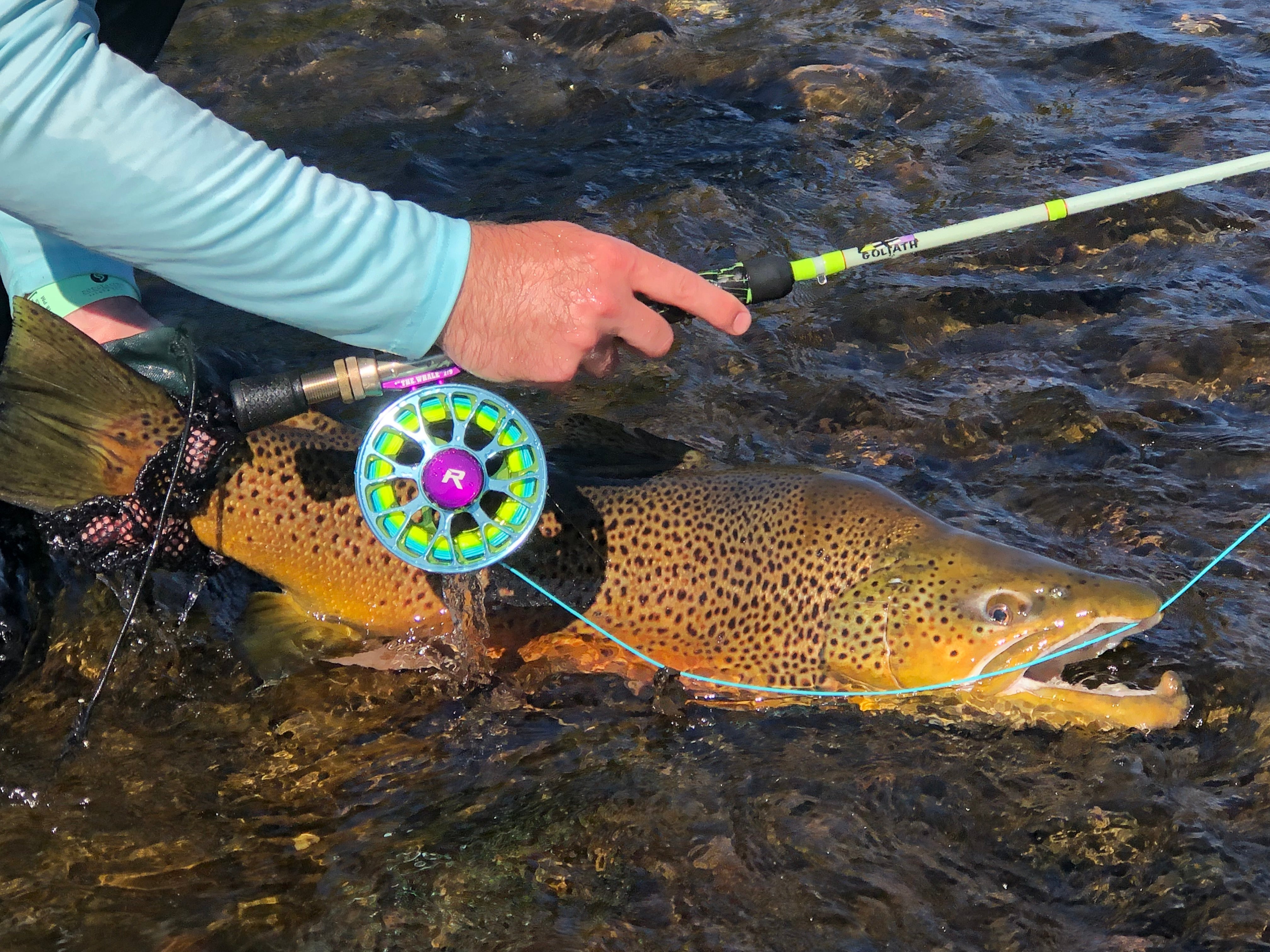
An 8-weight is the standard bonefish rod, with a sealed-drag reel that will survive salt. The Goliath Rod and Reel Combo covers the range, and "THE WHALE" is built for saltwater work. Pack the Postfly First Cast Beginner Saltwater Assortment and the Bonefish Banger Assortment, plus crab patterns from the Dirty Marsh Crab pack.
Sun protection is not optional on the flats — you're on reflective water with no shade all day. A hooded sun shirt like the FORLOH SolAir, a wide-brim straw sun hat, and a neck gaiter. Rinse everything in fresh water at the end of each day.
The world of Bonefish beckons with endless intrigue and challenge. Whether you're a seasoned angler seeking to refine your skills or a newcomer eager to explore the mysteries of the flats, there is always more to discover. May your adventures be filled with excitement, camaraderie, and unforgettable moments on the water.
Read all the details on fly fishing for bonefish and other species in Belize.
Go on a fly fishing trip you'll never forget
The water you keep thinking about is bookable. Tell us where you want to go and we'll help you get there. Don't wait.
Book a Trip
By Christian Bacasa
Host of the Fly Fishing Insider Podcast
ffipodcast.com
@flyfishinginsiderpodcast
@dupeafish
Watch on YouTube