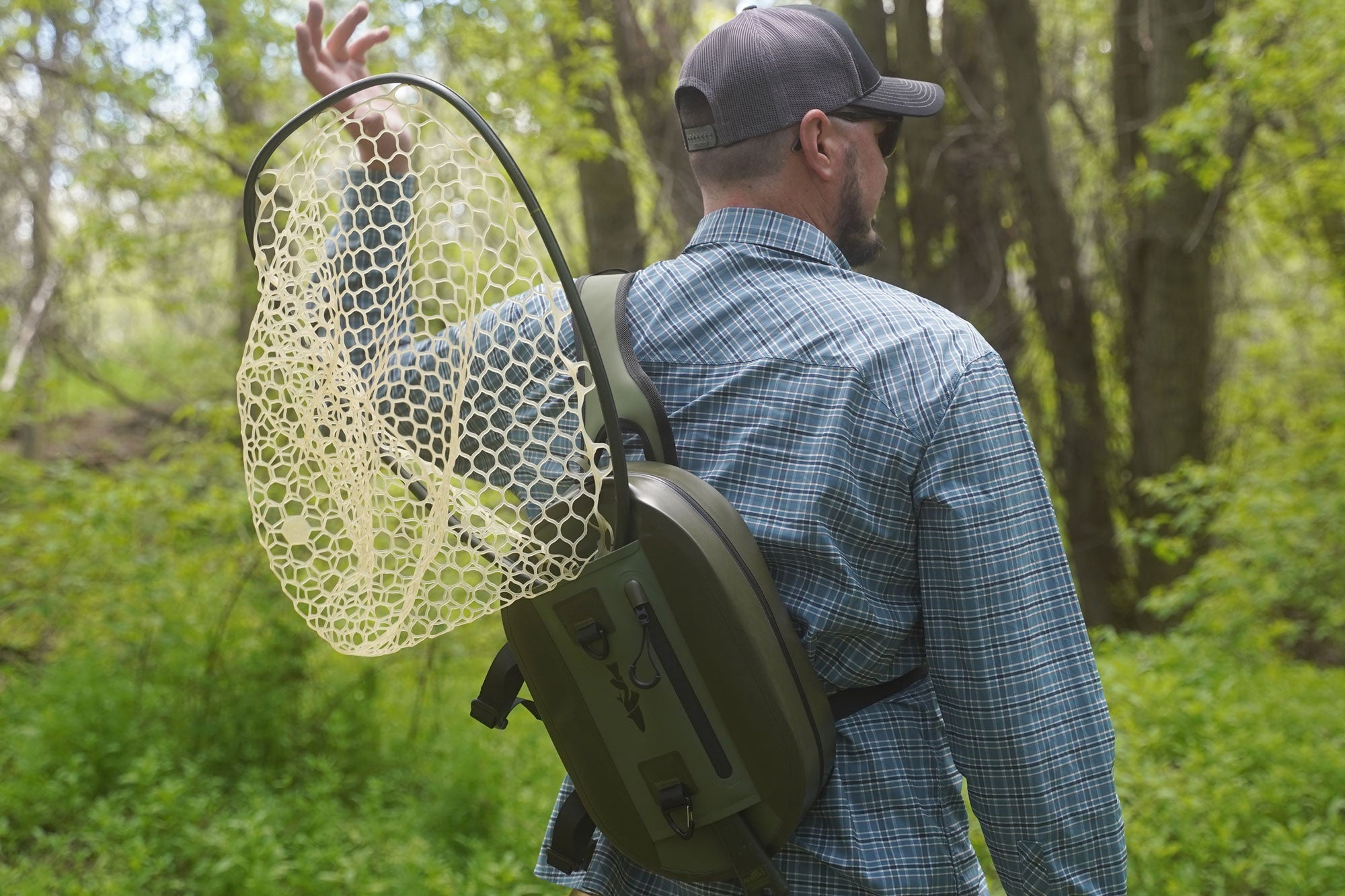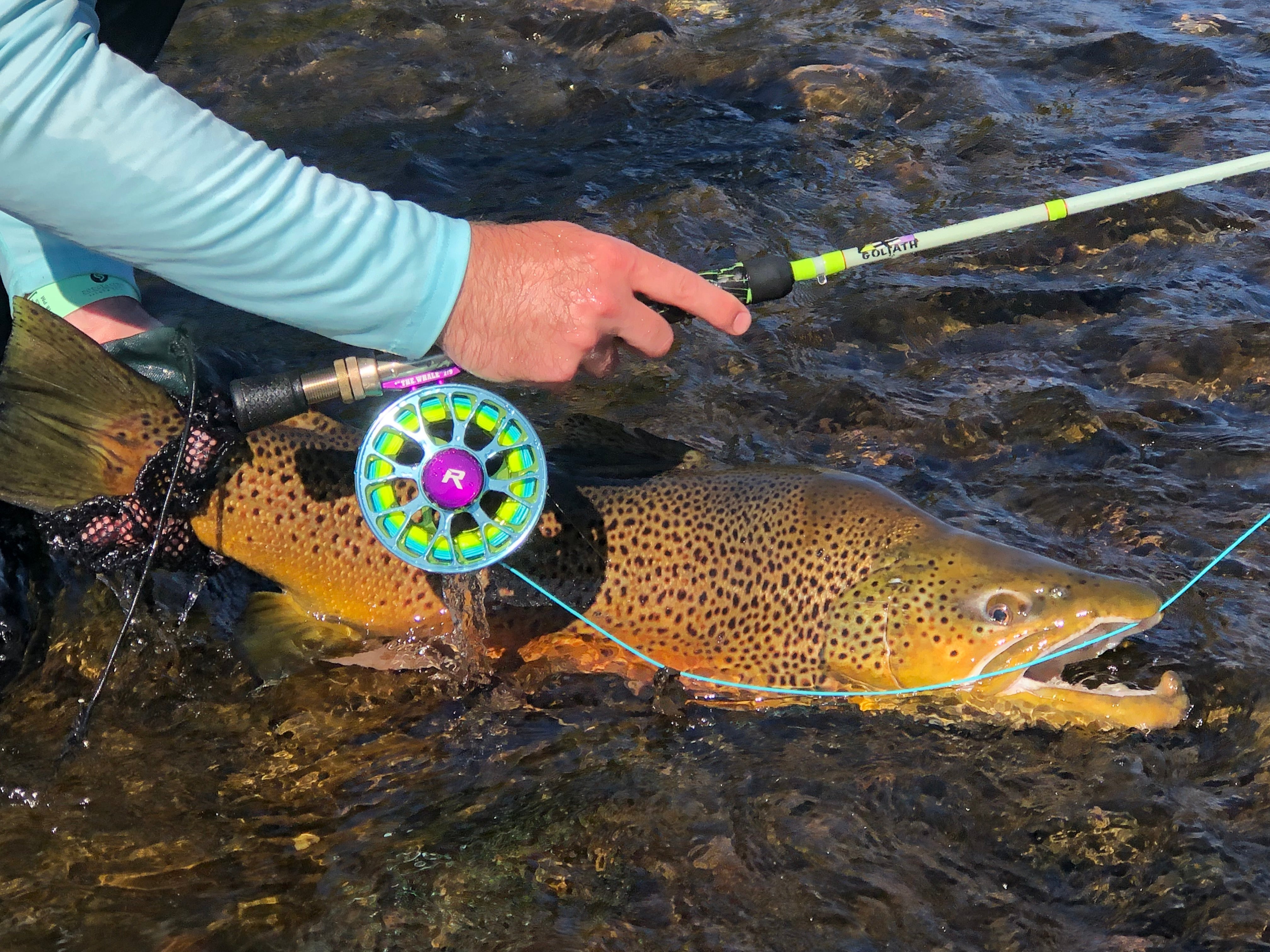

Jay and I split a run on the Weber River last March and made a bet neither of us admitted out loud. He rigged a bobber and split shot. I rigged a ten-foot three-weight and a sighter. By noon we'd each caught fish, we'd each blanked a stretch the other one cleaned out, and the "winner" was decided entirely by which forty-foot chunk of river we happened to be standing in. That's the honest answer to euro nymphing vs indicator nymphing, and it's the one nobody wants to hear, because both camps would rather argue about it than admit the river already decided.
The short answer: Fish euro nymphing when you're inside about 25 feet of your target, in broken or moderate water where you need direct contact and instant strike detection. Fish an indicator when you need to cover water farther out, suspend flies at a set depth through slow or deep runs, or fish in heavy wind. Depth, distance, and current speed decide it — not preference.
Key Takeaways
- Euro nymphing and indicator nymphing solve different problems: one maintains direct contact at short range, the other suspends flies at a fixed depth at longer range.
- The deciding variables are distance to the target, water depth, current speed, and wind — in that order.
- Euro nymphing detects takes faster because there's no slack and no floating buffer between your hand and the fly.
- Indicator nymphing covers more water per drift and holds a consistent depth through long, uniform runs that euro rigs can't reach.
- You can carry both on a single day with one spool change and a couple of feet of leader — you don't have to pick a tribe.
The Argument That Wastes Everybody's Time
Somewhere in the last fifteen years, nymphing turned into an identity. You're either a euro guy with a ten-and-a-half-foot three-weight and a competition sighter, or you're a bobber guy who thinks the euro crowd is overcomplicating a solved problem. Both sides can point at a good day to prove their case.
Here's the thing: they're arguing about tools as if a river were one kind of water. It isn't. A single mile of the Weber River has pocket water you can only fish at rod's length, a long uniform run you have to reach across forty feet of current to cover, a deep slot you need to suspend flies in, and a shallow riffle where the whole game is contact. No single rig is best in all four. Being fluent in both is what actually raises your catch rate.
Think of it like a mechanic's socket set. Nobody argues that 10mm is better than 14mm. You look at the bolt. Rivers hand you the bolt, and your job is to recognize which one you're looking at before you start cranking.
Jay is the cautionary tale here, and he'd tell you so himself. He bought a euro outfit two winters ago, fished nothing else for a full season on principle, and had a genuinely worse year than the one before. Not because the rod was bad — because he spent half his time standing forty feet off a far-bank seam trying to hold contact that physics wouldn't allow. The rig wasn't failing him. His water selection was.
What Is the Real Difference Between Euro Nymphing and Indicator Nymphing?
The real difference is what holds your flies at depth and what tells you a trout ate. Euro nymphing — also called tight line nymphing or contact nymphing — uses heavy flies and a long thin leader with the rod tip held high, so you stay in direct physical contact with the flies and detect takes through the sighter and your hand. Indicator nymphing suspends the flies beneath a buoyant marker set above them, so the indicator holds depth and reports strikes visually.
Everything else follows from that one distinction.
Because a euro rig carries no fly line on the water, nothing drags your flies and nothing absorbs a take. That's why contact anglers feel eats that an indicator never registers. But it also means your effective range is limited to roughly the length of rod plus leader you can hold off the water — realistically 15 to 25 feet for most anglers. Past that the sighter sags, you lose contact, and the advantage evaporates.
Because an indicator rig uses fly line, it can be cast 40, 50, even 60 feet and still fish. The indicator holds the flies at a set depth all the way down a run. But the tradeoff is slack: line on the water, a floating anchor pushed by the fastest surface current, and a take that has to travel through all of that before you see it.
The gear difference, honestly stated
A dedicated euro setup is a 10 to 11 foot rod in 2, 3, or 4-weight, a reel heavy enough to balance that length, and a level or tapered mono leader with a bi-color sighter section. The flies do the sinking — tungsten beads, jig hooks, tight bodies. Competition rules under FIPS-Mouche ban added weight and indicators, which is exactly why the flies in that discipline evolved to be so dense.
An indicator setup is the rod you already own. A 9-foot 5-weight, a floating line, a 9-foot tapered leader, split shot or a weighted point fly, and an indicator sized to float the rig. That's not a lesser setup. It's a different one, and it does things the euro rod physically cannot.
Which One Should You Fish Today? A Decision Table
This is the table I'd hand a friend who wanted one answer per situation. Run it top to bottom and stop at the first row that matches your water.
| Situation | Fish this | Why |
|---|---|---|
| Pocket water, target within 20 ft | Euro | Multiple seams inside one cast; contact beats any mend |
| Shallow riffle, 1–3 ft deep | Euro | Flies reach depth instantly; no indicator to spook fish |
| Long uniform run, 30–50 ft out | Indicator | Beyond contact range; indicator holds depth the whole way |
| Deep slot, 5+ ft, slow current | Indicator | Suspends flies at a fixed depth without constant tension |
| Fast heavy chute, 3–5 ft | Euro | Heavy flies cut the column faster than a suspended rig |
| Wind over 15 mph | Indicator | A long sagging sighter is unmanageable in wind |
| Drift boat, moving platform | Indicator | Boat speed removes the contact euro depends on |
| Gin-clear flat, spooky trout | Euro | Nothing lands on the surface above the fish |
| Winter, trout in slow deep water | Indicator | Long slow suspension in the strike zone wins cold-water eats |
| Small stream, overhanging brush | Euro | Lob and control with no backcast and no hardware to snag |
Notice how many rows come down to distance. If I had to compress the whole comparison into one rule: inside 25 feet, contact wins; past 25 feet, suspension wins. Everything else is refinement.
Dry Fly Tactics for Selective Trout (free eBook)
Same decision-making, applied on the surface. Grab the free eBook and take it to the river with you.
Get the free eBook →Where Euro Nymphing Genuinely Wins
I want to be specific here, because "euro catches more fish" is the kind of claim that gets repeated without evidence.
Strike detection in fast water
In a broken riffle, a trout can take and reject a fly in well under a second. With an indicator, that take has to move the fly, take up slack in the tippet, then overcome the buoyancy of the indicator before you see anything. With a tight line, the sighter twitches the instant the fly stops. I've had days on the Weber where I felt eats I'd never have seen — small brown trout (Salmo trutta) inhaling and spitting a size 16 jig in a blink.
Fishing water you can't cast to
A ten-inch slot behind a boulder with brush over it doesn't take a cast. It takes a lob and a lift. A euro rig has no fly line to manage and no indicator to hang in the willows, so you can drop flies into pockets an indicator angler walks right past. That's not a marginal advantage — on a brushy freestone it's most of the good water.
Depth control in three dimensions
With a tight line you're not locked to one depth. Raise the rod and the flies rise; lower it and they drop. You can fish the bottom of a pocket, then the mid-column on the same drift. An indicator holds one depth until you re-set it, which is a strength in uniform water and a liability in water that changes every three feet.
Where Indicator Nymphing Genuinely Wins
And now the other side, with the same honesty.
Reach
Some of the best water on a river is on the far bank. On the Green River below Flaming Gorge, some of the most productive seams sit thirty-five feet from where you can safely wade. No euro rig reaches that with contact intact. An indicator rig does, all day.
Suspension time in slow water
In a deep, slow winter run, the winning presentation is a fly hanging in the strike zone for a long time in front of a cold, unmotivated trout. Tight-lining that same water means constantly managing tension in current too slow to keep the leader loaded. The indicator just floats there doing its job.
It's forgiving, and that matters
An indicator rig tolerates an imperfect cast, a moment of inattention, and an angler still learning to read water. Euro nymphing punishes all three. If you're two seasons in and fighting your rig, the indicator will out-fish euro simply because you can execute it. Our guide to traditional indicator nymphing and depth control is where I'd send anyone wanting to sharpen that side first.
An oversized indicator hides the takes you're fishing for. Kaitlen and Jess Westbrook, the husband-and-wife Arkansas guide team and Mayfly Project mentors, made a point on their podcast episode that changed how I rig the indicator side of this comparison. Lower the fly and leader onto the water smoothly instead of piling them, size tippet to conditions, and match the indicator to the fly you're actually fishing. Slack sitting underwater works like a parachute, faking tension you don't have, and a too-big indicator swallows exactly the soft takes an indicator rig is already slow to show.
How I Actually Decide, In Order
Standing at the head of a run, here's the sequence that runs through my head. It takes about five seconds once it's a habit.
One: how far away is the fish? If I can get within twenty feet without blowing the run, I'm euro. If the good water is thirty-plus feet out and wading closer would put the fish down, I'm indicator. Distance is the first filter because it's binary — either contact is possible or it isn't.
Two: how uniform is the water? Water that changes depth and speed every few feet rewards a rig I can adjust mid-drift. A long even run rewards one I can set and forget.
Three: how fast is it? Fast water shortens the take window and favors contact. Slow water lengthens it and favors suspension.
Four: what's the wind doing? A fifteen-mile-an-hour crosswind turns a long sighter into a kite. That one variable overrides the first three more often than people expect, and Utah's canyon winds in spring make it a real factor.
Jay ran that sequence for one afternoon on the Weber and came off the water saying the thing I hoped he'd say: he'd switched rigs four times and it felt obvious every single time. That's the goal. Not loyalty to a method — fluency in reading the bolt.
Can You Carry Both Without Carrying Two Rods?
Yes, and this is the most practical thing in the article. You do not need a second rod to fish both methods in a day. You need one extra spool or a leader wallet and about ninety seconds.
The simplest version: fish a 10-foot 4-weight as your everyday rod. It's long enough to hold line off the water for real contact work and still casts a floating line well enough to fish an indicator at thirty feet. Keep a euro leader coiled in a wallet and a standard tapered leader on the reel, and swap at the loop-to-loop connection when the water changes character.
The second version, if you already own a 9-foot 5-weight and don't want to buy anything: fish it as your indicator rod, and build a longer mono leader for short-range contact work in pocket water. You'll give up some reach and some sensitivity compared to a purpose-built euro rod, but you'll cover eighty percent of the situations. Rod length genuinely matters here, and we broke down why in our piece on rod length effects on European nymphing.
There's also a legitimate middle ground worth knowing about: hybrid rigs that use a small indicator on a mono leader, or a dry-dropper acting as both indicator and fish-catcher. Our write-up on the hinged nymphing technique covers one of those hybrids in detail, and if you want the original FFIP take on this matchup, our earlier euro-style vs. indicator comparison approaches it from the rigging side.
How the Season Shifts the Answer
The decision table isn't static across the calendar, and this is where a lot of anglers get stuck fishing last month's rig.
Winter pushes the answer toward the indicator. Trout drop into deep, slow, oxygen-stable water and they will not move far for a fly. What wins is a long, slow suspension right in front of them, and a tight line struggles to stay loaded in current that lazy. This is the season where a well-set indicator genuinely outfishes contact nymphing on most Utah tailwaters.
Spring runoff flips it again, but not the way you'd guess. High flows push fish to the edges and into soft seams close to the bank — which are often within twenty feet of where you can stand. Heavy tungsten flies on a tight line cut that pushy water better than a suspended rig, and the short range is exactly euro's home field.
Summer is genuinely mixed. Low clear water makes trout spooky, which argues for a rig that puts nothing on the surface above them, but it also means longer casts and more careful approaches. This is the season where I switch rigs most often in a day.
Fall leans toward contact work. Fish move into riffles and pockets to feed hard before winter, brown trout get aggressive and territorial around the spawn, and those are precisely the short-range, broken-water situations where a euro rig shines. It's also when the canyon winds pick up, so check the forecast before you commit.
Common Mistakes on Both Sides
Most anglers who conclude "euro doesn't work for me" or "indicators are useless" made one of a short list of errors.
Euro mistake: fishing too far. If your sighter is sagging in a belly, you're not tight lining, you're doing a bad impression of it. Get closer or switch rigs.
Euro mistake: flies too light. Without split shot, the fly is the anchor. A size 16 tungsten jig that works in a two-foot riffle will never reach bottom in a four-foot chute. Carry a real weight range.
Indicator mistake: wrong depth. The old guideline of setting the indicator at roughly one and a half to two times the water depth exists because a rig needs slack to hang vertically in current. Setting it at exactly water depth keeps your flies riding above the fish all day.
Indicator mistake: oversizing. A bobber big enough to float a boat anchor will not register a soft take from a trout that inhales and spits. Size it to the rig, not to your eyesight.
Both: refusing to switch. The single biggest cost isn't picking the wrong rig for a run. It's standing in the wrong run for an hour because switching felt like admitting something.
Gear for Fishing Both Methods
You don't need a garage full of rods. You need a rod long enough to do contact work, a small indicator selection you'll actually trust, and flies weighted across a real range.
On the rod side, a dedicated nymphing rod earns its keep if you fish rivers most weekends. Our rod and reel collection has nymph-specific options, and the extra foot or two of length pays off every single drift on the contact side.
On the indicator side, buy a couple of styles and sizes rather than one. A small ball indicator for shallow technical water and a larger one for deep heavy runs covers almost everything, and both live in the storage and accessories collection. For leaders and tippet, keep a stocked leader drawer so switching methods is a ninety-second job instead of a project.
Flies are where I'd actually spend money. Tungsten-bead jig patterns for contact work, flash-back nymphs for indicator drifting, and a size range from 10 down to 18 so weight is a decision instead of an accident.


Everything you need to fish both rigs
A Note on Reading Water Before You Rig
All of this assumes you've looked at the river before deciding. Check the flow first — the USGS Utah water conditions page tells you whether a run will be wadeable and how fast the current will be, which shifts the whole decision table. And check the regulations for the stretch on the Utah Division of Wildlife Resources fishing pages, because tackle and harvest rules vary by water and change from year to year.
At high flows, wading gets limited, targets move farther out, and the indicator side of the table gets longer. At low summer flows, fish sit tighter to cover, distances shrink, and the euro side wins more rows. Same river, different answer, entirely because of a number you could have checked from the truck.
Frequently Asked Questions
Is euro nymphing better than indicator nymphing?
Neither is better overall. Euro nymphing outperforms in water within about 25 feet of the angler, in broken or fast current, and in pocket water where casting is difficult, because direct contact gives faster strike detection. Indicator nymphing outperforms at longer range, in deep or slow runs where flies need to suspend at a fixed depth, and in wind. The right choice is set by depth, distance and current speed.
What is the effective range of a euro nymphing rig?
Roughly 15 to 25 feet for most anglers, measured as rod length plus the leader you can hold off the water. Past that the sighter begins to sag, contact is lost, and the method's core advantage disappears. If you're regularly reaching for 35 or 40 feet with a euro rig, you're fishing an indicator rig badly rather than a euro rig well.
Do I need a special rod for euro nymphing?
You don't need one to start, but it helps a lot. A 10 to 11 foot rod in 2 to 4-weight holds the leader off the water and protects light tippet on the hook set. A 9-foot 5-weight will fish a mono leader in close quarters — you'll simply give up some reach and sensitivity. Start with the rod you own and upgrade once you know you'll fish the method regularly.
How deep should I set my strike indicator?
A common starting point is one and a half to two times the water depth, measured from the indicator to the point fly. That extra distance accounts for the angle the current puts in your leader — a rig set at exactly water depth rides above the fish. Adjust from there based on whether you're occasionally ticking the bottom.
Can you use split shot with a euro nymphing rig?
You can when you're fishing recreationally; competition rules under FIPS-Mouche prohibit added weight, which is why competition anglers rely on heavily weighted tungsten flies instead. For everyday fishing, a small shot above the tippet knot is a legitimate way to get a light fly down, though it does dull the contact feel a bit compared to an all-in-the-fly approach.
Which method is better for a beginner?
Indicator nymphing, in most cases. It tolerates imperfect casts and lapses in attention, it works with the 9-foot 5-weight most new anglers already own, and the visual strike detection is easier to learn than feeling a take through a sighter. Learn to read water and control depth with an indicator first, then add contact nymphing for the close-range water it unlocks.
Fish the Water, Not the Tribe
The anglers I know who catch the most trout aren't loyal to a rig. They look at a run, name what kind of water it is, and pick the tool that fits — sometimes twice in fifty yards. That's a much less satisfying answer than "euro is better," and it's the one that puts fish in the net.
So next time out, force yourself to switch once. Fish a run the way you normally would, then re-rig and fish it the other way before you move on. You'll learn more about your home water in one afternoon than in a season of doing what's comfortable. That's what we're after around here — helping you catch any fish, any time, and anywhere. Come tell me which rig won on your river over on Instagram at @flyfishinginsiderpodcast, and join the FFIP Insiders for gear deals if you're building out a second setup.
Join the FFIP Insiders
Get gear deals, trip intel, and tactics to help you catch any fish, any time, and anywhere — straight to your inbox.
Get the free eBook →Tight lines, everyone!