
Here's something nobody tells you when you buy your first fly rod: gear isn't what stops beginners. Most new anglers own a perfectly good outfit and still go months without a fish, because they have no plan. Fly fishing for beginners gets a lot easier when you treat it like learning a guitar, with short daily practice and a clear finish line.
The short answer: Fly fishing for beginners works best as a 30-day plan. In week one, get a 9-foot 5-weight outfit, a license and three knots. In week two, practice casting fifteen minutes a day. In week three, learn to read water and drift a fly. In week four, fish three focused trips for your first trout.
Key Takeaways
- A 9-foot 5-weight rod with a weight forward floating line is the right first outfit for trout almost anywhere.
- Three knots cover almost everything a beginner needs: the improved clinch, the double surgeon's knot and a loop-to-loop connection.
- Fifteen minutes of casting practice a day for two weeks beats one long, frustrating session on the river.
- Your first trout comes from reading water and getting a natural drift, not from long casts or fancy flies.
- Pick one easy, forgiving piece of water for your first trips and fish it well instead of chasing famous rivers.
I'm Christian Bacasa, host of the Fly Fishing Insider Podcast, and I've helped a lot of friends, listeners and guided clients through that first month on the water here in Utah. The pattern is always the same. The folks with a simple plan catch fish fast. The folks who try to learn everything at once get overwhelmed and put the rod in the closet. So let's build you a plan, one week at a time, from your very first cast to your very first trout.
Rachel's rod that lived in the closet
A few years ago my friend Rachel bought a beautiful rod and reel combo after listening to a couple of podcast episodes. She was fired up. Then she took it to a crowded, technical stretch of river on a windy Saturday, spent three hours tangled in the willows, and didn't get a single bite. The rod went into the closet and stayed there for most of a year.
When she finally pulled it back out, we made a deal. She'd give me thirty days and a little bit of time each day. No famous rivers, no complicated rigs, no marathon sessions. The first week she learned her knots at the kitchen table. The second week she cast in a park after work. The third week we walked a small creek and just looked at water. On day twenty-six she landed a chunky little rainbow trout (Oncorhynchus mykiss) on a Parachute Adams, and I'm pretty sure the neighbors three campsites over heard her.
Rachel didn't get more talented in those thirty days. She got organized. That's the whole secret of this plan.
Why most beginners stall out
Most beginners stall because they try to learn four hard skills at the same time, on the hardest possible day, with an audience of trout. Casting, knots, reading water and hooking fish are separate skills. Stacking all four on the first trip is like trying to learn to drive in a snowstorm on the freeway.
The second trap is information overload. There are thousands of fly fishing videos, and every one of them has a different "must-know" tip. Beginners end up knowing a little about euro nymphing, double hauls and tying articulated streamers, and nothing solid about the basics that actually catch their first fish. A plan protects you from that noise because it tells you what to ignore this month.
The third trap is water choice. Famous rivers are famous because they hold big, smart, heavily fished trout. They're amazing places to fish once you have the basics, and brutal places to learn them. For your first month, easy and forgiving water beats famous water every single time.
What gear do you need to start fly fishing?
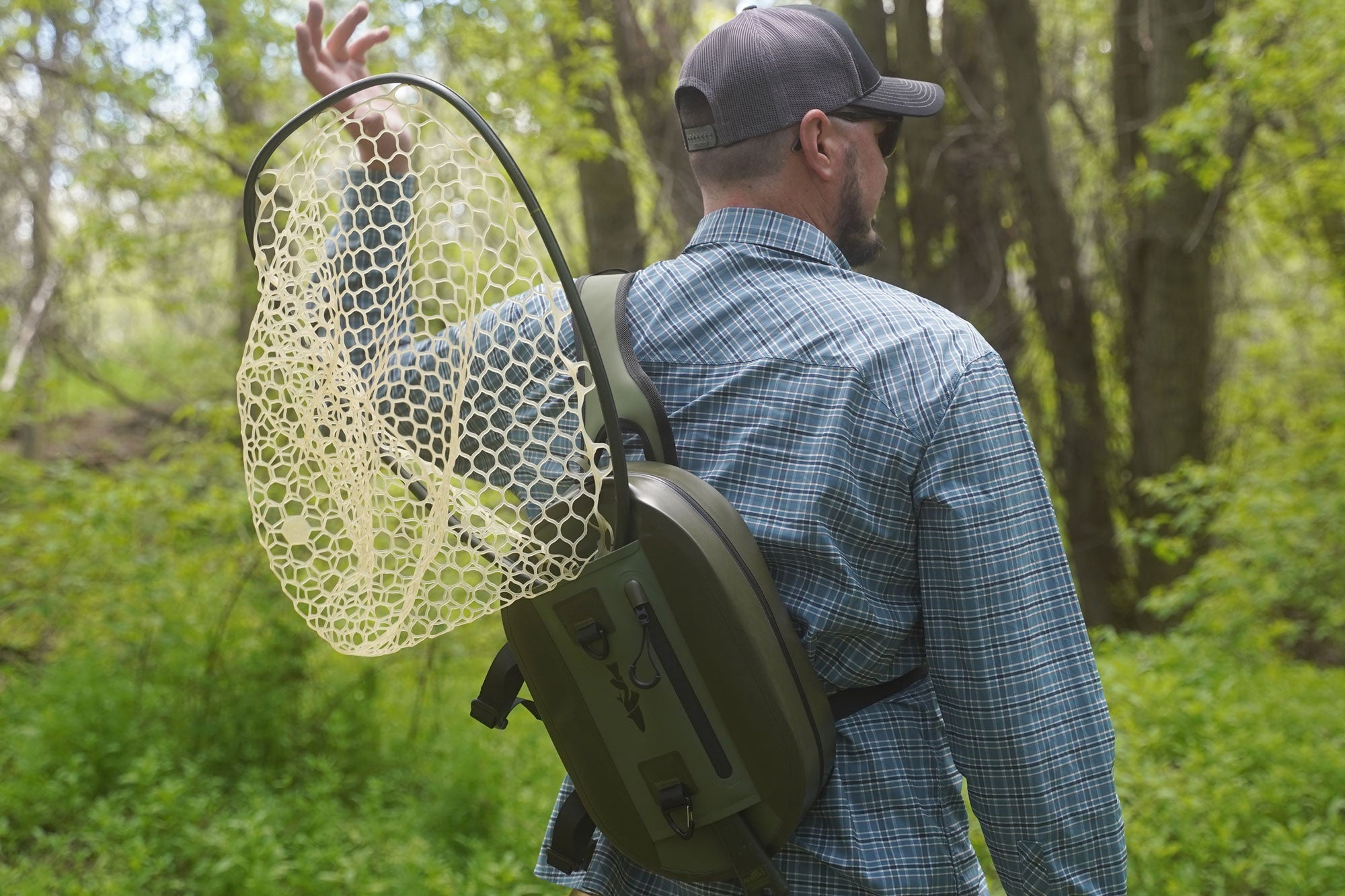
To start fly fishing for trout, you need a 9-foot 5-weight rod, a matching reel with a weight forward floating line, a few 9-foot tapered leaders in 4X or 5X, a spool of 5X tippet, a dozen basic flies, nippers, forceps, a landing net, polarized sunglasses and a fishing license. That's it. Everything else can wait until month two.
The 9-foot 5-weight is the Swiss Army knife of fly rods. It's long enough to cast and mend on a mid-size river, light enough to enjoy a 12-inch trout, and stout enough for small streams, ponds and the occasional bass. The easiest path is a matched rod and reel combo, because the line, reel and rod are already balanced for each other. If you want to go deeper on what each piece does, The Ultimate Guide to Beginner Fly Fishing: Gear walks through every item.
For flies, keep it simple. A starter box for trout might hold a few Parachute Adams and Elk Hair Caddis dry flies in sizes 14 to 16, some Pheasant Tail and Hare's Ear nymphs in sizes 14 to 18, a couple of Zebra Midges, and two or three Woolly Buggers. That's a real working selection. Add a small pack of strike indicators and some split shot and you're covered for most trout water in the country.
Week 1 (Days 1 to 7): Gear, license and three knots
Week one happens mostly at home. The goal is simple: by day seven, your outfit is rigged, your license is in your phone, and you can tie three knots without looking at a diagram.
Days 1 and 2: Get legal and get rigged. Buy your fishing license online from your state wildlife agency. Here in Utah, that's the Utah Division of Wildlife Resources license page, and it takes about five minutes. While you're there, look up the regulations for the waters you plan to fish. Then assemble your rod, put the reel on, and run the line through every guide. Most combos come with backing and line already spooled, so all you'll add is a leader.
Days 3 to 7: Learn three knots. Spend ten minutes a night at the kitchen table with some old tippet and a hook with the point clipped off. You need an improved clinch knot to tie the fly to the tippet, a double surgeon's knot to add new tippet to your leader, and a loop-to-loop connection to attach the leader to the fly line. Practice each one ten times a night. By Sunday, try tying them with your eyes closed. That sounds silly until the evening hatch starts and the light is fading.
The improved clinch knot is the one you'll tie the most, so it's worth getting fast at it. Here's my quick video with a trick that makes it easier when your eyesight or the light isn't cooperating.
Week 2 (Days 8 to 14): Learn to cast in the backyard
Week two is all about casting, and you'll do it on grass, not water. Grass is forgiving, it doesn't spook fish, and nobody on the lawn cares how many tailing loops you throw. Tie a small piece of bright yarn to the end of your leader instead of a fly, and you're ready.
Here's the key idea behind the fly cast. With spin fishing, the weight of the lure pulls the line off the reel. With fly fishing, the line itself is the weight, and the rod bends and flings that line like a flexible slingshot. The cast is really a smooth acceleration followed by a crisp stop. The stop is what makes the loop. If you remember one thing from this week, remember that the rod does the work when you stop it, not when you muscle it.
Days 8 to 10: The pick-up and lay-down. Strip out about 25 feet of line in front of you. Lift the rod smoothly, accelerate back, stop with the rod just past vertical, pause to let the line straighten behind you, then accelerate forward and stop at about eye level. Let the line fall to the grass. Do that twenty times a session. Turn your head and watch your backcast so you can see when the line has straightened.
Days 11 and 12: False casting and targets. Once the pick-up and lay-down feels smooth, keep the line in the air for two or three back-and-forth strokes before laying it down. Set out paper plates at 20, 30 and 40 feet and try to land the yarn on each one. Accuracy at 30 feet will catch more trout this year than distance at 60.
Days 13 and 14: The roll cast. The roll cast is your best friend on a brushy stream, because it needs no backcast. Slowly raise the rod so a curve of line hangs beside and slightly behind you, then drive the rod forward and stop. The line rolls out along the water like a wheel. Practice on a pond or even a swimming pool if you can, since the roll cast needs the grip of water to work well.
This video from Mad River Outfitters covers the casting basics clearly and is a great companion for the week.
If you want a checklist to go with the video, my 8 Step Guide to Better Beginner Fly Casting breaks the stroke into pieces you can work on one at a time. And here's the best shortcut of the whole month, straight from one of our guests.
Buy twenty minutes of casting help at your local shop. Spencer Durrant, news editor at MidCurrent and a bamboo rod builder, made this point on Episode 78: plenty of beginners avoid fly shops because they're worried about being judged, and they miss out on cheap, real instruction the staff are happy to give. Walk in during week two, offer to pay for a short casting session, pick up some tippet and flies while you're there, and you'll fix in twenty minutes what might take you twenty evenings alone.
Dry Fly Tactics for Selective Trout (free eBook)
Your first trout will very likely come on a dry fly. The free eBook covers presentation and fly choice for picky risers, so you're ready when the hatch starts. Grab the PDF.
Get the free eBook →Week 3 (Days 15 to 21): Read water and learn to drift
Week three moves you to the river, but not to catch fish yet. This is scouting week. The goal is to understand where trout live and how to make a fly drift naturally through those places. It's the most underrated week in the plan, and it's the one that turns casting practice into fish.
Days 15 to 17: Walk and look. Take two or three trips to a nearby river or creek with polarized sunglasses and no rod, or with the rod left in the truck. Trout need three things: food, safety and a break from the current. That's why they hold in seams, where fast water meets slow water, in the soft water behind boulders, at the heads of pools where riffles dump in food, and along undercut banks. Find those spots on your stretch of water and picture a trout sitting in each one, facing upstream, waiting for food to drift by.
Days 18 to 21: Learn the dead drift. Trout eat insects that float along at the speed of the current. Your fly needs to do the same. Rig a simple dry-dropper: a buoyant dry fly like an Elk Hair Caddis or a small foam hopper, with 18 to 24 inches of 5X tippet tied to the hook bend and a size 16 bead-head Pheasant Tail on the end. The dry fly floats and doubles as a strike indicator. Cast upstream and slightly across, then strip in slack as the flies drift back toward you so you stay in touch. If the dry fly starts to skate or leave a wake, the line is dragging it, and it's time to lift the line and flip it upstream. That little flip is called a mend.
Go ahead and fish during these sessions if a trout shows up, of course. But treat any fish as a bonus. The win this week is watching your dry fly float naturally for ten or fifteen feet without dragging. For more on the fundamentals behind the drift, The Ultimate Guide to Beginner Fly Fishing: Technique covers drifts, mends and hook sets in more detail.
Week 4 (Days 22 to 30): Go catch your first trout
Week four is fishing week. You'll plan three focused trips, each one with a single goal, on water that gives you a fair chance.
Choose forgiving water. A good first spot has plenty of trout, easy access and room to cast. A stocked community pond is a great option; Utah's Division of Wildlife Resources stocks many of them with rainbow trout, and you can find them through the Utah DWR fishing pages. A mid-size river with walk-in access and riffles you can wade safely is next. Here in Utah, parts of the Weber and Provo rivers fit the bill on a calm weekday. Wherever you live, ask the local fly shop which stretch they'd send a first-timer to. They'll almost always point you somewhere friendly.
Trip 1 (Days 22 to 24): Rig, cast, drift. Spend the first trip running your routine. Rig the dry-dropper at the truck, walk to one riffle, and fish it for an hour. Make short casts, 20 to 30 feet. Focus on good drifts and fast reactions. When the dry fly dips, twitches or disappears, lift the rod firmly but smoothly. Trout spit flies quickly, so the set should be a quick lift, not a giant swing.
Trip 2 (Days 25 to 27): Time the bite. Fish the first two hours after sunrise or the last two hours before dark. Trout feed more confidently in low light, and during summer those are often the best windows. If you see fish rising, swap the dry-dropper for a single dry fly that roughly matches the size and color of the bugs you see. Close is good enough for most trout on most days.
Trip 3 (Days 28 to 30): Land it and let it go. By now you've probably hooked a fish or two, and landing them is its own skill. Keep the rod tip up, let the fish run if it wants to, and use the reel or your line hand to gather line when it comes toward you. Slide the fish into the net headfirst. Wet your hands before touching it, keep it in the water as much as possible, pop the hook out with forceps, and hold it gently facing into the current until it swims away on its own.
| Week | Focus | Daily time | Done when |
|---|---|---|---|
| 1 (Days 1–7) | Gear, license, three knots | 10–15 minutes | You can tie all three knots without instructions |
| 2 (Days 8–14) | Casting on grass and water | 15 minutes | You hit a plate at 30 feet most of the time |
| 3 (Days 15–21) | Reading water and dead drifts | 2–3 river visits | Your dry fly floats 10+ feet without dragging |
| 4 (Days 22–30) | Three focused fishing trips | 2–3 hours per trip | You land and release your first trout |
How long does it take to catch your first trout on a fly?
Most beginners who practice a little each day catch their first trout on a fly within three to five fishing trips, which fits comfortably inside a 30-day plan. Anglers who skip casting practice and start on hard, heavily fished rivers often take much longer, sometimes a whole season.
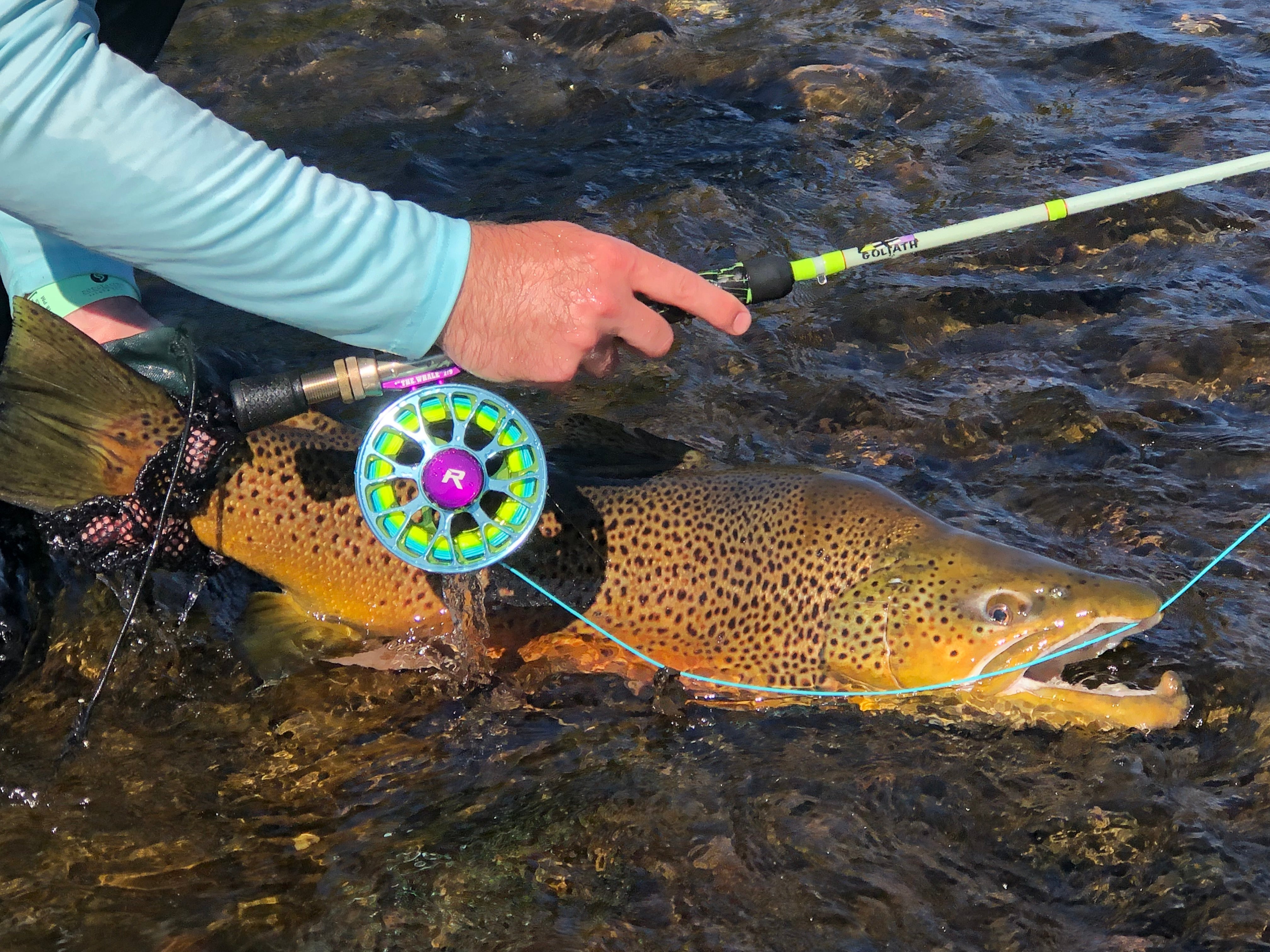
Honestly, the timeline depends more on water choice than talent. A beginner on a well-stocked pond or a healthy freestone creek might catch a fish on the first evening. A beginner on a technical tailwater full of picky brown trout (Salmo trutta) might go several trips without a take. Neither one is doing anything wrong. The water is just giving different grades on the same test. That's why the plan steers you toward forgiving water for the first month.
It also helps to measure progress by more than fish. My buddy Josh kept a little notebook during his first month: one line per session, just what he practiced and one thing that clicked. On the tough days the notebook showed him he was still moving forward, and on day nineteen he had a small brown trout in the net to write about.
What comes after day 30
Once you've landed that first trout, the sport opens up fast. Month two is a great time to learn indicator nymphing, try a few new rivers, and start noticing which insects are hatching when. Fish with friends when you can, because watching another angler read water teaches you more than any video. And keep going back to the fly shop; the folks behind the counter know which flies are working this week.
When you're ready for the next steps, The Ultimate Guide to Beginner Fly Fishing: Advancing Your Angling lays out where to go from here, from new techniques to new species. The same guitar analogy holds up. After your first three chords, you don't need a new guitar. You need new songs.
Gear to get you through the first 30 days
Here's the honest truth about beginner gear: you don't need the most expensive setup, but you do need a balanced one. A cheap mismatched outfit fights you on every cast, while a well-matched combo makes the whole first month easier. Start with a rod and reel combo from our rod and reel combos collection, grab a starter box from the fly pattern assortments, and add a simple net from our landing nets. The wider fly rods, reels and combos collection has more options once you know what you like.


Everything you need for your first 30 days
Frequently asked questions about fly fishing for beginners
What is the best fly rod for a beginner?
The best fly rod for a beginner trout angler is a 9-foot 5-weight with a medium-fast action, ideally sold as a matched rod and reel combo with a weight forward floating line. That setup casts easily, handles small streams and mid-size rivers, and is light enough to enjoy average trout.
Is fly fishing hard to learn?
Fly fishing is not hard to learn when you take the skills one at a time. Most beginners can make a usable 30-foot cast after a week or two of short daily practice. The harder part is patience, which is why a simple 30-day plan with clear weekly goals works so well.
What flies should a beginner use for trout?
A beginner can catch trout on most waters with a Parachute Adams and an Elk Hair Caddis in sizes 14 to 16, a bead-head Pheasant Tail or Hare's Ear nymph in sizes 14 to 18, a Zebra Midge, and a Woolly Bugger. A dry-dropper rig combining one dry fly and one nymph is the easiest beginner setup.
Can I teach myself to fly fish?
Yes, many anglers teach themselves to fly fish with videos, books and practice. A short paid casting lesson at a local fly shop speeds things up dramatically, because an instructor can spot and fix casting mistakes in minutes that might take weeks to diagnose alone.
Do I need waders to start fly fishing?
No. Many beginners start fly fishing from the bank of a pond or river, or by wet wading in summer with quick-dry pants and sturdy water shoes. Waders become worth buying when you want to fish colder water, fish in spring and fall, or reach spots you can't cast to from shore.
Where should a beginner go fly fishing for the first time?
A beginner should go fly fishing for the first time on forgiving water: a stocked community pond or a small to mid-size river with easy access, room to cast and plenty of trout. Ask a local fly shop which nearby stretch they recommend for first-timers, and save famous technical rivers for later.
Your first trout is closer than you think
Thirty days, a little bit of practice each day, and a plan that keeps you focused. That's the whole recipe. You don't need to learn everything about fly fishing this month. You need three knots, a 30-foot cast, a sense of where trout live and a few good drifts on friendly water. Rachel's rod came out of the closet for good after that first rainbow, and I'd bet yours will too.
Start today. Tie your first improved clinch knot tonight, and put day thirty on the calendar. We're here to help you catch any fish, any time, and anywhere, and it all starts with the first one.
Join the FFIP Insiders
Get gear deals, trip intel, and tactics to help you catch any fish, any time, and anywhere, straight to your inbox. Start with the free Dry Fly Tactics for Selective Trout eBook.
Get the free eBook →When that first trout comes to hand, snap a quick photo (keep it wet!) and tag @flyfishinginsiderpodcast so the whole Fly Fishing Insider Podcast community can celebrate with you. And if you want deals on equipment, fly fishing trips, and lots of good information, join the FFIP Insiders email list.
Tight lines, everyone!