
There's a sound I listen for on the Provo River in October, and it isn't a rise. It's the flat slap of a streamer landing eight inches off an undercut bank, and what I do in the second and a half after that slap decides whether a brown trout eats it or watches it die. I spent years thinking streamer fishing was about the retrieve. It isn't. It's about the handoff — the moment your fly stops being a thing you cast and starts being a thing that's alive.
The moment your streamer hits the water, your first move should be an immediate, deliberate strip or jerk made with the line already trapped under your rod-hand finger — not a pause, not a fumble for the fly line. A streamer that sits motionless for two seconds reads as dead to a trout that just watched it crash in. Make contact before the fly sinks out of the strike window, and you convert follows into eats.
Key takeaways
- The streamer first move after the cast is a contact problem, not a retrieve problem. If you have to hunt for the fly line after the fly lands, you have already lost the best two seconds of the presentation.
- Trap the fly line under your rod hand's index finger during the delivery so your line hand can strip the instant the fly touches down. That single habit fixes most bank-fishing frustration.
- Stop the cast high and let the leader straighten so the streamer lands on a tight line. A pile of slack on the water means your first strip moves line, not fly.
- Your casting angle sets your first move. Down-and-across gives instant tension and wants an immediate strip; up-and-across buys depth and wants a quick slack recovery first.
- Strip set, don't trout set. Lifting the rod on a streamer eat pulls a big hook sideways out of a hard jaw and kills the follow-up chance.
The Provo River bank that taught me this the hard way
Two Octobers ago I was working the middle Provo with Todd, who shows up in half my fishing stories because he's honest enough to tell me when my advice is wrong. We were walking a cut bank with willows hanging over the water — the kind of place where you just know there's a brown trout under every shadow.
Todd was casting beautifully — tight loops, streamer landing within inches of the bank every time — and catching nothing. It took me fifteen casts to see why, because it wasn't the cast and it wasn't the fly.
Here's what he was doing. The streamer would land, he'd drop the rod tip, and then he'd spend a second and a half reaching across with his line hand, hunting for the fly line down by the reel. By the time his first strip happened, the fly had been sitting dead on a slack line for nearly two seconds, drifting away from the bank.
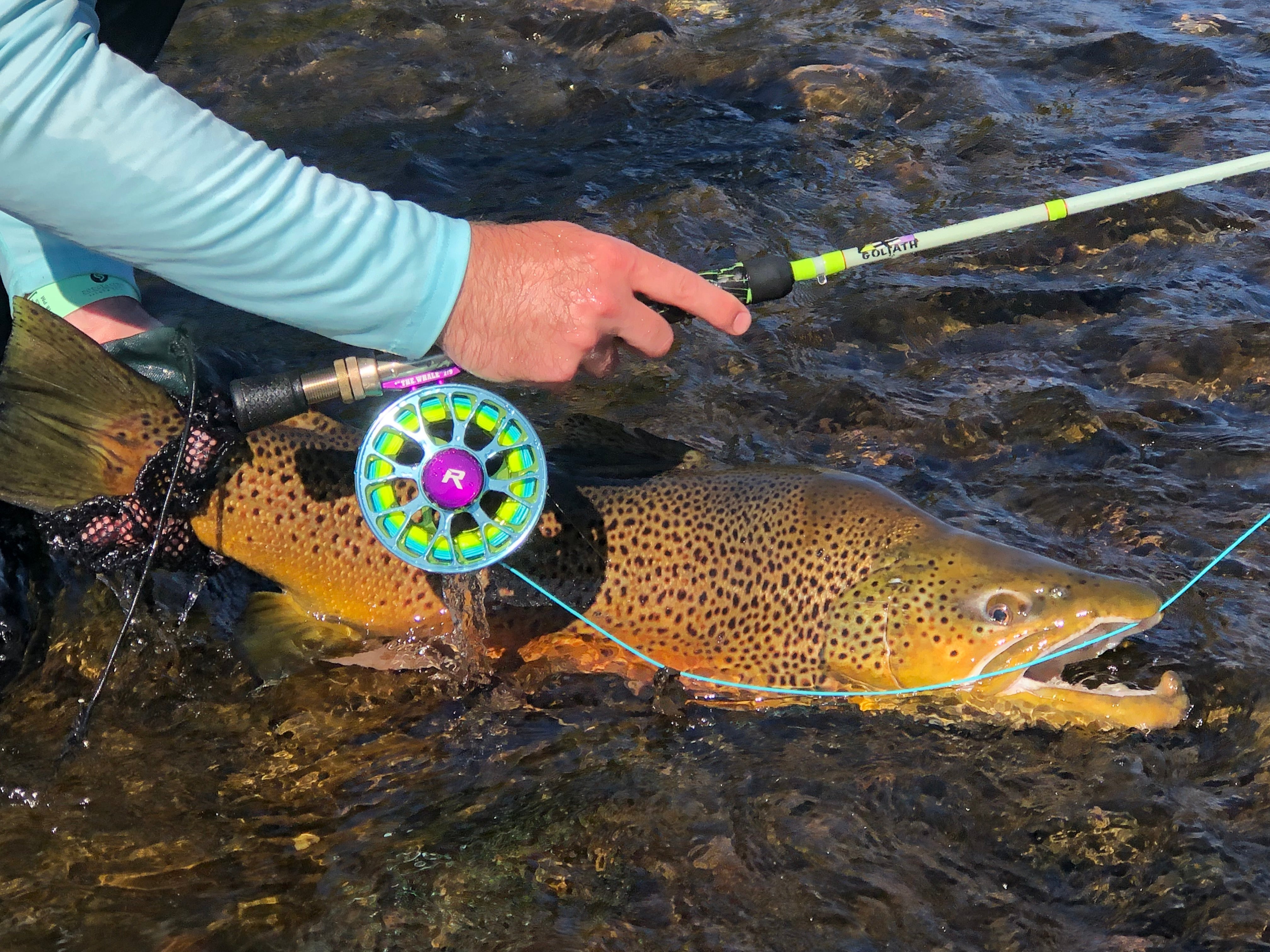
I asked him to try one thing: hook the fly line under his rod-hand index finger before releasing the cast, then strip the instant the fly landed — line hand already on the line, no searching. Three casts later a seventeen-inch brown came out from under a root wad and ate the fly so hard Todd said a word I won't print. He caught four more before we got to the end of that bank.
Same rod, same fly, same water, same angler. The only difference was that his fly started moving a second and a half earlier. That's the whole article, really — but which move you make, and when, is worth working through properly.
What should you do the instant a streamer lands?
The instant a streamer lands you should make contact with the fly and move it — a short, firm strip or a rod-tip jerk — before it has time to sink on a slack line. The exceptions are deliberate: if you are fishing a deep slot and you want the fly at four feet before it starts moving, you count it down on a tight line, which is a different thing from accidentally losing contact.
The reason comes down to how a trout processes a streamer. A brown trout under a bank isn't evaluating your fly the way it inspects a size 20 midge in a flat pool. It's making a fast, coarse, predatory decision: is that prey, is it fleeing, can I get it before it's gone? A minnow knocked into the water by a collapsing bank doesn't hover. It bolts. A sculpin dislodged by your wading boot scrambles for the nearest rock.
When your streamer lands and then sits, you've shown that trout something that doesn't exist in its world. Prey that stops moving in open water near a predator is either dead or a leaf, and the fish goes back to its lie. You got one clean look and spent it proving your fly is furniture.
The analogy I use when I'm teaching this on the water is a dog and a tennis ball. Roll a ball past a dog and it's gone — the chase is automatic, no thinking involved. Set the same ball on the ground three feet away and the dog looks at it, looks at you, and lies back down. Your streamer is the ball. The first move is the roll.
Why does the first strip matter more than the rest of the retrieve?
The first strip matters more than the rest of the retrieve because it happens while your fly is still in the highest-percentage water of the entire cast. On a bank-oriented streamer presentation, the strike zone is measured in feet, not yards — most of the fish you're targeting are holding within three or four feet of the structure you just cast to. By the time you've made three strips, your fly has left that zone and is swimming through open water where far fewer big trout live.
There's a second reason, and it's about the fish that were already watching. A streamer hitting the water is loud — it announces itself, and trout that weren't thinking about eating are now looking at the spot the noise came from. The first movement your fly makes is seen by more fish than anything that follows. Wasting it on a dead drop is like walking on stage and then standing there.
We went deeper on the water-reading side of this in 4 Fly Fishing with Streamers Tips: Mastering Grid Techniques for Optimal Contact Drift. Covering a run as a grid and making a clean first move in every cell are two halves of the same skill.
The three variables you are actually controlling
Those two seconds come down to three things: slack, angle, and the first move itself. Get one wrong and you're fishing a wet sock.
Slack: the problem you solve before the fly lands
Slack is the villain, and the mistake is trying to fix it after the fact. You can't strip it out fast enough to save the first second. You have to prevent it during the delivery.
Two habits do most of the work. First, stop the cast high and let the leader turn over and straighten in the air, so the streamer arrives at the end of a tight line rather than landing in a heap with the fly line piled on top of it. Second — and this is the one Todd was missing — trap the running line under the index finger of your rod hand as you shoot the cast. Feather it against the cork, let the line slow and stop, and now that line is pinned exactly where your line hand expects to find it. You are not searching. You are already holding the rope.
A short leader helps too. Streamer leaders are not delicate tapered things; I run short and stout so the fly turns over hard and lands in line with the tippet instead of tumbling back on itself. The Platinum HOGzilla Furled Leader ($15.99) is a three-and-a-half-foot fluorocarbon power leader built exactly for this job — it turns over a heavy articulated fly, and because fluorocarbon is dense it sinks with a sinking line instead of floating up behind it, so the rig behaves as one piece instead of a hinge.
Angle: the cast decides the move
Where you put the cast relative to the current determines what your first move can even be, and this is where a lot of otherwise good streamer anglers are inconsistent — they use the same first move regardless of angle, so half their casts are fighting the river.
Down-and-across (say, 45 degrees below straight across) puts tension on the line almost immediately because the current is pulling the belly downstream and away from you. The fly is under load the moment it lands. Your first move here is a short, sharp strip — you don't need to recover anything, you just need to give the fly a jolt of life.
Straight across is the middle ground and the most common bank-fishing angle. A single long strip or a hard rod-tip twitch gets you connected and moving.
Up-and-across is the angle people struggle with, and it's the one that buys you depth, because the fly sinks while the current carries it toward you. The first move here isn't a strip for the fish — it's a fast slack recovery, two or three quick short strips, so you're in contact before the fly reaches the zone. I use this angle deliberately on deep slots and boulder pockets where down-and-across keeps the fly riding too high.
The first move itself: strip, jerk, or swim
There are really three flavors, and the water tells you which one to use.
The strip-jerk is my default on banks: a six- to ten-inch strip with the line hand combined with a small downstream twitch of the rod tip, so the fly darts and then wobbles. This is the most aggressive, most prey-like first move and it draws the most violent eats.
The long draw is a slow, steady, eighteen-inch pull that just makes the fly swim — my choice in cold water, where a darting fly outruns what a sluggish trout will chase.
The tension swim is barely a move at all: you drop the rod tip to the water, point it at the fly, and let the current load the line so the streamer swims on its own. This is the one for heavy flows and for swinging water below a riffle, and it's the presentation where a lot of the biggest fish of my life have eaten.
Here's the sequence I actually run on every streamer cast
Here's the whole thing as a sequence. It's a rhythm more than a checklist, about four seconds from start to fish-or-no-fish, and the goal is to stop thinking about it.
One: pick your target and your angle together. Decide where the fly lands and what the current between you and that spot will do before you load the rod. Streamer fishing rewards people who aim at a specific square foot of water, not at a bank in general.
Two: trap the line. As you shoot, pin the running line under your rod-hand index finger and feather it to slow the cast. Your line hand comes up to meet it while the fly is still in the air.
Three: stop high, let it straighten. A high stop with a little check gives the leader room to turn over so the streamer lands nose-first with tippet stretched behind it.
Four: rod tip goes down and points at the fly — immediately. Not down toward your feet, down toward the fly. A tip held at waist height puts a foot and a half of free slack into the system. On windy days I'll stick the tip an inch into the water.
Five: make the first move, matched to the angle. Strip-jerk on down-and-across and straight-across, slack recovery on up-and-across, tension swim in heavy water.
Six: pause — but only after the fly has moved. The pause is where the eat happens most often, because that's when the fly dips and flutters like a wounded baitfish. It only works as a pause if it follows motion.
Be stripping as the fly touches down, not after. Ryan Jarvis, who represents Monic Fly Lines and spends a lot of his life with a streamer rod in his hands, made this point better than I have in his episode on the podcast: keep light contact on the line all the way through the cast so the first strip-and-jerk happens as the fly lands, and save your pauses for afterward. His reasoning is exactly what this whole article is built on — a streamer sitting still reads as lifeless, and the seconds you spend fumbling for the fly line are the seconds your fly spends in the best water tight to the bank.
Dry Fly Tactics for Selective Trout (free eBook)
The surface-fishing companion to everything here — leader setups, rise-form reading, and the presentations that turn refusals into eats. Free, and it reads fine on your phone at the truck.
Get the free eBook →Strip set, every time — and why the trout set costs you the fish twice
A brown trout that eats in that first window usually eats hard and going away from you. Lift the rod — the reflex we all built on dries and nymphs — and you do two bad things at once: you pull a heavy hook sideways out of a hard, bony jaw, and you yank the fly six feet away from a fish that was fully committed.
The strip set is the fix: rod tip low and pointed at the fly, hook driven home with a long, hard pull of the line hand. A strip set pulls the hook straight back along the line into the corner of the jaw, with no rod flex soaking up the energy.
The part people don't talk about enough is the second chance. Miss a strip set and the fly moves eighteen inches and keeps swimming in the strike zone — trout eat it again constantly. Miss a trout set and the fly is airborne behind you while the fish watches a rod wave over its head. That's why I call the trout set a double cost.
Retraining the reflex takes a season, honestly, and I still blow it when a fish eats during a moment I wasn't focused. What helped me most was muttering "strip, strip" on the first few casts of every outing — a silly ritual that put the word in my head before a fish put a reflex there.
Advanced adjustments once the basic handoff is automatic
Change the first move when fish follow but don't commit
A follow is information. Your fly, angle, and first move were good enough to move a fish, and something in the next beat broke the spell. Nine times out of ten it was acceleration — the trout was closing on something it believed was wounded and watched a healthy minnow outswim it.
The fix is counterintuitive: when a fish follows, make the fly turn rather than making it run. A sharp change of direction — a hard strip combined with a rod-tip sweep to the side — looks like prey panicking into cover, and panicking prey is exactly the shape of the thing a predator commits to.
Match your first move to water temperature
Trout are cold-blooded, so their willingness to chase runs on water temperature. As a rough field guide I fish fast, erratic first moves in the mid-50s to mid-60s Fahrenheit, moderate strips in the high 40s to low 50s, and a slow tension swim below about 45. On a winter tailwater like the Green River below Flaming Gorge, the winning first move is often almost no move — just enough tension to keep the fly tracking as it sinks. The USGS gauge at Green River near Greendale, Utah posts real-time flows, and checking it before the drive saves a lot of guessing.
Tie the fly on a loop knot
A loop knot lets the streamer pivot and swing on the first strip instead of being dragged stiffly by the nose, and the difference in how a weighted fly jigs is genuinely visible in clear water. We broke down a strong, simple option in The Rapala Knot Explained: A Better Loop Connection for Streamers and Dry Flies. Ten extra seconds on the bank, and it changes every fly in your box.
Choosing your first move: a quick field table
| Situation | Cast angle | First move after landing | Why |
|---|---|---|---|
| Undercut bank, 55°F water | Down-and-across, tight to cover | Immediate strip-jerk, 6–10 inches | Line is already under tension; the fish is close and reactive |
| Deep slot or boulder pocket | Up-and-across | Two fast short strips to recover slack, then fish | Buys sink time, but you must be connected before the zone |
| Cold winter tailwater, 40°F | Across or slightly down | Rod tip down, tension swim only | Sluggish trout won't chase a fleeing fly |
| Heavy spring runoff, off-color water | Down-and-across | Long slow draw, big profile fly | Fish hunt by vibration and silhouette, not speed |
| Drift boat along a bank | Slightly downstream of perpendicular | One committed strip-jerk, then recast | The boat is stealing your window; make the first move count |
| Fish followed and refused | Same angle, repeat | Hard strip plus a sideways rod sweep | A turn triggers commitment; acceleration kills it |
Gear that makes a fast first move possible
I'd rather you fix your handoff with the rod you already own than buy anything. But if you're building a streamer setup, here's where the money actually matters.
The line is the biggest lever. A floating line with a short sink tip gets the fly down without the sag of a full sinking line, and keeps the running line on the surface where you can see and control it. The Stone Creek Sink Tip Fly Lines ($60.00) come in Type 3 intermediate (3–4 inches per second) and Type 5 fast sink (5–6 ips) with a 30-inch tip, in 3- through 10-weight. Type 3 covers most trout rivers; Type 5 is for deep, fast water. The full fly lines collection has other heads and sink rates.
The leader should be short and stiff. Long tapered leaders hinge and let the fly drift out of line with your tip. Three to five feet of stout fluorocarbon is plenty, and the leaders collection has the furled and straight options I use.
The rod should have enough backbone to turn a heavy fly over and stop it high. A 9-foot 6- or 7-weight is the sweet spot for trout streamers. The 23PS Rods from Risen Fly ($329.99) come in a 9-foot 6-weight 4-piece at 3.4 ounces and a 10-foot 7-weight with a fighting butt — fast tip-flex IM12 graphite, which is what you want for punching an articulated streamer into a headwind.
Flies that move on the first strip. You want profile and water-pushing material more than weight. Articulated patterns start swimming the instant they're loaded, and marabou and rabbit strip keep breathing during the pause. The streamer fishing collection is where I'd start, and if you're wondering how big to go, we work through that tradeoff in 10 Streamer Fishing Tactics for Trophy Trout.


One more thing: know the rules where you're swinging meat
Fall streamer fishing puts you on banks and in spawning-adjacent water, often on stretches with special hook, season, or closure rules. Before you hunt brown trout (Salmo trutta) with a big articulated fly in October, check the current regulations for that specific water — the Utah Division of Wildlife Resources fishing pages keep Utah's rules and closures current, and every state has an equivalent. Fish actively spawning on redds deserve to be left alone.
Frequently asked questions
What should you do the second a streamer hits the water?
Make the fly move. In most trout streamer situations the right first move after the cast is an immediate six- to ten-inch strip combined with a small rod-tip twitch, made with the fly line already trapped under your rod-hand finger. The exception is a deliberate countdown in deep water, where you keep tension while the fly sinks instead of letting it fall on slack line.
Should you let a streamer sink before stripping?
Sometimes, but only on purpose and only on a tight line. Letting a streamer sink is the right call in deep slots, cold water, and heavy flows where the fish are holding four feet down or deeper. What's never right is letting the fly sink because you lost contact with the line. A controlled sink means you can feel the fly the whole time; an accidental one means you can't.
Is a strip set or a trout set better for streamers?
Strip set, without exception, for streamer fishing. Keep the rod tip low and pointed at the fly and drive the hook home with a hard pull of the line hand. A trout set lifts a large hook sideways out of a hard jaw and simultaneously pulls the fly out of the strike zone, so a missed trout set ends the opportunity while a missed strip set leaves the fly swimming for a second chance.
Why do trout follow my streamer and refuse to eat it?
The usual culprit is acceleration. A trout closing on what it believes is a wounded baitfish loses interest when that baitfish suddenly swims away at full speed. When you see a follow, make the fly change direction instead of speeding up — a hard strip with a sideways rod sweep looks like prey bolting for cover, which is the trigger a predator commits to. Dropping a size or two in fly length is the other reliable fix.
Go fix your handoff this week
If you take one thing from this, make it the finger. Trap the line under your rod hand on every streamer cast for one full outing and refuse to search for the fly line after the fly lands. You don't need a new rod, line, or box of flies to add fish to your day — you need to stop giving away the best second and a half of every cast.
That's the Fly Fishing Insider Podcast approach in a sentence: find the small mechanical thing quietly costing you fish, fix it, and let the rest of your fishing improve around it. It's how you catch any fish, any time, and anywhere.
When you put it together and something mean comes out from under a bank, tag us on Instagram at @flyfishinginsiderpodcast. Christian Bacasa here — I genuinely want to see that fish, and I want to hear which bank it came off.
Join the FFIP Insiders
Get gear deals, trip intel, and tactics to help you catch any fish, any time, and anywhere — straight to your inbox. Start with our free dry fly playbook.
Get the free eBook →Tight lines, everyone!