
Fly Fishing Insider Podcast
The gap between good anglers and the top few percent is not fly selection, it is stealth and repeatable process. A trout that never sees the angler will usually eat, even a size 14 on 6X where convention says size 26 and 8X. Focus on five simple steps done correctly rather than on catching.
Antoine Bissieux is a French-born fly fishing guide on the East Coast who spent seven years teaching at a fly fishing school before turning to guiding, and now fishes alongside European competition anglers to bring their methods back to his clients.
Also on Apple Podcasts · Spotify · YouTube
What actually separates the top 10% of fly anglers?
Process, not fly boxes. The single most useful lesson from fishing with competition-level anglers is to stop trying to catch a fish and instead do five simple things correctly, because the variables in fly fishing are effectively endless: water temperature, wind, clarity, speed, light, insect behavior. An angler who tries to solve all of them at once never starts fishing. Five repeatable steps, executed well most of the time, catch fish; a swung nymph, for example, breaks down into casting downstream, dragging, flipping the rod tip to bring the fly upstream, leading the fly with a rod lift, and letting it rise.
Why does stealth matter more than fly pattern?
A trout carries two counters, a feeding counter and a fear counter, and they move in opposite directions. The feeding counter is always up until the fish detects the angler, at which point fear rises and feeding falls. That is why the same water reputed to require a size 26 on 8X can be fished successfully with a size 14 on 6X: the fish that never sees the angler eats what drifts past. When you can see the fish, the fish can generally see you, and at that point the fly pattern has stopped being the limiting factor.
What is the OSCCP formula for fly selection?
OSCCP stands for observation, silhouette, size, color and presentation, deliberately in that order. Observation comes first: how often the fish are feeding, why, how far they are moving, and what is actually on the water. Silhouette comes next, because what a trout sees against the light is an outline, which is why a hare's ear works and why a good fly holds its silhouette as it rotates in the current. Color ranks last of the selection factors and is largely aimed at the angler rather than the fish, while presentation outranks everything, since a fly that behaves like food gets eaten even when size and color are off.
How do you skitter a dry fly upstream?
Skittering a caddis downstream is familiar; the harder and more useful version moves the fly upstream, away from the angler. Set it up with a curve cast that puts the fly above and to the side of a fish with slack leader lying downstream of it, then use water tension on the line: moving the rod tip pulls the fly upstream, and a roll cast to either side steers it left or right. The trout sees only a fly traveling upstream and no tippet, and nothing in the drift except live food moves upstream on the surface, so the fly reads as food. Done properly the angler can navigate a single fly around upstream lies and pick which fish to show it to.
How do you throw an accurate curve cast?
Underpower the curve cast rather than overpowering it. Make the cast with less power than the distance needs, then lower the rod tip to kill the remaining energy so the loop never fully unfolds and the leader and tippet collapse into the curve. A low side cast followed by a rod lift makes the fly touch down first and skate upward while the leader carries the residual energy. For a curve to the inside, rotate the rod blank at the end of the stroke so it bends in two planes and the fly turns back toward the angler. The overpowered version places the leader accurately but whips the fly, which makes it hard to know exactly where the fly will land.
How do you build a dry fly leader that turns over?
The leader starts with five feet of 0.50 mm material nail-knotted directly to a double taper line whose front taper has been cut off, so the butt diameter nearly matches the line and no power is lost to a loop-to-loop connection. From there each section is half the length of the one before it, stepping down through 0.44 mm, 0.30 mm and 0.20 mm, which is an aggressive taper by design. A short colored sighter section and a micro perfection loop finish the leader at about 10 feet, and four to eight feet of tippet, usually 6X, brings the whole rig to 14 to 18 feet. All of it is soft, limp, low-memory material that stretches around 26 percent, so the leader itself acts as a shock absorber and fine tippet becomes very hard to break.
Where should a dry fly land relative to a rising trout?
Divide the water above a rising trout into three zones. The sacrificial zone is the stretch above the fish's window where the cast lands and the drift settles; the sight zone is where the fly enters the trout's vision already looking right; and the feeding zone is where the eat happens, extending past the fish because a trout will turn and follow. Casting straight to the rise ring skips the first two zones, so the fly arrives without having established itself and the presentation reads as false. Landing the fly before the leader and line also matters: if the line touches down first, it starts dragging downstream and the usable drift is short.
How do you help a fish recover after a long fight?
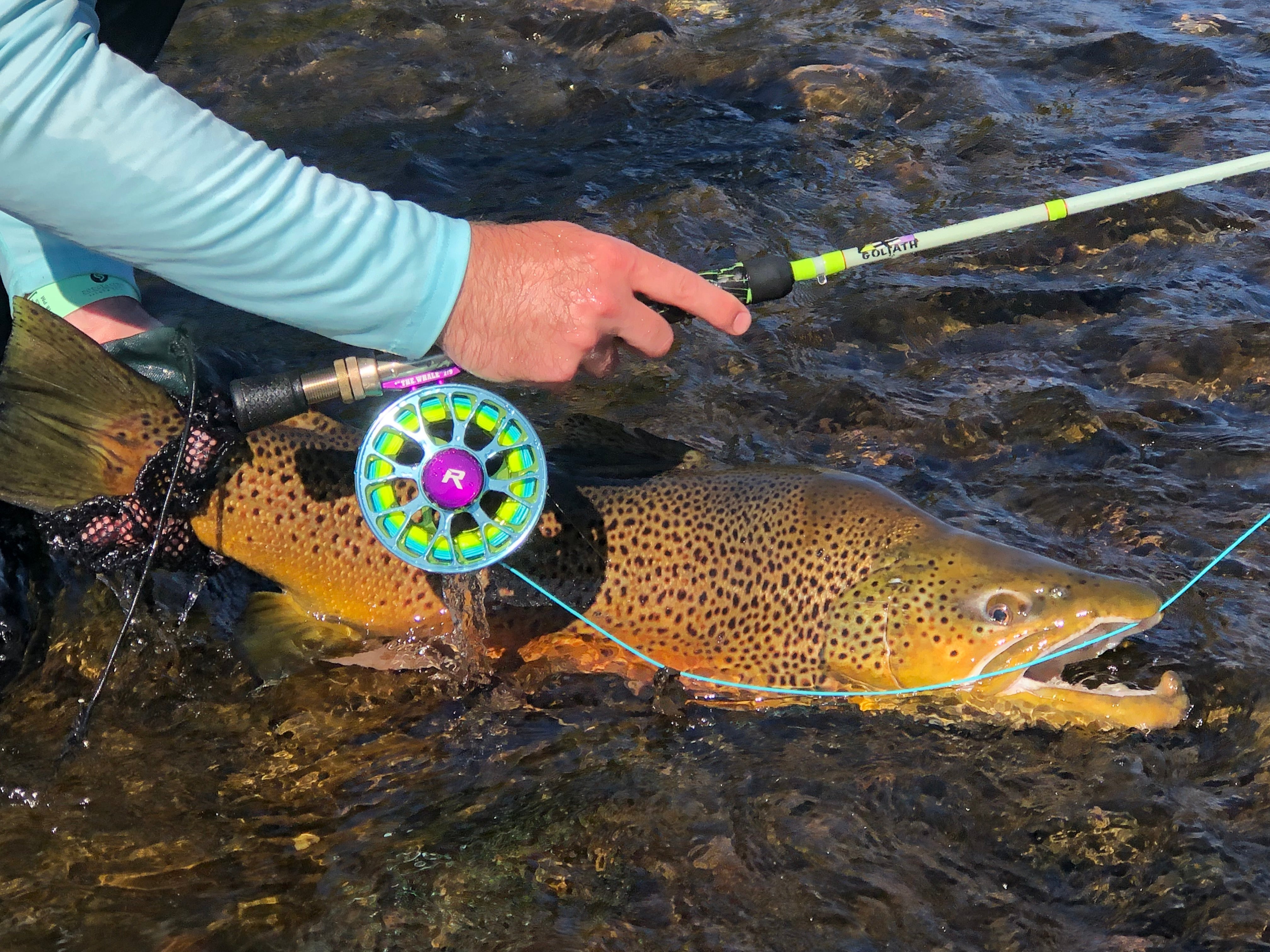
A played fish is oxygen-starved and disoriented, its red cells swollen, and a released fish that sits motionless on the bottom is vulnerable. Swim Well Fish Spray is an all-natural spray applied to the flank and under the gill plate to reoxygenate the fish directly, since a stressed fish takes somewhere between 10 and 30 percent of its oxygen through the skin rather than the gills. Keep the fish in the net and in the water, lift the net just enough to spray, and the fish typically darts off rather than sinking. That matters because a handicapped fish in a river attracts larger fish, which will harass and eat it.
Key takeaways
- Pick five simple actions for the technique you are fishing and execute those, instead of trying to solve every variable at once.
- Prioritize not being seen; a trout that has not detected you will eat a size 14 on 6X on water that supposedly demands a size 26.
- Select flies by observation, silhouette, size, then color, with presentation outranking all of them.
- Underpower a curve cast and drop the rod tip to kill energy, rather than overpowering it, for a more predictable fly landing.
- Build leaders by halving each section below a long, heavy butt nail-knotted straight to the fly line, and finish with 4 to 8 feet of 6X.
- Land the fly in the sacrificial zone above the fish's window, not on the rise ring, so it is already drifting naturally when it enters the trout's vision.