
Fly Fishing Insider Podcast
Trophy trout are predatory, and certain profiles trigger a strike whether the fish is feeding or not. Big trout eat for return on energy, so they take big meals rarely rather than small meals constantly. That is why an oversized articulated streamer works on a trout stream, and why the biggest fish come on overcast, stormy, off-color days.
Simeon Myers is a professional poker player, songwriter and Pennsylvania streamer angler who fishes over a hundred days a year and ties his own articulated patterns for trophy brown trout.
Also on Apple Podcasts · Spotify · YouTube
What can a big Rapala teach you about streamer fishing for trout?
The lesson came on a freezing Pennsylvania opening day, on a pool with roughly a hundred anglers shoulder to shoulder and nobody catching anything for over an hour. A friend pulled out a six-inch diving plug in a brown trout finish, threw it across the pool, ripped it back while sweeping the rod side to side, and caught a twenty-two inch brown on the first cast. Working from hole to hole that morning produced three brown trout over nineteen inches on the same plugs, in water where nothing else was moving fish.
Why do big trout hit a streamer when they are not feeding?
The plugs demonstrated something that changed how this angler thinks about trophy trout: they are predatory, and some presentations trigger an instinctive strike rather than a feeding decision. You can drag any number of things past a big trout that it has no interest in at all, and then show it one thing that it apparently has to eat. Over two seasons of covering whole sections of stream with plugs, that reaction bite produced more tagged trophy trout than anything else being fished, enough that the tags collected filled a fly bin.
Should you swing a big streamer or fish it up and across?
The traditional streamer presentation is down and across on the swing with a few strips worked in, which still catches plenty of trout. What made the big articulated streamer approach different was casting up and across and bringing the streamer back across the current, the same directional idea as ripping a plug through a pool. That retrieve is what produces the instinctive strike from trophy fish rather than the slower interest a swung woolly bugger gets.
What conditions produce the best big-trout streamer fishing?
The single biggest tip here is to target inclement weather. Trophy trout may only feed once a day, or once every few days, because they are looking for the biggest return on the energy they spend - a large meal, taken rarely. The window when those fish throw caution aside is overcast days, stormy days, and days when the water is off color, which for anglers who cannot fish at night is the practical substitute for darkness.
What color streamers work in off-color limestone water?
Pennsylvania limestone streams carry a chalky hue year-round, and in that water dark colors do the work. Black, dark brown and olive get fished almost exclusively; light-colored flies rarely come out of the box. When the water gets genuinely dirty, black is the only color used, because black is what shows up as a silhouette against whatever light is getting through.
What rod and line do you need to fish big articulated streamers?
Weighted articulated streamers thrown on sinking line make rod selection a real constraint rather than a preference, because the rod has to deliver the fly and let you roll cast the whole rig across the stream. Even on modest Pennsylvania water - streams that run from 150 cfs up to about 1,200 cfs at the top end, and usually sit around 350 to 500 cfs - the working choice is a seven or eight weight. The line is a 250-grain sinking line with a ten-foot sinking head, sinking somewhere around six or seven inches per second.
How long should a streamer leader be?
Leader length changes with fly size and depth rather than staying fixed. A smaller streamer fished in deeper holes gets a longer setup, roughly eight feet of leader tapering to 4X. A big articulated streamer gets only four or five feet of leader in 0X to 2X, because a trout inspecting a six-inch fly is not going to be refusing it over tippet diameter.
How do you net a big fish without losing it?
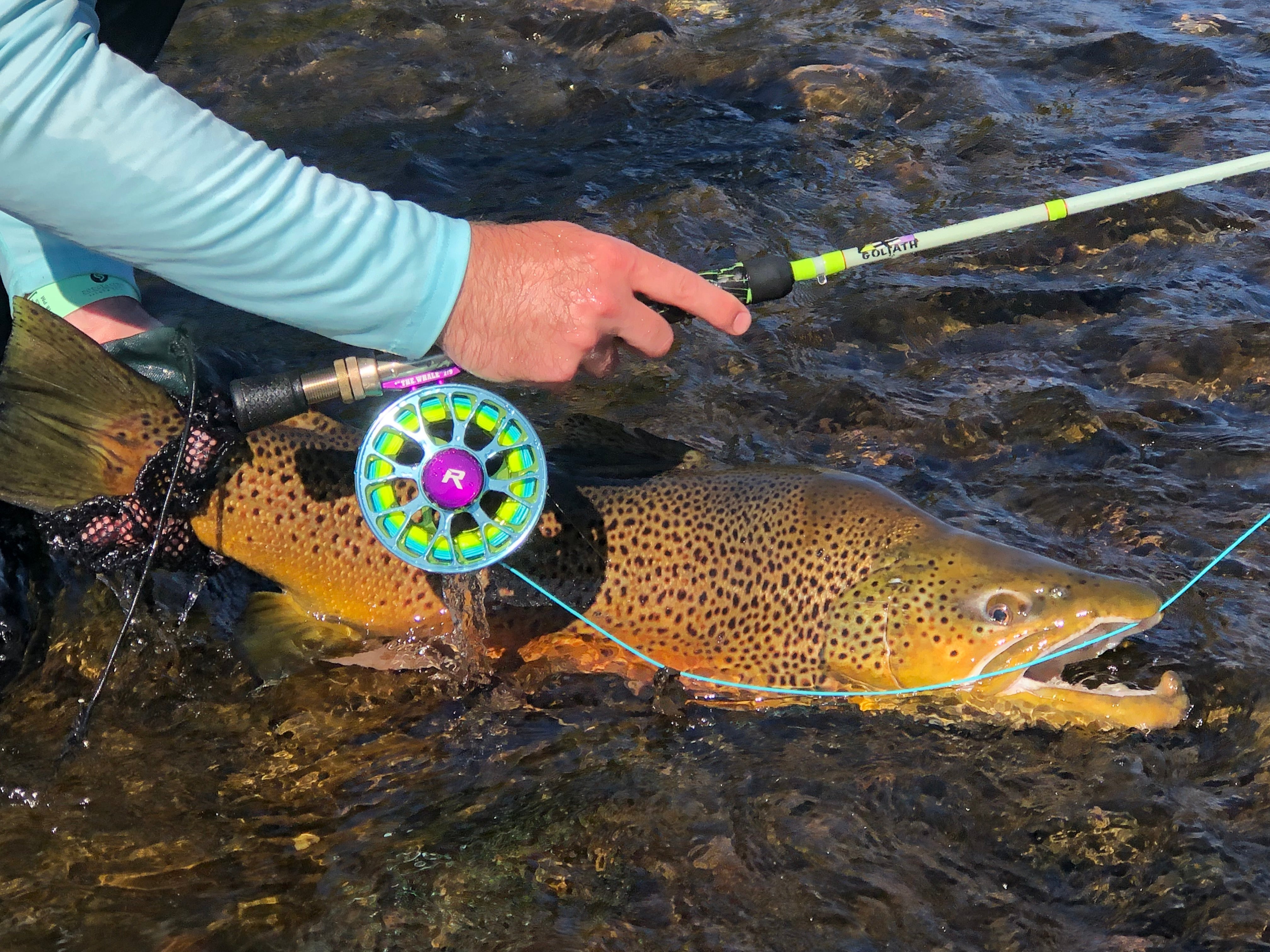
A fish cannot swim backwards. When it flares its tail it moves forward, which is exactly why netting from behind fires a big fish straight out of the hoop. Put the net in front of the fish's head instead, so that even a spooked fish swims into the net, then lift. On a twelve-inch rainbow it does not matter much; on a thirty-pound king salmon fought for half an hour, it decides whether the fish is landed.
Key takeaways
- Target overcast, stormy and off-color days for trophy trout on streamers - that is when big fish drop their caution.
- Fish big streamers up and across and bring them back across the current, rather than swinging them down and across.
- In chalky limestone water use black, dark brown and olive; in genuinely dirty water fish black almost exclusively.
- Throw weighted articulated streamers on a seven or eight weight with a 250-grain sinking line and a ten-foot sinking head.
- Run four to five feet of 0X-2X leader behind a big articulated streamer, and about eight feet down to 4X for smaller streamers in deep holes.
- Net every fish head-first - a fish cannot swim in reverse, so a spooked one swims into the net rather than out of it.
- Do not fish treble-hooked plugs for trout you intend to release; they do real damage.