
It was the second week of August on the middle Provo River, hot enough that the willows were full of grasshoppers and clumsy enough of an afternoon that half of them were ending up in the water. I had a size 8 foam hopper tied to the end of a nine-foot 5X leader — the same leader I had been fishing size 18 pale morning duns on that morning — and every single cast landed the same way. The fly line straightened, the leader kept going for about four feet, and then the whole front end folded over on itself and dropped the hopper in a pile of slack a foot short of the bank.
A trout ate it anyway on about the eleventh cast, which is the worst thing that can happen when you're doing something wrong. It took me another half hour to admit the obvious: my fly was fine, my cast was fine, my drift was the problem, and my drift was the problem because my leader was never designed to carry that much fly.
The right leader for big dry flies is short and stout: 7.5 to 9 feet total, built on a stiff butt section of about .021 inches, stepping down to 0X through 3X tippet depending on fly size, with only 18 to 24 inches of that tippet. A size 8 hopper on 5X hinges because the tippet cannot carry the fly's mass and wind resistance through the end of the cast.
Key Takeaways
- Hinging is an energy problem, not a casting problem — the leader runs out of stiffness before the fly runs out of momentum.
- Match tippet to hook size with the divide-by-three rule: size 8 hopper gets 2X or 3X, size 12 gets 4X, size 18 gets 5X or 6X.
- Shorten the tippet before you change anything else. Eighteen inches of 2X turns over a Chubby Chernobyl; four feet of it will not.
- Build the taper in three pieces — roughly 60 percent butt, 20 percent mid, 20 percent tippet — and stop the diameter from dropping more than .002 inches per knot.
- In wind, go shorter and one X heavier, not longer and finer. Turnover beats stealth on a hopper every time.
The August Afternoon Tanner Outfished Me With the Same Fly
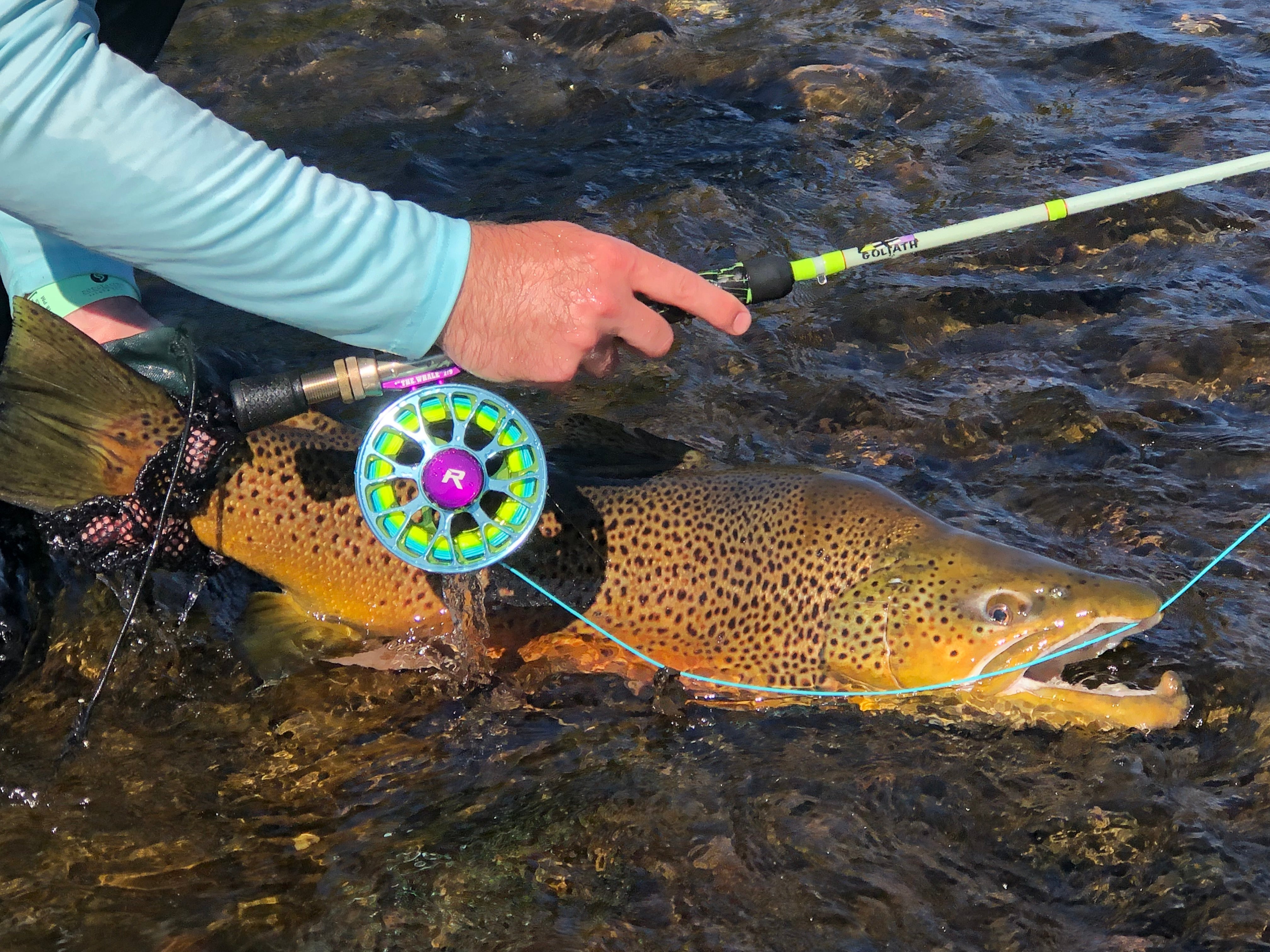
The story above has a second half. Tanner showed up an hour later, walked the bank below me, and started catching brown trout (Salmo trutta) against the grass with a hopper that looked exactly like mine. Same tan foam body, same rubber legs, same hook size. He wasn't casting better than me. He was not standing in a better spot. He caught four fish in the time I caught one, and every one of them came on the first or second drift.
When I finally walked down and looked at his rig, the whole thing came apart in about ten seconds. He had a 7.5-foot 3X leader with maybe sixteen inches of fresh 2X tied onto the end of it. Total leader length, call it eight and a half feet. My leader was twelve feet of tapered nylon that ended in something thinner than a human hair, because I had been fishing tiny mayflies at dawn and never rebuilt.
Tanner's hopper hit the water tight to the bank with the leader stretched out straight behind it, drag-free from the first inch of drift. Mine landed in a coil, and by the time the current pulled that coil tight, my fly had already been dragging for two feet. The fish got a hopper that moved wrong. His got a hopper that fell in the water like a grasshopper does.
Here's the part that still bugs me: I had a full leader wallet in my pack. Rebuilding would have taken four minutes. I just didn't want to stop fishing, so I paid for it in an hour of bad drifts.
Why Does My Leader Hinge With a Big Dry Fly?
A leader hinges with a big dry fly because the energy traveling down the leader dies before it reaches the fly. Picture the cast as a wave rolling from the rod tip toward the fly, passing from fly line to butt section to mid taper to tippet. Every diameter change is a handoff, and if one is too abrupt — a stiff .021-inch butt tied straight to limp .006-inch tippet — the wave stops and the front of the leader falls.
The analogy I use with clients on the water is a bullwhip. A whip works because it tapers continuously from a thick handle to a thin popper, and the energy accelerates as the mass decreases. Cut a whip in half, tie a length of shoelace to the end, and crack it. Nothing happens. The shoelace has no relationship to what came before it. That's a 5X tippet under a size 8 hopper. A dry fly leader is a whip with a bug on the end, and every knot is a chance to break the taper.
There are three separate forces fighting you when the fly gets big:
Mass. A size 8 foam hopper with rubber legs and a foam indicator post might weigh five or six times what a size 18 Blue Winged Olive weighs. The tippet has to physically drag that mass through the final ten feet of the cast.
Air resistance. This one is bigger than mass, and most anglers underestimate it. Rubber legs, a deer hair wing, and a wide foam body create drag in the air the same way a shuttlecock does. That drag decelerates the fly hard right at the end of the stroke, precisely when the tippet has the least energy left.
Rotation. Big dry flies spin in the air, and that spin twists fine tippet into something like an old phone cord. Twisted tippet transmits even less energy than straight tippet, so the problem compounds over an afternoon.
Notice that none of those three problems get fixed by casting harder. Casting harder makes the fly decelerate faster relative to the line and usually makes the hinge worse. The fix lives in the leader.
What Leader Do You Need for Big Dry Flies?
For big dry flies — hoppers, Chubby Chernobyls, salmonfly patterns, big stimulators, mouse patterns — you want a leader between 7.5 and 9 feet with tippet in the 0X to 3X range. That is dramatically shorter and heavier than the twelve-foot 5X setups people fish over spring creek risers, and the reason is simple: you are trading delicacy for turnover, and with a fly that size, the trout is not inspecting your tippet diameter anyway.
The easiest sizing rule in fly fishing still works here. Divide the hook size by three and round to the nearest X. Size 6 hopper, 2X. Size 8, 2X or 3X. Size 10, 3X. Size 12 stimulator, 4X. It isn't a law of physics, but it gets you inside one X of right almost every time, and being one X too heavy on a big dry is a much cheaper mistake than being one X too light.
Here's the practical chart I actually work from on Utah water:
| Fly size and type | Tippet | Tippet diameter | Tippet length | Total leader |
|---|---|---|---|---|
| Size 4–6 mouse, big salmonfly | 0X–1X | .011"–.010" | 14–18 in | 7.5 ft |
| Size 6–8 foam hopper, Chubby | 2X | .009" | 16–20 in | 7.5–9 ft |
| Size 8–10 Morrish Hopper, Fat Albert | 3X | .008" | 18–24 in | 9 ft |
| Size 10–12 stimulator, golden stone | 3X–4X | .008"–.007" | 20–24 in | 9 ft |
| Size 12–14 attractor, small hopper | 4X | .007" | 24–30 in | 9 ft |
Two things in that table surprise people: how short the tippet sections are, and how short the whole leader is. Anglers who learned on technical tailwaters are used to three or four feet of tippet, because long fine tippet buys slack and a drag-free drift. Under a big air-resistant fly, that same length is what kills turnover.
If you want the broader picture of how leader length and taper change across every technique — nymphing, streamers, dries, saltwater — I laid out the whole set in our guide to six leader formulas for various techniques. This article is the big-dry-fly corner of that map.
How I Actually Build a Hopper Leader
I build big dry fly leaders from three pieces of material and two knots. You can buy a knotless tapered leader and modify it — more on that in a minute — but building from scratch teaches you what each section is doing, and once you have the spools, a leader costs about sixty cents.
The proportions I use come from the old 60/20/20 idea that leader builders have been passing around for decades: roughly 60 percent of the total length in the stiff butt, 20 percent in the mid taper, 20 percent in the tippet. On a nine-foot hopper leader that works out to about 5.5 feet of butt, 1.5 feet of mid, and 2 feet of tippet.
The butt section carries everything
Start with stiff nylon around .021 inches — the classic hard monofilament used for leader butts, not soft tippet material. The butt section should be roughly two-thirds the diameter of the tip of your fly line. Most trout weight-forward lines finish somewhere around .030 to .034 inches at the tip, which puts you right at .021 or .023 for the butt. If you go too limp here, the whole leader hinges at the loop-to-loop connection before the energy ever reaches the fly. If you go too stiff, the leader pushes the line around and kicks instead of rolling.
This is also where leader memory shows up. Stiff nylon that has lived on a spool all winter comes off in coils, and a coiled butt section eats energy like a spring. Stretch it between your hands or run it through a leader straightener before you fish — it takes eight seconds and you can feel the difference on the first cast.
The mid section is the handoff
From .021 butt I step to about .015 for eighteen inches, then to tippet. The rule I hold myself to is never to drop more than .002 to .003 inches at a single knot once you are below .015. Big jumps are exactly where turnover dies. If you want a smoother taper, add a short 12-inch piece of .017 between the butt and the .015 — it costs you one more knot and it noticeably improves how the fly lands at distance.
The tippet does the least work and gets the most blame
Tie on 16 to 24 inches of 2X or 3X and stop there. Nylon, not fluorocarbon, for dry flies: nylon is more supple, it floats rather than sinking the nose of your fly, and it stretches a little, which protects light hooks on a hard take. Fluorocarbon is denser and stiffer and has its place on streamers and nymphs, but on a foam hopper it pulls the front of the fly down and fouls the float.
When that tippet gets chewed down to eight inches after four fly changes, replace it. Do not just tie the next fly on. A tippet section that has been shortened past about a foot turns your careful taper back into a step, and the hinge comes right back.
If you would rather modify a store-bought leader than build one: buy a 7.5-foot 3X knotless leader, cut 12 inches off the thick end if it feels too limp against your line, and add 18 inches of 2X to the tip. That gets you 90 percent of a hand-built hopper leader for about a minute of work. Our breakdown of blood knots versus triple surgeon's knots for leader building covers which connection to use where — the short version is that blood knots are slimmer through the guides, and surgeon's knots are faster and more forgiving when the two diameters are far apart.
Wet the surgeon's knot before you pull it tight, and trim the tag close. This one comes from our own on-camera knot-tying tutorial on the Fly Fishing Insider Podcast, and it matters more on a hopper leader than almost anywhere else. Cinching a dry surgeon's knot generates enough friction to weaken the nylon in a way you will never see until a good brown trout is on, and a long or angled tag end catches your running line mid-cast — which is its own kind of hinge. Wet it, draw both strands slowly so the coils seat evenly, and clip the tag close before you fish it.
Dry Fly Tactics for Selective Trout (free eBook)
The leader is half the battle — this free eBook covers the other half: reading rise forms, choosing patterns, and presenting a dry fly to trout that have seen everything.
Get the free eBook →How Do You Cast a Big Dry Fly Without Collapsing the Leader?
Cast a big dry fly with a wider casting arc, a slower rhythm, and a longer pause on the back cast than you use with small flies. A heavy, wind-resistant fly needs time to straighten behind you before you start forward, and it needs an open loop to travel through. Tight loops and big hoppers are a bad marriage — the fly catches the leg of the loop and tangles, or the loop closes on itself and dumps everything.
Three adjustments that do most of the work:
Open the loop on purpose. Widen the arc of the rod tip slightly. You are trying to make a loop the fly can fly through rather than one it collides with. This feels sloppy if you have been drilled on tight loops, but it is correct for this job.
Slow down and wait. Count the back cast out if you have to. A size 6 hopper on a nine-foot leader takes noticeably longer to straighten than a size 18 dun, and starting the forward stroke early is the single most common cause of the hinge people blame on their leader.
Stop punching. When the fly doesn't turn over, the instinct is to drive the rod harder. That accelerates the line while the air-resistant fly stays put, which folds the leader. I wrote a whole piece on this fault because it shows up everywhere — you can read it in stop punching your cast — but the on-water version is: relax the grip, lengthen the stroke, and let the rod do it.
There's also a diagnostic I use constantly. On a lawn or a gravel bar, make ten casts and watch where the fly lands relative to the leader. Landing short of a straight leader means you are hinging; landing beyond it and bouncing back a few inches means your turnover is right. That thirty-second test beats an afternoon of guessing.
Advanced Leader Adjustments for Wind, Droppers, and Pressured Fish
Wind: shorter and heavier, every time
The instinct in wind is to lengthen the leader for stealth. Do the opposite. In a steady fifteen-mile-an-hour canyon wind on the Weber River or the Green below Flaming Gorge, I cut the hopper leader back to 7.5 feet and go up one X — from 3X to 2X, or from 2X to 1X. Heavier tippet has more mass, and mass is what punches a wind-resistant fly through moving air. You will not get refused for 2X under a size 8 foam fly in a chop. You will absolutely get refused for a fly that lands in a heap.
The hopper-dropper changes the math
The moment you hang a weighted nymph off the back of your hopper, your leader is carrying two objects with different flight characteristics, and the dropper tends to swing around the dry in the air. Keep the dropper tag short — 14 to 20 inches for most water — and tie it to the hook bend of the dry with a clinch knot, or off a tag left from your tippet knot. Go one X lighter on the dropper section than your main tippet so that a snagged nymph breaks off the dropper and not your hopper. If you fish that rig a lot, the deeper dry-dropper mechanics live in our guide to the dry-dropper nymphing trick for technical water.
Loop knot or clinch knot at the fly?
I use a non-slip mono loop on big foam flies and a clinch on smaller dries. The loop lets a hopper sit at a natural angle instead of being pulled nose-down, and it gives the fly a hair of independent movement in broken water. The trade-off is honest: a loop knot costs a little turnover energy and about an inch of tippet per retie. On 2X and heavier you won't notice; on 4X and lighter I go back to a clinch.
When the fish are genuinely spooky
Flat, clear, late-August water with trout that have seen hoppers since July is the one situation where I'll stretch the leader back out — 10 feet with 3X, and I accept a slightly softer landing in exchange for a fly that arrives before the leader does. The fix that actually matters there isn't diameter, it's angle: get downstream or across, and put the fly on the fish before the tippet crosses his window. Terrestrial season rewards position more than it rewards fine tippet, which is a theme I dig into in our full guide to terrestrial dry fly fishing with ants, beetles, and hoppers.
Furled leaders are worth a look
A furled leader is a braided taper rather than a knotted or extruded one, and the thing it does best is turn over bulky flies at short range. I keep a floating furled leader with a hi-vis tip in my pack for small-stream hopper work where most casts are under thirty feet. You still add your own tippet — typically 20 to 24 inches of 2X or 3X off the tip ring — so the sizing rules above all still apply.
Gear That Makes Big Dry Flies Turn Over
None of this requires expensive equipment. A hopper leader is three spools of material and a knot you already know. Still, a few specific items make the job easier, and these are what I carry in the terrestrial months. Everything here is live on the Fly Fishing Insider Podcast shop, and you can browse the whole leaders collection or the broader fly lines, leaders and backing section if you want to compare options.


If you want the fly side of the equation stocked before hopper season, the fly patterns collection has the whole terrestrial lineup, including the Morrish Hopper at $1.19 — a slimmer, lower-riding hopper that turns over a little easier than a full Chubby when the wind is up.
Everything you need to build a hopper leader
- Stone Creek™ Mono Tippet — your 2X and 3X front end
- Loon™ - Leader Straightener — kills butt-section memory
- Chubby Chernobyl — the fly you are building the leader for
A Note on Rivers, Seasons, and Regulations
Terrestrial season in Utah runs roughly from mid-July through the first hard frosts, and the best hopper days are hot, breezy afternoons. Flows matter as much as the calendar: check the USGS gauge for the Provo River at Provo before you drive, and read the current Utah Division of Wildlife Resources fishing regulations for your water, since section-specific tackle rules change. For a broader manufacturer-side reference on taper, the Orvis pro tips on a simple approach to leaders lines up with everything above.
Frequently Asked Questions
What size tippet should I use for a size 8 hopper?
Use 2X or 3X for a size 8 hopper. That's .009 to .008 inches in diameter, which has enough mass and stiffness to carry a foam body and rubber legs through the end of the cast. The divide-by-three rule gets you there: hook size 8 divided by 3 is roughly 2.7, so 2X or 3X. Fishing 4X or lighter under a size 8 hopper is the most common cause of a leader that hinges and drops the fly in a pile.
How long should a leader be for big dry flies?
A leader for big dry flies should be 7.5 to 9 feet total, with only 16 to 24 inches of that as tippet. Shorter leaders transfer energy better and give you more control for tight bank casts, which is where most hopper eats happen. Go longer than 9 feet only on flat, clear, heavily pressured water, and accept that you are trading some turnover for a softer presentation.
Why does my hopper land in a pile of leader?
A hopper lands in a pile because the tippet is too long, too fine, or both, so the casting energy dies before it reaches the fly. Fix it in this order: shorten the tippet to under two feet, go up one or two X sizes, then check that your butt section is stiff .021-inch material and not coiled. If the fly still piles, slow the casting stroke down and widen the loop to give the fly time to straighten.
Should I use fluorocarbon or nylon tippet for big dry flies?
Use nylon for big dry flies. Nylon floats, is more supple, and stretches slightly under a hard take, while fluorocarbon is denser and pulls the front of a foam fly down into the film where it fouls the float and the hookset angle. Save fluorocarbon for nymphs, droppers below the dry, and streamers where sink rate and abrasion resistance actually help you.
What is leader hinging in fly fishing?
Leader hinging is when the front of the leader folds instead of straightening, because a diameter or stiffness mismatch stops the casting energy from transferring down to the fly. It shows up as a fly that lands short, in a coil, or off to the side of where you aimed. The usual causes are a too-abrupt step in diameter at a knot, tippet that is too fine for the fly, or a limp butt section that cannot carry the load from the fly line.
Can I just add tippet to a store-bought tapered leader?
Yes, and it's what most anglers should do. Buy a 7.5-foot 3X knotless leader, add 18 inches of 2X to the tip with a wetted surgeon's knot, and you have a functional big-dry-fly leader in about a minute. The only thing to watch is X-size drift: every time you retie and shorten, you creep back toward the original leader's taper, so replace the tippet section rather than tying fly after fly onto a stub.
Go Rebuild That Front End
The single best thing you can do before your next hopper afternoon is spend four minutes at the tailgate rebuilding the end of your leader. Stiff butt, clean steps, less than two feet of 2X or 3X, tags trimmed close. Then take ten casts on the grass and watch where the fly lands. That's the whole article, and it costs less than a cup of coffee in material.
A trout blowing up on a hopper against a grass bank is the kind of eat you remember all winter. It just asks you to rig for it honestly instead of fishing this morning's mayfly leader all afternoon — the part I got wrong on the Provo, and the part Tanner had right.
If you build one and it changes your afternoon, tag us @flyfishinginsiderpodcast — I genuinely love seeing the fish that come out of a rig somebody rebuilt because of something they read here. That's what all of this is for: helping you catch any fish, any time, and anywhere.
Join the FFIP Insiders
Get gear deals, trip intel, and tactics to help you catch any fish, any time, and anywhere — start with our free dry fly eBook.
Get the free eBook →Tight lines, everyone!