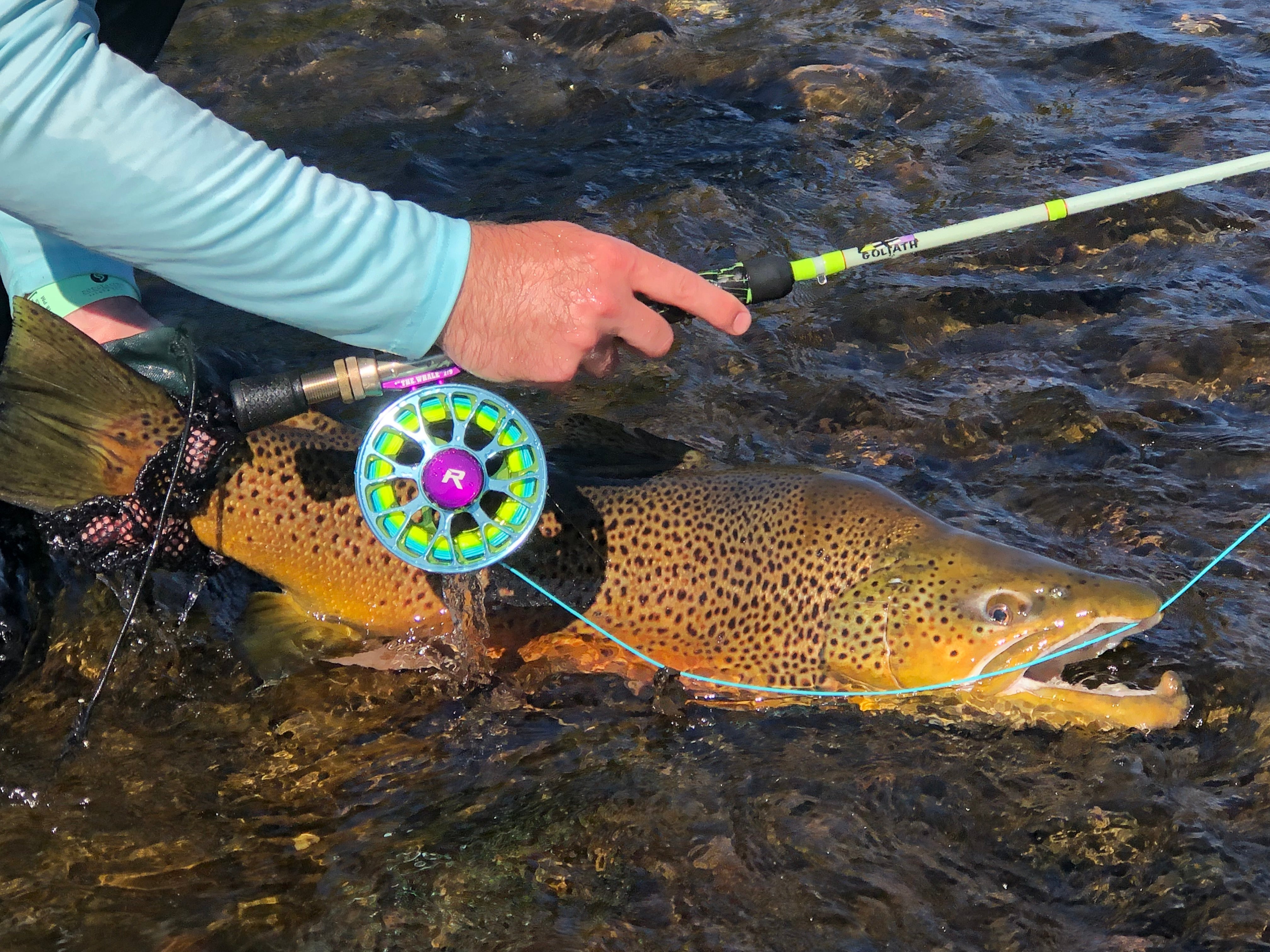

The best carp fly rod setup for most anglers is a 9-foot 7-weight, a weight-forward floating line, a sealed-drag reel with 100-plus yards of backing, and a 9- to 12-foot leader ending in 1X to 3X fluorocarbon tippet. Use a 6-weight for small urban carp and an 8-weight for big fish and wind.
A buddy of mine hooked his first real carp on his trout rod. Five-weight, 5X tippet, a little click-and-pawl reel he'd owned for twenty years. The fish tipped down, ate, and then just left. It took his fly line, went well into his backing and wrapped him around a submerged branch before he'd turned the handle once. He stood there holding a limp rod and laughing. "That wasn't a fish," he said. "That was a pickup truck."
That story is the whole point of this guide. Carp fight like saltwater fish and feed like trout, so your setup has to cover both: delicate enough to present a small fly without spooking a fish in a foot of water, and strong enough to stop a double-digit fish from reaching the weeds. If you're the angler from the Reddit thread who lives an hour from the nearest fly shop and got odd looks at the tackle counter, this is the shopping list I'd hand you.
Part of our Carp on the Fly series. New to carp? Start with the beginner's guide to carp on the fly, and when your rod is rigged, stock up with the best carp flies.
Denver urban guide Nic Hall broke down his entire carp rod, reel, line and leader setup with me near the end of episode 229, after learning much of it the hard way on the South Platte. Episode page.
- Seven is the sweet spot. A 9-foot 7-weight handles most carp water; go 6 for small urban fish and 8 for big fish, big water and wind.
- Floating line, almost always. Carp feed shallow, so a weight-forward floating line in a natural color does nearly everything.
- The reel matters. Carp run hard, so you want a smooth, sealed drag and 100 to 200 yards of backing.
- Tapered leader plus fluorocarbon tippet. A 9- to 12-foot leader to 1X-3X fluorocarbon sinks well and handles abrasion. The visibility benefit is real on paper but debated.
- Don't forget the small stuff. Polarized glasses, a big net, a hook file and muted clothing catch as many carp as the rod does.
Why Does Carp Gear Trip Up Trout Anglers?
Carp gear trips up trout anglers because a common carp is far stronger than the trout most of us fish for, and it lives around weeds, rocks and wood. A 5-weight trout outfit can cast a carp fly, but it often can't turn a big fish, and light tippet and an old click drag make it worse.
Nic Hall went through exactly this. On episode 229 of the Fly Fishing Insider Podcast, he told me he was still fishing 5-weights when a friend took him carp fishing for the first time and handed him a 6- or 7-weight instead. He also started out on 0X to 2X tippet, and after stalking fish for an hour only to lose them to obstacles, he moved to much heavier material and landed far more of them. That's a lesson a lot of us learn with a broken heart and an empty net.
What Weight Fly Rod Is Best for Carp?
The best fly rod weight for carp is a 7-weight for most anglers, with a 6-weight for small fish in sheltered water and an 8-weight for big fish, big water and wind. MidCurrent's carp stalking guide calls the 9-foot 7-weight the versatile standard, the American Carp Society recommends 7- to 8-weights at nine feet, and many guides who chase bigger fish simply start at an 8.
Our guests land in the same range. On episode 117, Matt Martin told former host Greg that a 9-foot 8-weight is the best all-around rod for the big Great Lakes carp he guides on, that a 7-weight can work in open water if wind isn't a problem, and that he bumps up to a 10-weight in heavy cover. He also said a 5-weight is plenty for the three- or four-pound fish in a neighborhood stormwater pond. Nic Hall fishes a 7-weight in Denver. When he came back on the show to preview Denver Trout Unlimited's Carp Slam, his advice for amateurs was to bring a 6- or 7-weight.
| Situation | Rod | Line | Tippet |
|---|---|---|---|
| Small urban ponds and creeks, fish mostly under 5 lb, little wind | 9' 6-weight | WF6 floating | 3X-2X fluorocarbon |
| Urban rivers with brush, snags and current | 9' or 10' 7-weight | WF7 floating | 2X-1X, or heavier in snaggy water |
| Most lakes and flats, mixed fish sizes | 9' 7-weight | WF7 floating | 3X-2X fluorocarbon |
| Big reservoirs, brackish or open flats, 15-20+ lb fish, wind | 9' 8-weight | WF8 floating | 1X-0X fluorocarbon |
| Heavy weed and timber, very large fish | 9' 9- or 10-weight | Matched floating | Heavy fluorocarbon, 15 lb and up |
Here's the trade-off in plain terms. A lighter rod casts small flies more delicately and makes a five-pound fish feel huge. A heavier rod punches through wind, turns big flies over and ends the fight faster, which is better for the fish. If you fish open, windy water like the brackish flats the Reddit poster described, lean toward the 8. If you fish a city creek, a 6 is a joy. If you can only own one, buy the 7.
What rod action works best for carp?
A moderate-fast action works best for most carp anglers, because it loads at the short distances carp fishing demands and still has backbone for the fight. Slower rods have fans too. The American Carp Society notes that fiberglass's slower action allows a more delicate presentation and absorbs enough shock to fish lighter tippet. Nic Hall likes a 10-foot rod for reaching over bankside brush and getting a better drag-and-drop angle, though he said the extra flex can feel sloppy with heavier flies.
What Reel and Backing Do You Need for Carp?
A carp reel needs a smooth, strong drag, ideally sealed, and room for at least 100 yards of backing behind the fly line. MidCurrent recommends 100 to 200 yards because carp routinely run into the backing. Matt Martin said even a five- or six-pound fish in open water will surprise you, and that his average Great Lakes fish takes him into the backing two or three times. He prefers sealed drags because a carp reel will get dunked in sand and muck.
Nic Hall learned that one personally. His first carp reel didn't have a sealed drag, gravel got into it, and for about a month he was fighting 10- and 12-pound carp by stripping line by hand. He now runs a large-arbor, sealed-drag reel with roughly 150 to 200 yards of backing, and he keeps the drag set fairly tight so the reel does the work in snag-filled urban water. The large arbor also picks up line faster when a fish turns and runs at you.
Should You Use a Floating or Intermediate Line for Carp?
A weight-forward floating line is the right choice for carp almost every time, because carp feed in shallow water and a floating line lets you lift, drag and drop the fly with control. Outdoor Life's carp guide puts it simply: any full floating line will do. Matt Martin will occasionally use an intermediate line in spring to crawl a small baitfish pattern slowly along the bottom, but that's the exception.
Two small details help. Pick a line in a natural, muted color, which is what Nic Hall does, since carp see well and a bright line flashing overhead spooks them. And expect to replace it more often than a trout line: Nic said urban carp fishing chews through a fly line in about eight to twelve months. A true-to-weight or slightly heavy front taper makes the drag-and-drop cast easier, since you're often loading the rod with very little line out.
Rig it right the first time
Get new carp tactics, setup tips and gear deals from the Fly Fishing Insider Podcast. Free signup on our homepage.
Sign up freeHow Should You Build a Carp Leader?
The easiest carp leader is a 9-foot tapered monofilament leader with 2 to 3 feet of 1X to 3X fluorocarbon tippet added to the end. Lengthen it toward 12 feet on calm, clear days, and shorten it when wind makes accuracy harder. Here's how I actually rig it:
- Start with a 9-foot 3X tapered leader. It turns over carp flies well on a 6- to 8-weight.
- Decide your tippet. For 3X fluorocarbon, add it straight to the leader. For 2X, snip 12 to 18 inches off the leader tip first so the diameters step down smoothly.
- Join them with a double surgeon's knot. Wet it well and pull it tight slowly, since fluorocarbon is stiff and easy to overheat.
- Add 2 to 3 feet of tippet. That gets you to 11 or 12 feet for spooky fish in clear water.
- Tie on the fly. Use an improved clinch knot for flies you drop and let sit, or a non-slip loop knot for flies you want to swim.
- Shorten for wind or cover. On a windy day or around heavy structure, cut back to 7 or 8 feet total and go heavier.
Our guests go shorter and heavier than that in tough spots. Nic Hall builds his own leaders from 25-pound fluorocarbon, about six or seven feet long with a loop-to-loop connection, and fishes 20-pound tippet in snaggy urban water. On episode 128, Eric Leininger described his hand-built all-fluorocarbon leader for sight fishing carp on the Columbia River flats: roughly seven and a half feet, stepping down in heavy sections because his shots are close and the water is shallow. Matt Martin runs a 9-foot 0X leader, stretching it to 12 feet on bright calm days, with at least 12-pound tippet and 15 in heavy cover. His reasoning: carp are more line-shy than leader-shy, so keep the fly line from landing over their backs.
Why use fluorocarbon tippet for carp?
Fluorocarbon tippet is popular for carp because it sinks, resists abrasion well and is harder for fish to see than nylon, though that last point is debated. Here's the honest breakdown:
- It sinks. Fluorocarbon is denser than nylon, so it pulls your fly down instead of holding it in the surface film. Flylords' mono vs. fluoro breakdown explains why that matters for subsurface flies.
- It handles abrasion. That's a big deal around rocks and weeds, but diameter matters more than material. In a sandpaper test reported by On The Water, fluorocarbon and nylon of the same diameter performed nearly the same.
- It may be less visible. Fluorocarbon's refractive index (about 1.4) is closer to water's (1.33) than nylon's (about 1.6), per the same On The Water piece. Whether carp notice the difference is debated, and our guests fish heavy tippet without much trouble.
- The downsides. It's stiffer, knots need extra care, and it costs more than nylon.
My take: the sink rate and toughness alone justify fluorocarbon for carp. Any visibility edge is a bonus.
Build a rig that survives urban water. Nic Hall's closing tip on episode 229 is a purpose-built carp setup: a 9-foot 7-weight (a 10-footer when he needs reach over brush), a large-arbor reel with a sealed drag and 150 to 200 yards of backing, a muted floating line, and a homemade leader that steps from a heavy butt section down to 20-pound fluorocarbon. That is heavier than most beginners expect, and in snaggy city water that is the point.
What Else Belongs in a Carp Fly Fishing Kit?
Beyond the rod, reel, line and leader, a carp kit needs polarized sunglasses, a big net, a hook file, pliers and clothing that blends in. These are the pieces beginners skip, and they cost fish.
- Polarized sunglasses. You can't cast to a fish you can't see. Amber, copper or brown lenses are the usual pick for bright flats. Matt Martin suggested approaching with the sun at your back for a better view through the glare.
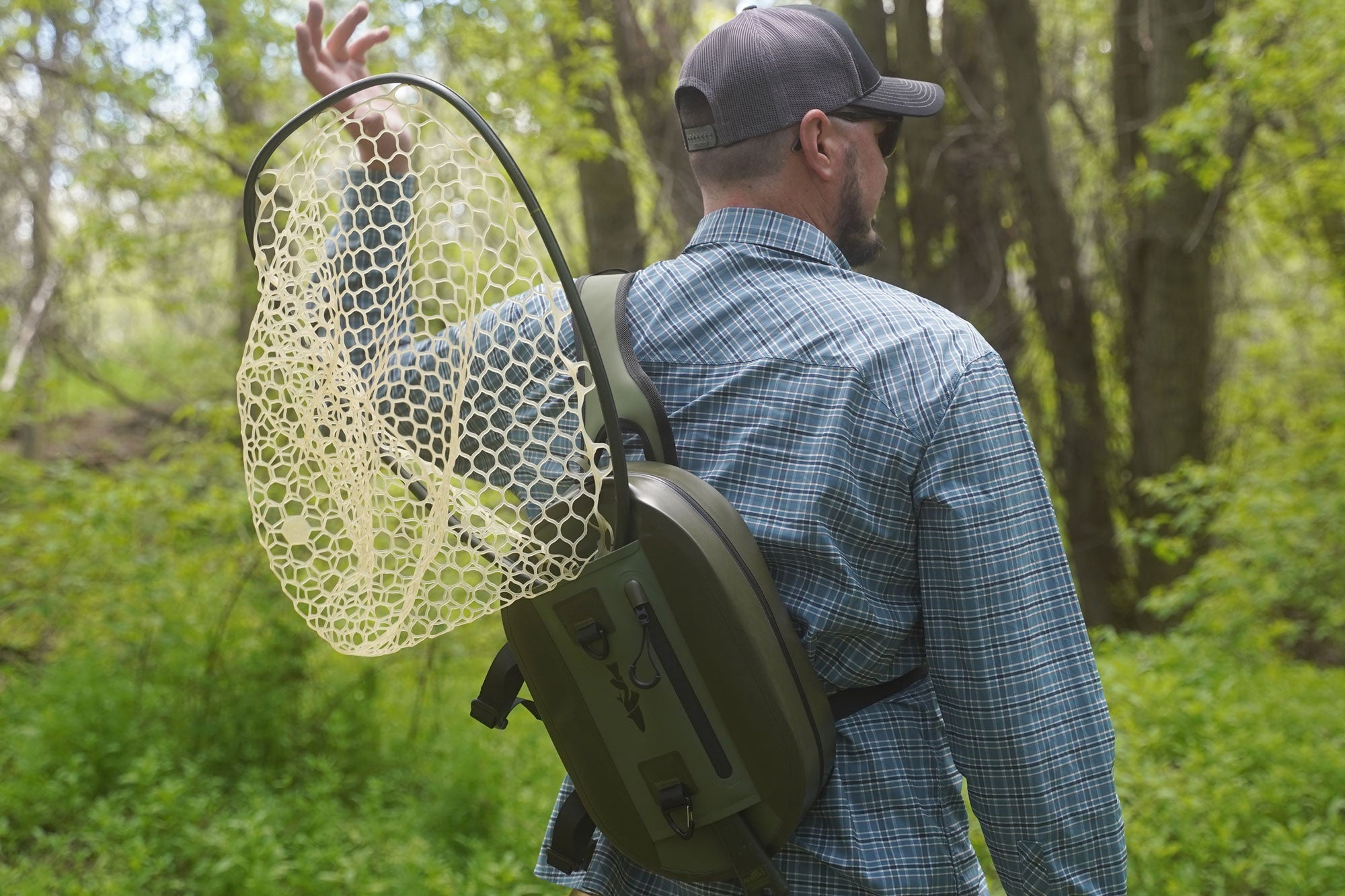
- A big net. A carp won't fit in a trout net. Nic Hall carries a pretty big net. From our shop, the Rising Lunker Net Package is built for big fish, and the Brookie Net is a lighter option for small urban carp. Browse all our nets.
- A hook file. Carp mouths are tough, and rocks dull hooks fast. Touch up the point every few fish.
- Pliers. For cutting heavy tippet, pinching barbs and quick releases.
- Muted clothing. Nic Hall's advice was to dress like you're going hunting and leave the neon sun hoodies at home. Earth tones and olive blend into the bank.
What If There's No Fly Shop Near You?
If there's no fly shop nearby, order your rod, reel, fly line, leaders and flies online, and use a big-box store for fluorocarbon line, pliers and polarized glasses. That's exactly the spot the Reddit poster was in, and it's more common than people think.
Here's what's realistic at a general tackle or big-box store. The conventional line aisle usually carries fluorocarbon on spools labeled by pound test rather than X size. Tippet X ratings vary by brand, and MidCurrent pegs 3X at roughly 10 pounds, so a spool of 8- to 12-pound fluorocarbon puts you in the right neighborhood, though conventional line can run a bit stiffer and thicker than fly tippet. Some stores with a fly section also carry a few tapered leaders. What you probably won't find is a carp-worthy fly reel, a quality weight-forward line or proper carp flies, so order those.
As for the odd looks? Ignore them. My friend Rachel got the same raised eyebrows asking about carp tackle, then got the last laugh when she sent the counter guy a photo of a fish that barely fit in her net. Carp fly fishing has plenty of company now, and our urban fly fishing guide shows how many anglers are chasing them in their own backyards.
Set your drag at home before you ever see a carp. Pull line off the reel by hand: it should be firm enough to bend the rod when you pull hard, but never so tight that it jerks. Then practice your knots in fluorocarbon at the kitchen table, not on a flat with a tailing fish in front of you.
Budget vs. Step-Up: Best Fly Rods for Carp in Our Shop
The best fly rod for carp on a budget is a 7- or 8-weight you'll actually fish hard, and you don't need to spend a fortune. Here's how I'd tier the carp-weight rods we carry:
- Budget: Genesis Fly Rod, 9' 7-weight or 8-weight ($139.99). A moderate-fast rod from Risen with a lifetime warranty. The 7 is my pick for most carp water, the 8 for big lakes and wind, and a 9' 6-weight is $129.99.
- Small and urban carp: HG Series Fly Rod, 9' 6-weight ($280). A moderate/fast Stone Creek rod that's a treat on smaller fish in sheltered water.
- Big water step-up: NIRVANA Moksha Fly Rod, 9' 8-weight ($349.99). Moonlit's Moksha 8-weight comes with a fighting butt and a case, and it's the one I'd want for heavy fish and windy flats.
If you already own a 5-weight trout outfit, like the Genesis Rod and Reel Combo, you can start there on small fish in calm water. Just know its limits, go heavier on tippet than you would for trout, and plan to step up once carp get their hooks in you. You can also browse our full rods, reels and combos collection.


- Genesis Fly Rod (9' 7-weight) — the do-it-all carp rod
- Fly Line Combo — floating line, backing and leader matched to your rod
- Stone Creek Leaders (9' 3X) — spare tapered leaders to build on
- Fluorocarbon Tippet Spools — 3X and 2X
- Brookie Net — for small urban carp, or the Lunker Net Package for big fish
- Diamond File — keeps hooks sharp for tough carp mouths
- Bobs Tactical Crocodile — cuts, crimps barbs and releases fish
Frequently Asked Questions
What weight fly rod is best for carp?
A 7-weight fly rod is best for most carp fishing. Use a 6-weight for small carp in sheltered urban water and an 8-weight for large fish, open water and wind.
Can I catch carp on a 5-weight fly rod?
Yes, you can catch small carp on a 5-weight fly rod in calm water, but it struggles with wind, bigger flies and larger fish. Use heavier tippet than you would for trout and avoid heavy cover.
What size tippet should I use for carp?
Most carp anglers use 1X to 3X fluorocarbon tippet. Go lighter in clear, open water with small fish, and much heavier around snags and weeds.
Is fluorocarbon better than monofilament for carp?
Fluorocarbon is usually better than monofilament for carp because it sinks faster and holds up well around rocks and weeds. Its lower visibility is often cited, but how much that matters to carp is debated.
How much backing do I need for carp?
You need at least 100 yards of backing for carp, and 150 to 200 yards is better on big lakes and rivers where fish have room to run.
What knot should I use to tie on a carp fly?
An improved clinch knot is the standard for tying on a carp fly. Use a non-slip loop knot when you want the fly to swim more freely on the retrieve.
Get the rod, reel and leader right, and carp stop feeling like pickup trucks and start feeling like the best fight in your backyard. Once you're rigged, fill your box with the best carp flies, learn the drag-and-drop method and revisit the complete beginner's guide whenever you need the big picture. I'll see you on the flats.
Tight lines, everyone!
Next in the series: The Carp Fly Box: Patterns That Actually Get Eaten, then the drag-and-drop method. Join the FFIP Insiders for gear deals, trip intel and tactics to help you catch any fish, any time, and anywhere.
Join freeShow us your carp on Instagram @flyfishinginsiderpodcast