
To cast to carp, get within 20 to 40 feet with the sun at your back, pick a feeding fish, and get the fly on the water within one or two false casts. Land the fly line short of the fish, lead a cruiser by a few feet, and drop the fly 4 to 8 inches beside a tailer's head.
Learning how to cast to carp humbled my buddy Tanner in about four seconds. We were wading a flat on a Utah reservoir when a big common carp came straight at us, slow and steady, head down every few feet. Tanner made a beautiful cast, and it landed right on the fish's head. The carp spun and left a wake like a jet ski. Twenty minutes later, a second fish came down the same lane. This time he dropped the fly a few feet ahead and a little to the side, let it settle, and waited. The fish slid over, tipped down and ate.
Same angler, same fly, same cast distance. The only difference was where the fly landed and when. That's what this guide is about.
Part of our Carp on the Fly series. New to carp? Start with the beginner's guide to carp on the fly, and pair this with the drag-and-drop method, step by step.
Eric Leininger of Fly Fish Portland described sight-fishing Columbia River carp from a poling platform, including which fish he ignores and where he drops the fly, on episode 128 of the Fly Fishing Insider Podcast. Episode page.
- Feeding fish first. Tailing and slow-browsing carp are worth your cast. Fast cruising pods usually aren't.
- Lead cruisers by a few feet. Roughly 2 to 4 feet for slow fish, more for faster fish or deeper water.
- Drop beside the head, not on it. For tailers, aim 4 to 8 inches off to the side of the head.
- Depth changes your lead. Doubling the depth roughly doubles the time your fly needs to sink, so time your flies.
- Watch the fly, not the tail. Set when the fly disappears, with a strip, and fight with low side pressure.
Why Does Fly Placement Matter So Much With Carp?
Fly placement matters so much with carp because a feeding common carp (Cyprinus carpio) has a small feeding window and won't move far to eat. Nic Hall said on episode 229 of the Fly Fishing Insider Podcast that carp are opportunists that usually won't chase food even a couple of feet. Matt Martin, on episode 117, described the same small window, along with a strong lateral line that picks up clumsy casts.
Carp and their relatives also hear unusually well. Britannica explains that fish in this group have the Weberian apparatus, a chain of small bones that carries sound from the swim bladder to the inner ear. Eric Leininger put it simply on episode 128: too close and the fish spooks, too far and it ignores you. Sometimes a fish 50 feet away spooks and runs right into the one you were targeting.
It's like throwing to a receiver running a route. You throw to where he'll be, not where he is.
Which Carp Shots Should You Take, and Which Should You Pass?
The carp shots worth taking are fish that are feeding and angled toward you or across your position. Fish swimming away and fast-moving schools are usually worth passing up. Before any of this, decide whether the fish is even catchable. Our guide to reading carp behavior covers tailing, cruising and sunning fish in depth.
| Fish orientation | Shot | Lead distance | Notes |
|---|---|---|---|
| Tailing or mudding, head down (any angle) | Take it. Best shot on the water. | No lead. Drop 4 to 8 in beside the head. | Cast 1 to 3 ft past and drag in. Eric Leininger estimated about a 10-second window once the tail tips up. |
| Head-on, slow and feeding | Take it. | 2 to 4 ft ahead, in its lane, slightly to one side | Let the fly settle before the fish arrives. Stay low, because it's looking your way. Keep the fly line well short of it. |
| Quartering toward you | Take it. Often the easiest cruiser shot. | 2 to 4 ft ahead, 1 to 2 ft past its path | Drag the fly into the lane. The line stays off the fish naturally. |
| Broadside, crossing in front | Take it if the fish is slow. | 3 to 5 ft ahead, landing past its far side | Biggest risk is lining the fish. Cast a little short and use the drag to finish the placement. |
| Quartering away | Marginal. Only for slow, feeding fish. | More lead than you think, off the eye side | You're partly behind it, so line-over-back is a real risk. Better to move and get ahead. |
| Going away, tail toward you | Usually pass. Reposition ahead of it. | n/a | Exception: a stationary or rooting fish. Matt Martin approaches those from behind, in the blind spot. |
| Sitting still, hovering | Worth a careful shot. | Within 6 to 8 in of its face | Matt Martin said most of these fish will take a well-placed fly. |
| Fast cruising school | Pass. | n/a | Eric said schools with somewhere to go rarely eat. |
The head-on shot
The head-on shot trips people up because the fish is looking right at you. Matt Martin said carp are more line-shy than leader-shy, so with a 9-foot leader, his fly line lands several feet short of the fish. Put the fly a few feet ahead and slightly to one side, let it reach the bottom, and give it one tiny twitch as the carp closes in. Nic Hall added that carp wander more than trout, so sometimes the best move is to set up and let the fish come to you.
The going-away fish
Casting over a departing carp's back to get ahead of it usually lines it. Circle wide and meet it instead. The exception is a carp parked or rooting in place. Matt likes sneaking up on those from behind and dropping the fly right on its dinner plate.
How Far Should You Lead a Cruising Carp?
Lead a slow cruising carp by roughly 2 to 4 feet, and lead faster fish by more, so the fly reaches the carp's level just as the fish gets there. The Reddit commenters said a few feet, and that matches what guides teach. Marshall Cutchin at MidCurrent recommends leading a cruising fish by two to three feet. Matt Martin casts 3 to 4 feet past the head, lets the fly drop within about 2 feet of it, and then moves the fly into the feeding zone.
Three things change those numbers:
- Speed. A fish moving at a slow walk needs more lead than one poking along, stopping to root.
- Depth. Deeper fish need more time for the fly to get down, which means more lead.
- Mood. A feeding cruiser will detour a little. A traveling one won't.
For tailers, forget lead. Matt aims 4 to 6 inches off one eye, Nic drops at 6 to 8 inches, and Eric aims about 6 inches ahead and slightly to the side. All three said the spot right in front of the nose is hard for a carp to see.
Borrow a redfish guide's aim point. Florida redfish guide Lucas Largel made the case on episode 230 that presentation beats pattern, and his target is precise: land the fly ahead of the fish on its outside eye, the side facing away from you, and lead it rather than dropping it right in its face. Carp are not redfish, but the same geometry keeps your line off the fish and your fly in its lane.
How Long Does a Fly Take to Reach a Carp at 2 Feet vs. 4 Feet?
The time a fly takes to reach a carp depends on the fly's sink rate, and doubling the depth roughly doubles the time. There's no universal number, because eyes, materials and hook size all change the fall. But the math is simple:
Lead needed ≈ how fast the fish is moving × how long your fly takes to reach its level.
Here's a worked example with made-up round numbers, so time your own flies before trusting it. Say your fly falls about half a foot per second. To reach a carp feeding in 2 feet of water, it needs about 4 seconds. In 4 feet of water, it needs about 8. If the fish is creeping along at a foot per second, that's roughly 4 feet of lead in the shallows and 8 feet in the deeper water. Double the depth, double the lead.
A few practical notes on the math:
- A cruiser's eye level isn't the bottom. For a fish swimming mid-water, the fly only needs to reach its level, not the mud.
- Water usually looks shallower than it is, especially when it's clear. Assume a little deeper.
- Tailers burn the clock. If Eric's rough 10-second window is right, a slow fly in 4 feet of water uses up most of it. Go heavier, or drop closer with the drag-and-drop.
- Cold fish want slow. Matt said cold, slow carp want a very slow fall, so he goes unweighted or uses tiny bead chain and gets closer instead.
To learn your numbers, drop each fly in clear water by the bank and count until it hits bottom.
Sharper shots, more eats
Get guest tactics, new carp breakdowns and gear deals from the Fly Fishing Insider Podcast. Free signup on our homepage.
Sign up freeHow Do You Make a Quiet, Accurate Cast to Carp?
You make a quiet, accurate cast to carp by keeping it short, low and nearly free of false casts, with the fly line landing short of the fish. Most good carp shots happen between 20 and 40 feet. Matt Martin pushes his clients to get even closer, into the 15- to 20-foot range, because shorter casts mean less line on the water and a softer landing.
- One or two false casts. Eric Leininger drills this with his clients: fly in hand, line out, one or two false casts and the fly is on the water. By the sixth false cast, the fish is gone. False cast off to the side, not over the fish.
- Go sidearm. I cast low and sidearm whenever I can, so the rod and line stay out of the fish's view.
- Keep the line off the fish. The leader can pass near a carp. The fly line can't.
- Choose quieter flies in calm water. Nic Hall switches from lead eyes to bead chain in low, calm water, because heavy eyes make too much splash.
- Adjust for wind. Matt goes to a shorter leader on windy days for accuracy and a longer one, up to about 12 feet, on bright, calm days. He added that a little ripple actually hides mistakes.
If your loops are still unpredictable, spend an evening with our 8-step guide to better fly casting. Accuracy at 30 feet beats distance every time with carp.
How Do You Approach Carp Without Spooking Them?
You approach carp without spooking them by moving slowly, keeping low, managing your shadow and putting the sun behind you. Luke Annear, who runs Freshwater Flats Guide Service in southern Wisconsin, built episode 171 around exactly this idea: target the carp's feeding zone and quiet your approach, because these are spooky fish cruising in shallow water.
- Walk like you're stalking. Matt Martin tells clients to walk slowly and confirm there isn't a fish in front of them before every step.
- Sun at your back, shadow managed. Matt said the sun at your back lets your polarized glasses see much farther, but you have to keep your shadow from reaching the fish.
- Dress like a hunter. Nic Hall's advice is to skip the bright sun hoodie and wear muted colors.
- Stay low and slow in the water. Marshall Cutchin recommends wading slowly and flat-footed.
- Rest spooked water. Matt said spooked carp can need 15 to 20 minutes to settle. Stand still and let them come back.
Lessons from Eric Leininger's poling platform
Eric Leininger gave us a perspective most carp anglers never get. On episode 128, he described poling his boat across clear sand flats on the Columbia River near Portland and calling shots from the platform, like a flats guide. He wants sunny days for visibility, ignores cruising schools, and finds the slow, head-bobbing fish he calls browsers the hardest, because they're alert. He loves tailers, because they're too busy feeding to notice you.
He calls shots by clock position and distance, like 10 o'clock at 20 feet. He casts across the fish, a foot or two past it, then drags the fly and drops it just off the side of the head. Most of us don't have a platform, but height still helps you see, so use a high bank or a rock.
How Do You Spot a Carp Eating Your Fly?
You spot a carp eating your fly mostly by watching the fly and the fish's head, because you rarely feel the take. Carp suck food in and spit it out fast. Nic Hall said a carp can decide a fly isn't food almost instantly and spit it, which is why seeing the eat matters so much. Watch for these tells:
- The fly disappears. This is Nic's go-to signal, and it's the most reliable one.
- The mouth opens. Matt Martin looks for a flash of white as the mouth extends.
- The gills flare. Eric sees this on clear flats, but Nic said it's usually subtler than on a redfish.
- The fish stops, turns or tips onto the spot. This means it's interested. Matt warned that a tilt alone isn't the eat, so wait for one of the tells above.
- A fresh puff of mud or a tail kick right where your fly landed, especially in dirty water.
Fly color helps you see all this. Nic likes black, olive and rust because they contrast with the bottom. If you can't see your fly at all, read catching carp you can't see.
How I Actually Make the Shot
- Spot and judge the fish. Is it feeding? Which way is it facing? How fast is it moving? Decide in a couple of seconds whether it's a take or a pass.
- Close the distance. Move slowly to get within 20 to 40 feet, with the sun behind you and your shadow off the fish.
- Pick the landing spot. Choose one based on lead, depth and which side of the head you want the fly on.
- Cast low with one or two false casts. Land the fly past the fish and the line short of it.
- Drag and drop. Skate the fly into the lane and drop it so it arrives when the fish does.
- Watch the fly and wait. Freeze, and set only on a real eat.
- Strip-set and fight low. Then clear your line and let the fish run.
How Do You Strip-Set and Fight a Big Carp?
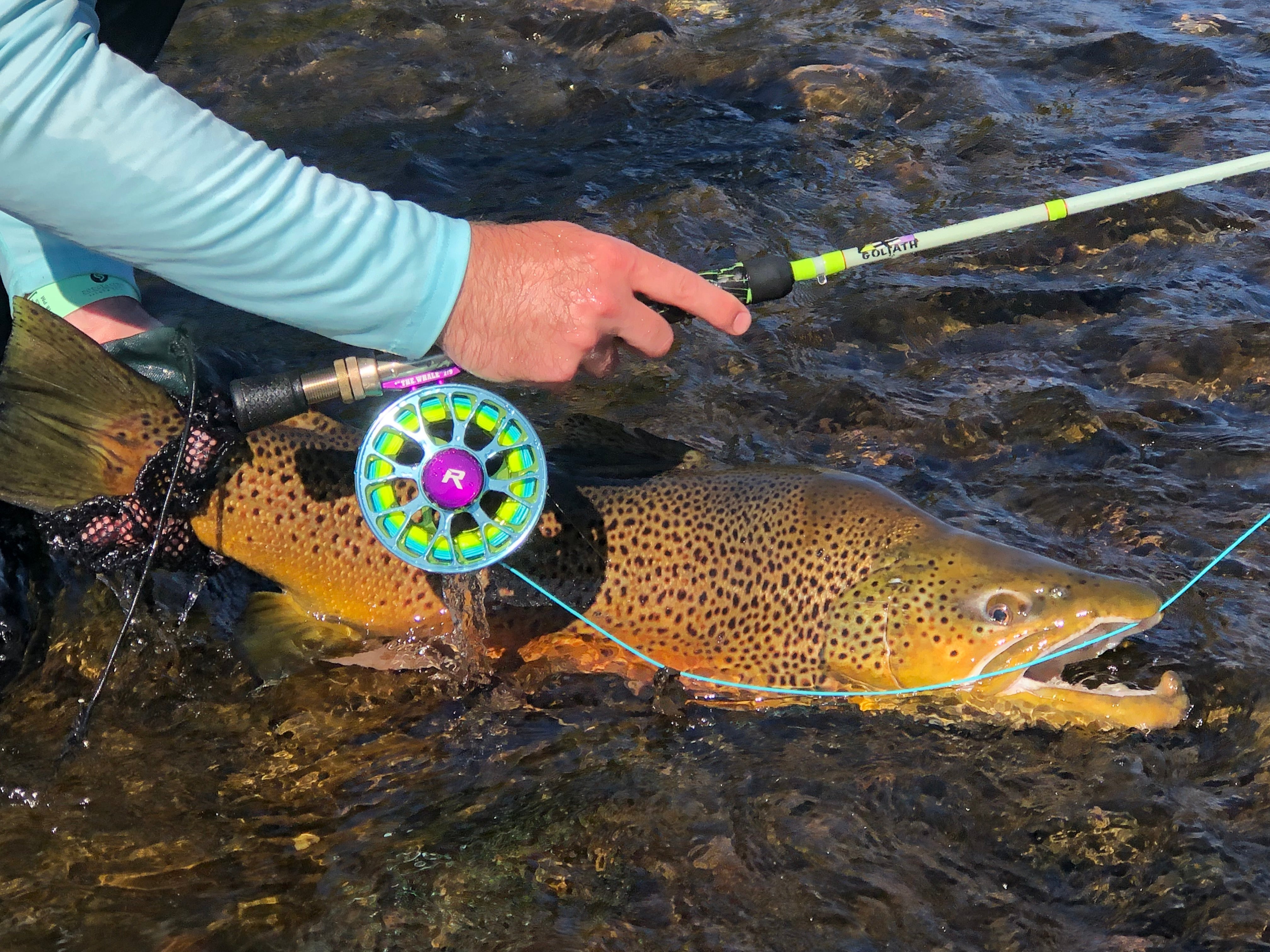
You strip-set a carp by keeping the rod low and pulling the line firmly with your line hand, then fighting the fish with low side pressure and letting it run on the reel. Matt Martin explained on episode 117 that a strip set is your best bet on fish 20 to 40 feet away, because a missed strip moves the fly only a few inches, so the fish can still eat. He starts with a quick strip, and if he feels weight, he follows with a harder one. For a fish practically under your rod tip, inside about 15 feet, he's fine with a trout set.
Then the fun starts. A few rules for the fight:
- Get the line on the reel. Let the first run take up the loose line, and keep it away from your feet.
- Let it run, then be ready. Matt said big carp often take a long run into the backing, then turn and sprint back at you. Reel fast or back up to keep the line tight.
- Keep the drag firm, not locked. Nic Hall runs a fairly tight drag in current, but warned that horsing a carp can tear the hook free.
- Fight low and to the side. Matt uses low rod angles and changes angles to turn the fish's head, which shortens the fight. Domenick Swentosky at Troutbitten explains why side pressure beats a high rod: it takes away the fish's leverage.
- Land it with a net. Matt said a carp's tail folds when grabbed, so you can't tail one like a trout. Nic uses a big net. For catch and release, keep the fish wet and release it quickly.
Before every shot, decide which way you'll steer the fish if it's hooked. Look for the snags, weed beds and drop-offs before you cast. Once a big carp is running, there's no time to plan, and a fish that reaches cover is usually a lost fish.
Gear That Helps You Place the Fly and Land the Fish
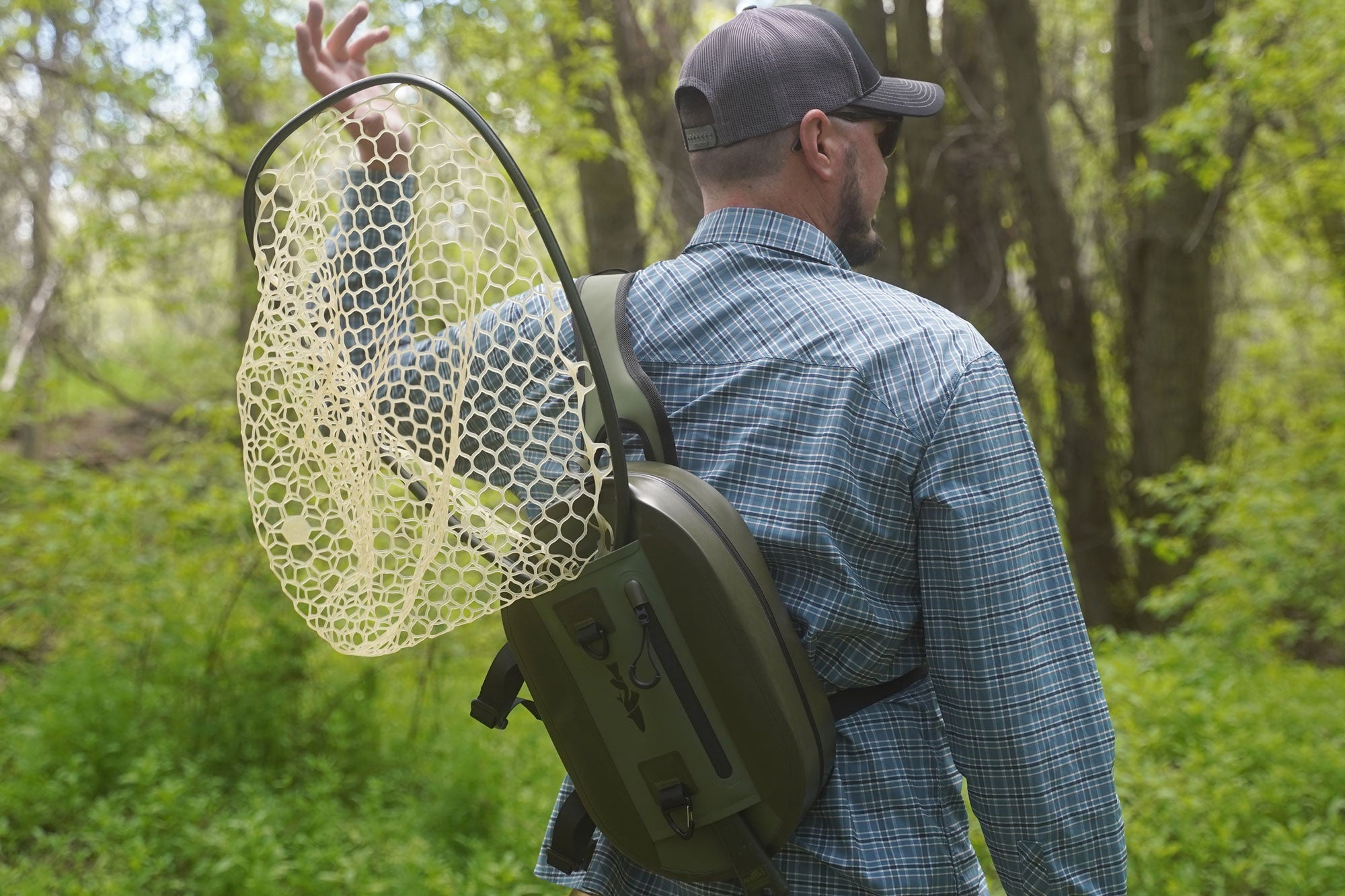
The gear that helps most with carp placement is a slow-sinking fly you can see, a rod with enough backbone to cast accurately in wind, and a net big enough for a double-digit fish. My friend Josh landed far more carp once he moved up from his 5-weight. Here's what I'd grab from our shop. For line and leader details, read our carp fly rod setup guide, and browse the full lineup of nets.


Frequently Asked Questions
How far should I lead a cruising carp?
Lead a slow cruising carp by about 2 to 4 feet, and lead faster or deeper fish by more. The goal is for the fly to reach the carp's level just as the fish arrives, so time how fast your fly sinks.
Should I cast to a carp swimming straight at me?
Yes, a slow, feeding carp swimming toward you is a good shot. Put the fly a few feet ahead and slightly to one side, keep the fly line well short of the fish, stay low, and let the fly settle before the carp gets there.
Where should the fly land for a tailing carp?
For a tailing carp, cast 1 to 3 feet past the fish and drag the fly back so it drops about 4 to 8 inches beside the head. Directly in front of the nose is hard for a carp to see.
How do I know when to set the hook on a carp?
Set the hook when the fly disappears, the mouth opens or the gills flare, not when the carp simply tips toward the fly. Keep the rod low and strip-set.
What weight rod is best for casting to carp?
A 6- to 8-weight rod is best for most carp fishing. A 7-weight is a good middle ground, with enough backbone to punch through wind and turn big fish.
Put It Where They'll Eat It
Carp reward anglers who think a step ahead. Choose a feeding fish, read its direction, figure out where it'll be when your fly gets down, and keep your line off its back. It's the same thinking that helps any angler catch any fish, any time, and anywhere. Next, sharpen the presentation itself with the drag-and-drop method, learn which carp are worth casting to, or head back to the complete beginner's guide.
Tight lines, everyone!
Next in the series: The Drag-and-Drop Method and Reading Carp Behavior. Join the FFIP Insiders for gear deals, trip intel and more carp tactics.
Join freeShow us your carp on Instagram @flyfishinginsiderpodcast