
A fly fishing trip with a non-fishing partner works when you answer one structural question first: is this a fishing lodge that tolerates non-anglers, or a resort that happens to run a fishing program? Then ask what the non-angler rate includes, what there is to do on a fishing day, and whether transport exists that isn't the boat.
My buddy Todd called me from the dining room of a very good lodge on the third night of a six-night week. Not about the fishing — the fishing had been excellent. He was calling because his wife had spent three days in a beautiful building with a hammock, a shelf of paperbacks, satellite internet too thin for a video call, and no road out. Nothing was wrong with the lodge; the lodge was exactly what it advertised. Todd had booked a fishing lodge, and his wife had entirely reasonably expected a vacation.
I'm Christian Bacasa. I host the Fly Fishing Insider Podcast, I've been at this about 25 years, I guide here in Utah, and I book travel as an Authorized Agent for Frontiers International Travel. Roughly a third of the trips I help put together involve somebody who doesn't fish. The ones that go beautifully and the ones that go sideways almost never differ on destination — they differ on about nine questions that got asked, or didn't, before anybody paid a deposit. The wider checklist lives on the Before You Book hub.
Is it a fishing lodge that tolerates non-anglers, or a resort with a fishing program?
Ask that first, out loud, in those words. Nearly all the disappointment I see comes from someone booking the first kind of place while quietly picturing the second.
A fishing lodge is built around getting anglers onto water and feeding them afterward. Boats leave at a fixed time, the building empties at 7am and refills at 6pm, and the social life of the place is dinner. Non-anglers are welcome the way a plus-one is welcome at a work conference: warmly, and with no programming built for them. A resort with a fishing program is the reverse — a hotel with a spa, a pool, a restaurant serving lunch to people who aren't in a boat, and skiffs off to one side. The fishing can be world class either way. The week feels completely different.
Copal Tree Lodge in southern Belize is a clean example of the second kind. They publish an actual couples fly fishing package where the angler fishes and the non-angler gets a 60-minute massage, a snorkel tour with the chef, a sunset river cruise, a chocolate-making class and a farm tour, with one day set aside for the two of you. Nobody had to invent that on arrival — it was a product before you got there, and that's what you're shopping for. But the honest part: the first kind of place is often where the best fishing is. Remote is remote for a reason. This isn't a nudge toward the resort every time. It's a nudge toward knowing which one you booked.
| Lodge type | Non-angler rate? | What there actually is to do | Who it suits |
|---|---|---|---|
| Remote fly-in fishing lodge (bush-plane Alaska, jungle, far-flung atoll) | Often unpublished, or a flat bed-and-board figure | The lodge, the deck, a trail from the door, wildlife, a book. No town, no road, usually no second boat. | Someone who wants to be unreachable and has brought a project |
| Destination lodge near a town (Montana ranch, Bahamas settlement, Patagonia estancia) | Usually yes, and usually published | Hikes, hot springs, ghost towns, a market, a brewery — most of it needing a rental car you book yourself | A partner happy with a car, a map and their own plan |
| Resort with a fishing program (Ambergris Caye, Belize jungle lodges, Caribbean and Baja hotels) | Yes, and close to full price | Spa, pool, beach, snorkel and sightseeing boats, ruins, cooking classes, restaurants, town by golf cart | Almost anyone. The safest mixed-interest booking there is. |
| Mothership or liveaboard | Rarely — bunk space is the constraint and it's sold by the rod | The boat. That's the whole list. | Nobody who isn't fishing |
| Rental house or DIY week | No rate at all — you rent a house and hire guides separately | Whatever the town offers. Total freedom, zero structure, all the logistics on you. | A couple who likes to self-cater, drive and improvise |
If the mothership row surprised you, that's worth knowing before you fall in love with a boat trip. I go deeper in the lodge versus mothership versus DIY breakdown.
How do you plan a fly fishing trip with a non-fishing partner? Nine questions to ask
Plan a fly fishing trip with a non-fishing partner by asking the lodge nine specific things before you send money. Not "is it good for non-anglers" — every lodge says yes to that. Ask these in one email so you get one written answer you can hold onto.
1. Is there a non-angler rate, and what exactly does it include?
"Included" does a lot of work there. All meals, or dinner only? Any day in a boat? The airport transfer, which on a remote booking can be a charter flight priced per seat? Get it itemized — our what all-inclusive really covers post applies double here.
2. Is the lodge remote, or is there a town?
Not "is it beautiful." Is there a town, how far, and can you reach it without the fishing boat? Ambergris Caye has a town you get to on a golf cart — see the Ambergris Caye guide. A fly-in lodge on Fish Lakes Creek in Alaska is, in the lodge's own words, accessible only by air or water. Both are great. Only one has a coffee shop.
3. Is there transport that isn't the fishing boat?
This is the question that saves marriages. Three skiffs, three guides, the other two booked by other anglers, no vehicle — and your partner's mobility for the week is walking. Ask about a courtesy vehicle, a bike, a golf cart, a second boat for snorkeling, or a taxi that can be called. "We can usually arrange something" is not an answer. Ask what it costs and whether it needs booking ahead.
4. What is actually available on a day when I'm on the water?
Make the lodge describe an ordinary Tuesday, 8am to 5pm, for one adult who isn't fishing. Spa? Pool? Beach with shade? A guided hike, a ruins trip, a market, a cooking class? Any of those is fine. Nothing is also an answer — better in writing in February than discovered in July.
5. Is there wifi or cell service good enough to work or call home?
"We have wifi" now means anything from real satellite broadband to one bar in the corner of the dining room. Ask precisely: can I hold a video call, is it in the rooms or only common areas, is it metered, and does it collapse at 6pm when every angler is back online? Some partners will happily come if they can keep one foot in their own life. Others are counting on being unreachable.
6. What are the meal times, and is dinner a communal fishing-talk table?
Some lodges seat everyone at one long table and the conversation is six hours of flies and fish counts. I love that table. Plenty of people would rather eat glass. Ask whether seating is communal or separate, when dinner actually lands, and whether the kitchen can do anything earlier. Small question, six evenings.
7. Can they ride along in the boat, and is there a charge?
Most flats skiffs and drift boats carry a third person and many lodges allow it, some for a fee, some capped by weight or boat. The honest version: riding along is wonderful for about four hours, and then it's a small hot platform with no shade and nowhere to go. A half day is a gift. Three full days running is an endurance event.
8. How many bedrooms, and what's the occupancy structure?
Bring two kids and "double occupancy" pricing stops meaning anything. Ask how many beds are in a cabin, whether there's a family unit or villa, whether a third person in the room is charged as an adult, and whether any unit sleeps four without an upcharge that eats the savings.
9. Is the single supplement working in my favor here?
This one surprises people badly enough that it gets its own section below.
The full vetting list for the fishing side — ratios, cancellation windows, who's actually guiding you — lives in the questions to ask before you book a lodge. Send both lists in the same email.
What does a non-angler rate at a fly fishing lodge actually cost?
A non-angler rate at a fly fishing lodge runs anywhere from roughly a sixth of the angler rate to nearly all of it, and the size of that gap is the most useful thing you'll learn. It tells you what the lodge thinks a non-angler is getting.
Two published examples, both from the lodges' own rate pages as of September 2026. At Big Hole Lodge in Montana, the angler pays $5,150 per person for five nights and four guided days, double occupancy. The non-fishing guest pays $860 for the same five nights — about $170 a night. That number tells the truth: you're buying a cabin, three meals, wine with dinner and the scenery. The guide and the boat were the expensive part, and your partner isn't using them.
Now El Pescador on Ambergris Caye, where the published high-season fishing package for four nights and three days runs $3,666 per person double, and the published non-fishing package for the same four nights runs $2,691. That's 73% of the angler price, and nobody is gouging anyone — the resort, the beach, the pool, the food and the island are the product, and the non-angler gets almost all of it.
Read those two figures right and you can screen lodges by rate sheet alone. Low non-angler rate: a fishing lodge, so come with your own plan. High non-angler rate: a resort, and the week is genuinely theirs.
The single supplement math nobody runs
Almost every lodge charges a single-occupancy premium, and it is not small. At Belize River Lodge, a seven-night, six-day package is $5,775 per person double and $8,325 for a single angler — a $2,550 gap. El Pescador's seven-night high-season package is $6,205 double and $9,355 single.
So run the real comparison. At El Pescador's published high-season four-night rates, going alone as a single angler is $5,466. Going with a non-fishing partner is $3,666 for you plus $2,691 for them: $6,357. Bringing another human being cost $891. Not $2,691 — $891, because you stopped paying the single supplement the moment somebody shared your room.
That lands every time I say it, because most anglers have quietly filed "bring my partner" under luxuries they can't justify. At a lot of lodges it's the cheapest upgrade on the sheet. Run the arithmetic before you decide you can't afford it.
Should the angler fish half days?
Yes — and the trips that work are the ones where the angler books half days, or three hard days out of six, deliberately, at booking. Not negotiated on day two in a hallway.
Rachel is why I frame it that way. Rachel is the angler in her house; her husband doesn't fish and has no interest in starting. She booked four full fishing days and two days together, and she put that in the original email, so the guide schedule was built around it from the start. The guide knew. The kitchen knew. Nobody was doing anybody a favor. It was just the shape of the week.
Compare the Todd version: six full days because that's what the package said, and by Wednesday Todd was giving up a day he'd paid for and feeling guilty while his wife felt like a problem to be managed. Same lodge, same money, completely different trip. The only variable was whether the compromise got designed in advance or extracted under pressure.
So ask whether half days are possible, whether they cost the same as full days (at many lodges they do, because the guide's day is committed either way), and whether you can fish hard early in the week and taper. Then write it into the booking. A shoulder-season week helps, because the lodge is less full and the schedule bends — see shoulder season fly fishing trips. A hosted trip cuts both ways: someone's job is making sure nobody is stranded, but the group's gravity is all fishing and your partner may be the only person at dinner who didn't have a day on the water. The hosted versus on your own comparison has the full argument.
Dry Fly Tactics for Selective Trout
If a half-day plan means fewer hours on the water, the hours you get need to count. This free eBook is our guide to fishing dry flies to picky trout.
Download the free eBook →How do you give a non-fishing partner a real day of their own?
Give a non-fishing partner a real day of their own by booking it as a day, with a guide and a purpose, the same way you booked yours — not as leftover time. The photography day works best: book a guided day for two where your partner's job is the camera. They're not tolerating the boat, they have an assignment. Suddenly the light matters, the birds matter, the guide poling on the platform matters, and they come home with something of their own.
Photograph the trip, not just the grip-and-grin. Russ Miller of Umpqua made this point on episode 30, and after 47 years in the fly business he's seen more trip albums than anyone I know: document the place, the people and the small moments, not only the fish in your hands. Every grip-and-grin looks like every other grip-and-grin; the shot of the cook laughing in the kitchen doorway is the one you'll still care about in ten years. That matters double on a mixed-interest trip, because an album of nothing but fish quietly tells the person who came with you that the week was borrowed rather than shared.
The other version is the lesson day, and it has one rule: no expectation. Book a half day with a patient guide, tell the guide the goal is a pleasant morning and not a fish, and let your partner try casting on a lawn or a quiet flat. Some people discover they love it. Most discover they finally understand why you disappear for four days at a time, which is worth more. The failure mode is turning the lesson into an audition. Caught nothing, enjoyed the morning: that day worked.
Does a fly fishing trip work with kids?
A fly fishing trip works with kids when you pick the destination for their tolerance rather than your target species, book half-day guides, and let them catch whatever bites instead of what you came for. Temperament predicts more than a birthday, but the floor for a real guided half day is around age eight, and ten to fourteen is the sweet spot.
Some lodges price for this and say so. Belize River Lodge publishes a 50% discount for children 12 and under; Northwoods Lodge in Alaska publishes two-thirds of the stated rate under 12. A published child rate is a signal — kids show up there often enough to need a line on the rate sheet, which means the staff has done this before.
Three things I'd hold to. Half days, always, and be genuinely ready to come in after two hours. Let them fish for whatever is willing — a kid who catches fifteen small snappers off a dock had a better day than one who spent six hours hunting a permit nobody landed, and the second day is how you manufacture an adult who hates fishing. And ask for the guide who's good with kids, by name. Every lodge has one. Not every lodge volunteers the distinction.
- A resort with a fishing program, where the non-angler week is a real product with a published rate
- A lodge within reach of a town, plus a rental car booked in your partner's name
- Half days, or three hard days of six, written into the booking from the start
- A partner bringing their own project — a book, a camera, a manuscript, a sketchbook
- One guided day for two, planned ahead, where they're the photographer
- Shoulder season, when the lodge is quieter and the schedule bends
- A remote fly-in lodge with no road, no second boat and no published non-angler program
- A mothership or liveaboard, where the only place to be is the boat
- Assuming a full-day ride-along in the skiff substitutes for having something to do
- Negotiating your half days on day two, after the guide schedule is set
- Counting on wifi you never asked a specific question about
- A destination chosen entirely for a target species your kid has no shot at
What conversation should you have before booking?
Have the honest one, before you look at a single lodge: what does each of you actually want out of this week? Not "would you like to come to Belize." That question has one polite answer, and a polite yes is how Todd's week happened.
The version that works is specific and slightly uncomfortable. I want to fish hard, and here's what hard means in hours. What would make this a good week for you — sitting still somewhere beautiful, or doing things? Unreachable, or able to keep working? Town and some noise, or somewhere empty? And: are you coming because you want to, or because you think I want you to? That last one deserves a real answer, and sometimes the answer is "you go with Todd and I'll take my own week in the fall." That's a completely good outcome nobody should feel bad about.
After that conversation you're shopping for two things at once, which is where a booking agent earns their keep. When I work a mixed-interest trip through Frontiers, the non-angler's week is a question I ask in the first email, not the last. Frontiers has been placing anglers since 1969 and knows which properties have a real answer and which have a brochure answer. Here's how the FFIP travel partnership works — and if a warm week in January is what makes this sellable at home, start with our winter fly fishing destinations roundup.
What gear matters when someone is coming along?
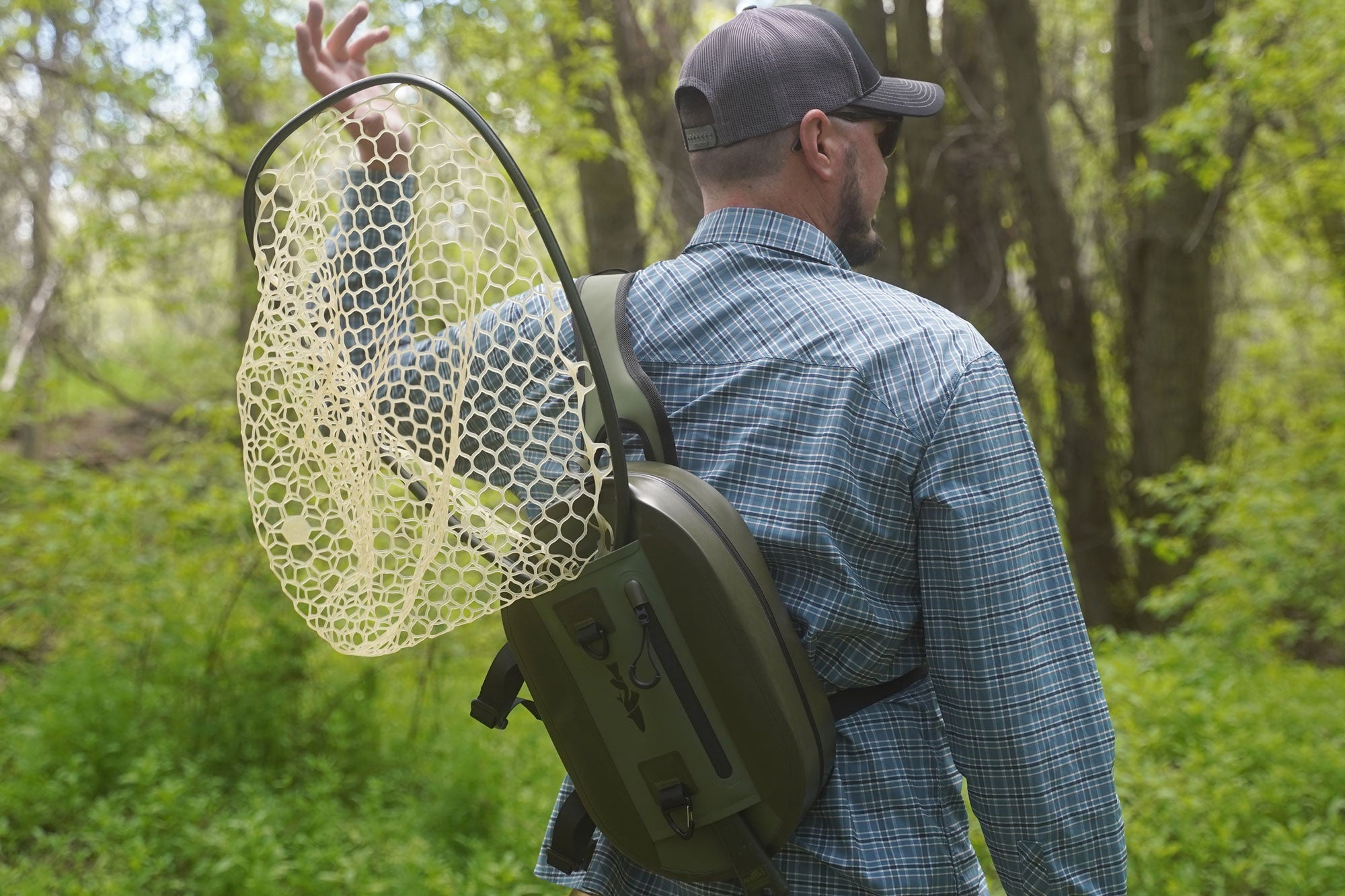
Not much, which is the good news — but the small stuff changes a non-angler's day in a boat. A dry bag comes first, because the person riding along has more to protect than you do: sunscreen, camera, hat, paperback, phone, dry shirt. A skiff takes spray and a drift boat takes rain, and nothing sours a ride-along faster than a soaked book. Compare sizes in the dry bags collection. Second is sun protection, which non-anglers underestimate because they've never been burned on the water — a brimmed hat and a neck gaiter from the hats, beanies and neck gaiters range does more for a partner's afternoon than any other $25 you'll spend. Third is reading: our FFIP eBooks let a curious partner understand what you're doing out there before deciding whether they care.


Frequently Asked Questions
Do all fly fishing lodges have a non-angler rate, and is it negotiable?
No. Destination lodges near towns and resorts with fishing programs usually publish one; remote fly-in lodges often quote it case by case or don't offer one at all, because every bed is sold as an angler bed in peak weeks. It's occasionally flexible in shoulder season and almost never in prime weeks. Ask for the rate in writing with an itemized list of inclusions rather than asking for a discount.
Can a non-fishing partner ride along in the boat every day?
Physically, often yes — most drift boats and flats skiffs take a third person, and many lodges allow it free or for a modest charge. Practically it's a bad plan: a skiff has no shade, no privacy and no exit, and the novelty of watching someone else cast wears off in half a day. Treat a ride-along as one good half day, confirm any charge and weight limit in advance, and build the other days around something on land.
Is there wifi at a fly fishing lodge if my partner needs to work?
It varies enormously, and "we have wifi" is not a useful answer. Satellite internet has made real connectivity possible at genuinely remote lodges, but bandwidth is often shared, metered, limited to common areas, and worst in the evening when every angler is back online. If your partner needs video calls, ask whether a video call actually holds, from the room or only the lodge, and what happens at 6pm.
What is the best fly fishing destination for a couple where one person doesn't fish?
Somewhere that was a destination before the fishing existed. In practice that means a Caribbean or Central American island or coast with a town, a beach and a spa — Ambergris Caye in Belize is the classic — or a jungle lodge with a full activities program like Copal Tree. Montana and Idaho ranch country works too, because there's a car, a road and a hot spring. Think twice about remote fly-in Alaska, motherships, and anywhere the only infrastructure is fishing infrastructure.
How young is too young to bring a kid to a fly fishing lodge?
Temperament matters more than a birthday, but a real guided half day generally starts working around age eight, and ten to fourteen is easiest. Younger can still work if there's a pool, a beach, a dock with willing fish and a parent who isn't fishing every day. Check for a published child rate — Belize River Lodge lists 50% off for 12 and under, Northwoods Lodge two-thirds of the rate under 12 — because a published rate means the staff has done this many times.
Is shoulder season better for a trip with a non-fishing partner?
Often yes. Shoulder season usually means a less full lodge, more flexible guide scheduling, easier half days, lower rates, and a better chance a non-angler rate exists at all. The tradeoff is weather and less predictable fishing, so it suits an angler who has already had their perfect week somewhere and is now optimizing for the whole trip rather than fish count.
Related reading
- 23 questions to ask before you book a lodge or guide — the fishing-side vetting list, for the same email.
- What all-inclusive really covers at a fly fishing lodge — the non-angler is the line item most often excluded.
- Hosted trips versus going on your own — the case for and against a hosted group.
- Shoulder season fly fishing trips — quieter lodges and softer schedules.
- Fly fishing Belize: Ambergris Caye — the easiest destination to sell at home.
- Where to fly fish in winter: 8 trips that book right now — warm weeks that work for both of you.
One last thing
The trips people still describe in detail years later are almost never the ones with the biggest fish. They're the ones where everybody who went had a week of their own. That's a bookable thing — it just has to be booked on purpose, in February, in writing, instead of negotiated in a hallway on a Wednesday night.
Ask the nine questions. Run the single-supplement math before you decide you can't bring anyone. Book the half days from the start. And take the photo of the cook in the kitchen doorway.
If you try this and it works, come find us at @flyfishinginsiderpodcast and tell me where you went and what your partner did with their Tuesday. To get this trip-planning material as it comes out, join the FFIP Insiders by following along on the podcast and the blog — the whole point here is helping anglers catch any fish, any time, and anywhere, ideally without leaving anybody in a lodge waiting for dinner.
Tight lines, everyone!
Go on a fly fishing trip you'll never forget
The water you keep thinking about is bookable. Tell us where you want to go and we'll help you get there. Don't wait.
Book a TripFly Fishing Insider Podcast has a referral partnership with Frontiers International Travel. If you book after being introduced through us, we may receive compensation at no additional cost to you.
A note on prices, policies and rules. Every rate, non-angler package, child discount and single-occupancy figure here is what Fly Fishing Insider Podcast could verify on the lodges' own published rate pages as of September 2026, and each is one named property's pricing used as a yardstick, not an industry standard. Non-angler rates, child rates, ride-along charges, meal schedules, activity programs, connectivity and occupancy rules change season to season and sometimes mid-season. Treat every figure as a planning range, not a quote, and get the non-angler inclusions itemized in writing before you pay a deposit. Frontiers International Travel confirms live pricing, policies and availability at the time you book.