
The fly fishing trip planning questions that matter most are these eight: what's actually included, agent or direct, how far out to book, the all-in cost, the cancellation terms, the skill and fitness demands, who travels with you, and how your rods get there. Answer those eight in order and you book with confidence.
A buddy of mine called me on a Tuesday night in February, nine weeks out from a saltwater week he'd been dreaming about for a decade. He'd found the lodge himself, wired a deposit, bought the flights — and then realized he had no idea whether the package included the boat, the guide, the flies, the beer, or the charter flight to the little strip near the lodge. Turned out it included two of those five. The trip was still great. It also cost a third more than the number in his head, and he spent two days doing math instead of watching for tails.
That is why this page exists. I'm Christian Bacasa, I host the Fly Fishing Insider Podcast, I've been fly fishing for around 25 years, I guide here in Utah, and I book travel as an Authorized Agent for Frontiers International Travel — putting anglers on water since 1969 and FFIP's travel partner for years. Across 225-plus episodes and the trips I've hosted around the world, I hear the same fly fishing trip planning questions in roughly the same order, from first-timers and from guys on their fifteenth lodge week. This page answers all of them, and points you to the post that goes deeper on each.
What are you actually buying when you book a fly fishing trip?
You are buying a number of guided days, a bed, a food plan, and access to specific water — and the word "all-inclusive" tells you almost nothing about which of those four are in the price. That's the single most expensive misunderstanding in fly fishing travel, and it is the first thing to nail down.
Here's the thing. At a classic Western lodge, "all-inclusive" usually means lodging, three meals, and a guided day on the river with a boat and a streamside lunch — and the bar might be in there too. At a saltwater lodge it usually means lodging, meals, and a boat with a guide shared between two anglers, with alcohol, flies, and gratuities all extra. At a remote Alaska operation it can include daily fly-outs in a float plane, or price every flight separately. Same phrase. Three completely different invoices.
So do not ask "is it all-inclusive." Ask the five questions that actually produce a number: how many guided days are in the package, how many anglers per guide and per boat, whether transfers and in-country flights are included, what beverages are included, and whether flies and terminal tackle are provided or sold. Write the answers down. If a lodge or an agent can't answer those five in a single email, that is information too. I break the whole thing apart in what an all-inclusive fly fishing lodge week really covers.
The other half of "what am I buying" is the shape of the trip. A lodge is a fixed base with a dining room and a boat dock. A mothership is a liveaboard that moves you to new water while you sleep. A DIY trip is a rental truck, a lot of freedom, and a lot of responsibility. Those three aren't price points for the same product — they're different products, and the right one depends more on your temperament than your budget. That comparison lives in lodge, mothership, or DIY.
Should you book a fly fishing trip through an agent or direct with the lodge?
Book through an agent for anything with a flight, a charter leg, a language barrier, a narrow season, or a five-figure total — and book direct when it's a local guide, a two-day drive from your house, or a place you already know well. The reason is simpler than most anglers expect: at the great majority of destination lodges, the rate is the same either way, because the lodge pays the agent's commission out of the rate it was already charging you.
Let me say that plainly, because it's the part people don't believe. Using an Authorized Agent does not add a markup to a lodge week at the lodges that work this way. What it adds is a person who has been to the place or sent dozens of anglers there, who knows the second week of June fishes better than the first on a particular river, and who picks up the phone when your connection cancels and your first day is on the line. When a trip of mine went sideways in a foreign airport, what saved the week wasn't a travel app. It was somebody who already knew my itinerary.
Where booking direct genuinely wins is close to home and small in scale. A local guide day, a cabin you've stayed in five times, a walk-and-wade outfitter two states over — call them yourself, build the relationship, and enjoy it. The tipping point in my experience is somewhere around the moment you're buying international airfare or a bush flight. Below that, direct is fine. Above it, the agent is free insurance.
- The trip involves international flights, visas, or an in-country charter leg
- You're choosing between destinations and want somebody who's fished several of them
- The season is narrow and the "right week" matters more than the right month
- You're organizing a group and need rooms, boats, and payments to line up
- You want one phone number when weather, strikes, or cancellations hit
- You're spending real money and want the deposit and policy terms in writing
- It's a single guided day or a weekend with a local outfitter
- You can drive there and you already know the water and the season
- You're doing a DIY trip built on rental vehicles and public access
- The operation is tiny and genuinely has no agent relationships
- You want the relationship with the guide to be direct and ongoing
- The total is small enough that a blown day is an annoyance, not a loss
The long version of this argument, including the handful of situations where an agent genuinely can't help you, is in booking agent vs booking direct, and I've written separately about the value of using a booking agency if you want the older take. If you'd rather skip straight to a conversation, the FFIP travel page is where that starts.
How far in advance should you book a fly fishing trip?
Book 12 to 18 months out if you want a specific prime week at a specific well-known lodge, 6 to 9 months out for most good-but-not-legendary dates, and 3 to 6 months out if you're flexible on destination and willing to fish a shoulder week. The reason prime weeks feel impossible to get is that they usually aren't for sale — returning guests rebook the same week before they leave, and the lodge only markets what's left.
The other reason to start early has nothing to do with availability. A trip booked 14 months out gets 14 months of preparation. A trip booked 9 weeks out gets a panic. Todd booked an Alaska week nearly a year and a half ahead, and by the time he flew he'd practiced with the actual 8-weight he was taking, broken in his boots, and read everything published about the river. He fished like a guy who'd been there before. That's what lead time buys.
Here's the timeline I actually use. Print it, screenshot it, whatever — this is the spine of the whole planning process.
| How far out | What you decide or do | Why it has to happen then |
|---|---|---|
| 18–12 months | Choose the destination and the target week. Get a hold or a deposit on prime dates. | Returning guests rebook peak weeks on site, so the best dates are gone earliest. |
| 12–9 months | Confirm the lodge, pay the deposit, and get the deposit and cancellation terms in writing. | Most strong weeks at most destinations are still open here, and you still have leverage to move dates. |
| 9–6 months | Book international and long-haul flights. Check passport expiration and any visa or entry form. | Award seats and sane fares on long routes disappear first; passport renewal takes real weeks. |
| 6 months | Buy trip insurance if you didn't at deposit. Lock the roster if it's a group trip. | Several of the strongest insurance benefits are time-limited from the date of your first deposit. |
| 4–3 months | Pay the final balance (30–90 days out is the normal window). Reconfirm guide and room assignments. | Miss the balance date and some lodges treat the week as cancelled under their own policy. |
| 3 months | Build the gear list against the lodge's own list. Order lines, leader, tippet, and flies. | Specialty lines and destination fly selections are routinely backordered for weeks. |
| 8 weeks | Start casting the exact rod and line you're taking, in wind, on grass, at 40 and 60 feet. | Skill is the variable you can still change this late. Gear isn't the thing that saves a flats week. |
| 4 weeks | Buy licenses and stamps. Handle prescriptions, vaccinations, and the cash plan for gratuities. | Some licenses can only be bought online in advance, and remote lodges rarely have an ATM. |
| 2 weeks | Reconfirm transfers, charter or float plane legs, and the per-person baggage weight limit. | Bush and charter legs carry much tighter weight limits than your airline does. |
| 1 week | Pack, photograph every expensive item, and split essentials across two bags. | A bag that arrives a day late costs a fishing day unless the critical gear is on your back. |
| The week you fly | Check water levels, weather, and hatch or tide reports. Confirm the rod tube plan with the airline. | Late-breaking conditions change your fly selection and sometimes your whole rod choice. |
Two branches off that timeline. If prime weeks are booked solid or the price makes you wince, the shoulder season is the most underrated move in fly fishing travel — fewer anglers, lower rates, and sometimes better fishing, in exchange for more weather risk. And if you're wondering how hard the deadlines above really are, that's its own conversation. Both are covered: how far in advance to book and shoulder season fly fishing trips.
What does a fly fishing trip really cost, all in?
Take the package rate, then add airfare, in-country charter legs, licenses, gratuities, alcohol, flies and tippet, trip insurance, and baggage fees — and plan for the all-in number to land meaningfully above the headline rate, not a rounding error above it. The package price is the biggest single line, but it is rarely the whole bill, and the gap is where trips get stressful.
The honest version is that I can't quote you a number, because a week in Montana and a week on a remote atoll are not the same animal, and lodge rates change every season. What I can do is hand you the checklist of lines that exist, so nothing surprises you in the dining room on night one.
| Cost line | What to expect | Prepaid or on site |
|---|---|---|
| Lodge package | The headline rate, usually quoted per person double occupancy. Single rooms carry a supplement. | Prepaid |
| Airfare | Route-dependent and often the largest add-on for anything overseas. | Prepaid |
| In-country charter or float plane | Sometimes bundled, sometimes a separate leg. This is the line most often assumed to be included. | Either — ask specifically |
| Fishing license and stamps | Alaska, for example, publishes nonresident licenses from $15 for one day to $100 annually, with king salmon stamps priced the same way (ADF&G). | Online in advance, usually |
| Gratuities | A real, plannable percentage of the package at a full-service lodge. Ask the lodge for their own guidance. | On site, often cash |
| Alcohol and soft drinks | Excluded at most saltwater lodges. Included at a lot of Western lodges. Never assume. | On site |
| Trip insurance | A percentage of insured trip cost, and a Cancel For Any Reason style upgrade costs more again. | Prepaid, early |
| Flies, leader, tippet, lines | The line anglers under-buy every time. Destination fly selections aren't cheap and aren't optional. | Prepaid |
| Baggage and sports equipment fees | Varies by carrier. Some airlines charge a flat sports equipment fee in place of oversize charges; others bill oversize and overweight separately. | At the airport |
Gratuities deserve their own paragraph, because guessing wrong in either direction feels terrible. Tipping at a lodge is not the same math as tipping a guide for a day float — at a lodge you're tipping a guide rotation plus a house staff that cooked, cleaned, and did your laundry all week. Start with tipping at a fly fishing lodge, and for single guided days my older piece on how to tip your fly fishing guide still holds up.
What happens if the fly fishing trip falls apart?
Whatever the lodge's written cancellation policy says will happen — which is why the policy, not the price, is the document you should read most carefully before you pay a deposit. Across the lodges I book, deposits commonly run 25% to 50% of the package, the balance falls due somewhere between 30 and 90 days before arrival, and a cancellation inside the final window is frequently non-refundable unless the lodge can resell your rod. Some published policies go further and tie any refund explicitly to the space being filled.
That is not lodges being greedy. A week at a small operation is a fixed cost — guides hired, food bought, staff flown in — and an empty bed can't be recovered. But it does mean the risk sits with you, and the only real tool for moving that risk somewhere else is trip insurance bought early.
Two things about insurance, and then I'll stop, because I'm a podcast host and a travel agent, not an insurance advisor. First, timing matters more than people think — many of the strongest benefits are only available if you buy within a short window after your first deposit. Allianz publishes that its Cancel Anytime upgrade reimburses 80% of prepaid non-refundable trip costs and must be bought within 14 days of the first trip deposit (Allianz); other insurers use different percentages, windows, and exclusions. Second, the wording is the product. Read the actual certificate, and ask directly whether a blown-out river, a lodge closure, or a work emergency is a covered reason under your plan.
The full breakdown of deposits, balance dates, cancellation ladders, and what the different insurance flavors actually do is in deposits, cancellation and trip insurance.
Dry Fly Tactics for Selective Trout
A free eBook from FFIP — because the trip you just booked is going to put you in front of fish that have seen a few flies, and the eight weeks before you fly are the right time to sharpen up.
Download the free eBook →Is this fly fishing trip right for my skill level and my body?
Ask the operation two blunt questions — "what's the honest minimum cast to have a good week here" and "how much walking, wading, standing, or boat time does a normal day involve" — and then believe the answer. Almost every disappointing destination trip I've heard about on the podcast traces back to a mismatch between the trip and the angler, not to bad fishing.
On the casting side, the honest test isn't distance in a parking lot. It's whether you can put a fly inside a dinner-plate target at 40 to 50 feet, in two or three false casts, with wind on your casting shoulder, from a standing position on a moving platform. Some destinations forgive a lot. A technical flat forgives nothing, and no amount of money buys you out of that. The good news is eight weeks of deliberate practice with the actual 9-foot 8-weight you're taking changes your week more than any gear purchase will.
On the physical side, be equally honest with yourself. Some lodge weeks are a comfortable boat, a cushioned seat, and a short step onto gravel. Others are six miles a day on slick basketball-sized rock, or eight hours standing on a bow in the sun. Neither is better. But a trip that demands more than your knees can give is an expensive way to find out. Tell your agent the truth about what you can do, and they'll steer you somewhere you'll love.
Both of those get their own deep dive: is this trip right for my skill level and how physically demanding a fly fishing trip really is.
Mine social media and the library before you go. In a solo segment on the Fly Fishing Insider Podcast I made the case for doing your homework on a new spot instead of showing up cold — message the guides and locals who post from that water, ask what actually works in the week you're arriving, and read a real guidebook for the region before you fly. I walked through the three sources I lean on in three ways to get information on a new fishing spot. The reading you do between deposit and departure is the cheapest upgrade available to you.
Who should you bring on a fly fishing trip — and what if nobody wants to come?
Decide early whether you're joining a hosted group, building your own group, bringing a partner who doesn't fish, or going alone, because that single choice changes which destinations make sense more than your budget does. All four work. They just work at different places.
A hosted trip means a host — sometimes someone like me, sometimes a Frontiers host — travels with the group, handles logistics, smooths the arrival, and makes sure nobody eats dinner alone. For a first international trip, or a destination where you don't speak the language, that's the lowest-anxiety way in. Going on your own means you pick the week, the water, and the pace, with nobody else's agenda in the boat. I do both, and the deciding factor is how much unfamiliarity I want at once.
Bringing a partner who doesn't fish is the question I get asked most and the one people are quietest about. It's absolutely doable — some lodges are built for it, with a pool, a town nearby, day trips, and a dining room where a non-angler isn't stuck hearing fly-by-fly recaps for seven nights. Others are a bunkhouse at the end of a dirt strip. Rachel came on a trip like the first kind and had a better week than most of the anglers. She'd have hated the second. Ask the lodge what a non-fishing guest's day actually looks like.
And if you're booking solo — do it. Single occupancy usually carries a supplement, some lodges will pair you with another single angler to avoid it, and a well-run lodge makes a solo traveler feel like a regular by the second dinner. Some of my favorite fishing friendships started at a lodge table where I showed up alone. Three doors here: hosted trips vs going on your own, bringing a partner who doesn't fish, and booking a fly fishing trip solo.
How do you get your fly rods and gear to the destination?
Carry your rods on whenever the airline's size limit allows it, put your reels and a minimum-viable set of flies in the bag that never leaves your body, and check the rest. TSA is not the obstacle most anglers think it is — TSA's own published guidance is that fishing rods are permitted in carry-on and checked bags, and that passengers should confirm with the airline that the rod fits within carry-on size limits (TSA). The airline's overhead bin, not the security checkpoint, is the real constraint.
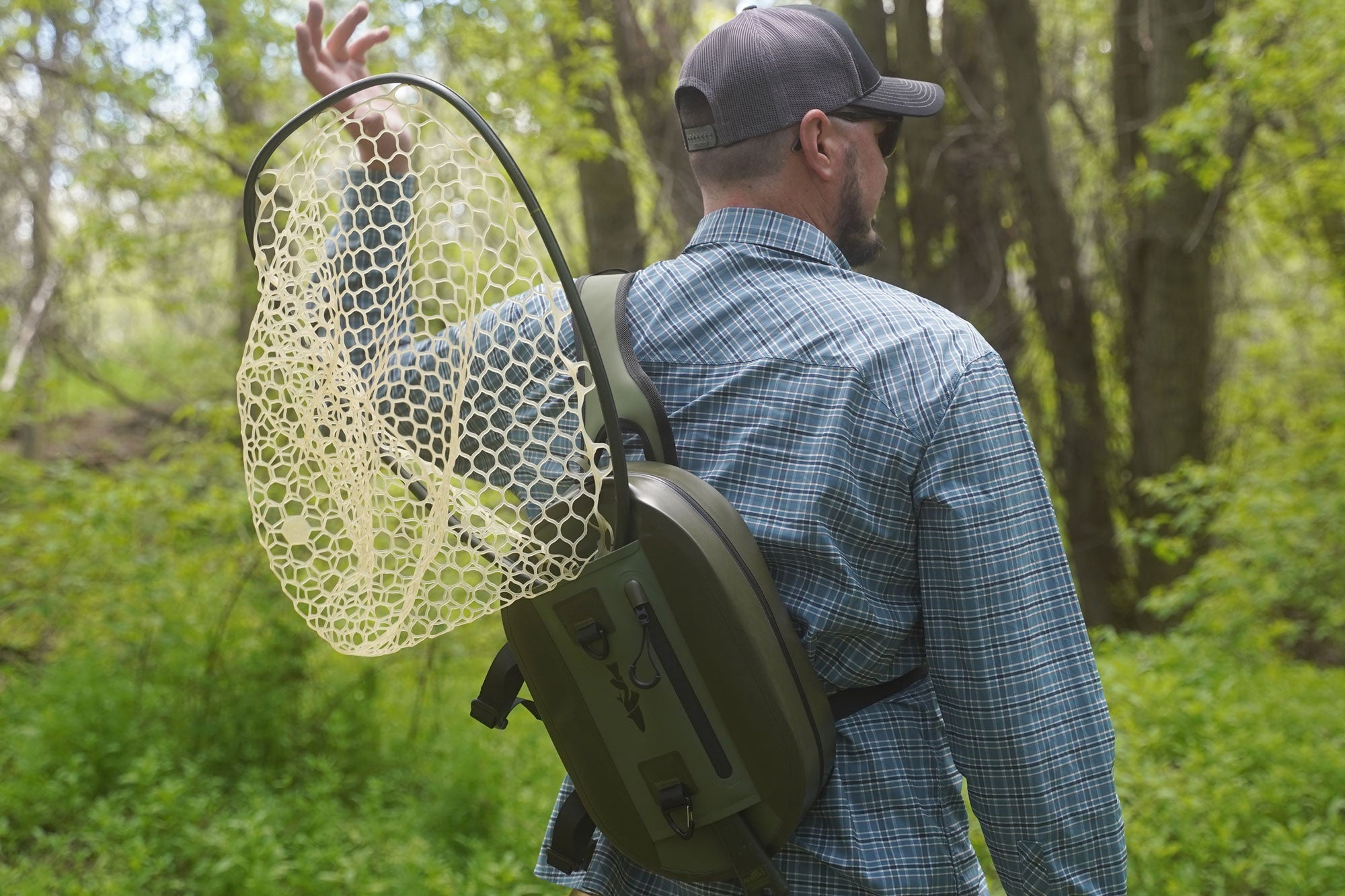
The rule I fish by after too many hard lessons: if losing it ends your trip, it travels on your back. Reels, a couple of lines, leader and tippet, your prescription glasses, your license paperwork, and one box of the flies that actually matter. Waders, boots, rain gear, and clothing can all be replaced or borrowed at a lodge. A reel loaded with the right line usually can't be, not out at the end of a dirt strip.
Then there's the leg nobody plans for. Your airline may allow 50 pounds a bag; the float plane or charter that carries you the last hour often allows less, and usually wants several smaller soft-sided bags instead of one big hard case. Operators publish different numbers and remote lodges frequently set their own lower limit. Ask for the figure in writing two weeks out and pack to it, rather than discovering it on a gravel apron with a duffel that won't fit.
The full playbook — rod tubes, carry-on strategy, what to declare, how to handle a four-piece versus a six-piece, and what to do when a bag doesn't show — is in flying with fly rods and gear. If you're still deciding whether to haul a travel rod at all, my older piece on travel fly rods, the myths and the reality is the honest version, and packing for a trip when you don't know what you'll face deals with the part where the forecast is a coin flip.
The fly fishing trip planning questions to ask before you send money
Before the deposit leaves your account, get written answers to these: what exactly is included, how many anglers per guide and per boat, what the deposit and cancellation schedule is, what the balance due date is, what the weather and water contingency plan is, what the baggage weight limit is on every leg, what gratuities are customary, and who I call when something goes wrong at 6 a.m. local time. Eight questions. One email. It takes a lodge or an agent ten minutes to answer and it removes almost every unpleasant surprise from the trip.
Long story short, the tone of the answer tells you as much as the content. An operation that answers specifically, in writing, with numbers, is an operation that runs a tight week. An operation that answers in adjectives — "world-class," "fully inclusive," "trip of a lifetime" — is telling you something about how the week will be run, too. I've never regretted asking a boring logistics question. I have regretted not asking one.
One more filter worth applying before you send money: whether anyone you trust can vouch for the operation. FFIP Certified exists for exactly that reason, and the process behind it is worth understanding whether you book through me or not — see FFIP Certified: how to find a guide or lodge you can trust. The complete question list, organized by when to ask it, is in questions to ask before booking a fly fishing lodge.
What gear should you actually buy before a destination trip?
Buy the things that protect your trip, not the things that upgrade it. Somewhere around month three of the wait there's a real temptation to spend your way into readiness — a new reel, a fourth rod, a jacket in a better color. Resist most of it. The purchases that pay off on a destination week are the boring, protective ones: a rod tube that survives baggage handling, a dry bag that keeps your passport dry in an open boat, and enough consumables that you never ration.
Then there's the question of whether to bring gear at all. A lot of saltwater lodges and Alaska operations rent quality rods, reels, and even waders, and for a one-off trip into a species you may never chase again, renting an 11-weight is often smarter than owning one. The tradeoff is casting a rod you've never cast on the day it matters most. I've written up both sides in rent gear at the lodge or bring your own.
If you only buy two things off this page, make it the eBook that walks the whole destination-travel process and a rod tube that actually protects what's inside it. And if you want to browse, the rod tubes collection and the dry bags collection are where I'd start for a trip like this.


Frequently Asked Questions
How early should I renew my passport before an international fly fishing trip?
Check your passport the day you put down a deposit, not the month you fly. The U.S. State Department notes that some destinations require at least six months of passport validity beyond your travel dates, and that some airlines will not let you board if that requirement isn't met. Add current processing times on top of that, and a passport that expires within a year of your trip is worth renewing immediately.
Should I buy flights before or after the lodge is confirmed?
Confirm the lodge week in writing first, then buy flights. Lodge weeks are the scarce, hard-to-move item; airline seats are the flexible one. Buying airfare before the lodge is confirmed is how anglers end up owning a change fee. The one exception is a long-haul route with genuinely limited seats, where you may need to reserve the flight and the lodge week in the same conversation — that's a good moment to have an agent coordinating both.
What happens to a fly fishing trip if the river blows out or a hurricane comes through?
Good operations have a contingency plan and will tell you what it is before you book — a second drainage, a lake option, a sheltered flat, or a schedule shift. Weather is almost never a refundable event under a lodge's own cancellation policy, because the lodge still incurred the cost of your week. Ask what the plan B water is, and if there genuinely isn't one, factor that into whether you want insurance.
How many days of fishing should I book on a first destination trip?
Six fishing days is the classic lodge week and it's a good target, but four to five days of fishing is plenty for a first trip into a new species or a physically demanding destination. Day one is usually spent learning the cast and the rhythm, and fatigue is real by day five if you aren't used to eight hours of standing and casting. Booking shorter and leaving hungry beats booking long and grinding out the last two days.
Do remote fly fishing lodges take credit cards, or do I need cash?
Assume the package was prepaid by wire or card before you arrived, and assume that what you settle on site — bar tab, fly shop purchases, and especially gratuities — may need to be cash. Remote lodges often have limited connectivity and no ATM within an hour's flight. Ask what the lodge accepts on site, and get the cash before you leave home rather than at an airport kiosk.
Is a fly fishing trip worth booking if I've only been fly fishing a year?
Yes, if you pick the destination to match where you are. A guided Western trout trip, a Montana float week, or a forgiving bonefish flat with a patient guide will all reward a one-year angler who can cast 40 feet. A technical permit flat or a windy atoll will not. The mistake isn't going too early — it's going to the wrong place too early.
Can I hold a week at a lodge without paying a deposit?
Sometimes, briefly. A lodge or an agent can often place a courtesy hold on specific dates for a short window — days, not months — while you check calendars with your group. That hold is not a booking, and it doesn't survive someone else arriving with a deposit in hand. If the week genuinely matters to you, the deposit is what secures it.
Related reading
- How our Frontiers partnership works — what actually happens when you tell me where you want to go, start to finish.
- Your first trip abroad: five that are hard to get wrong — if you've decided to go but not decided where, start here.
- Where to fly fish in winter: 8 trips that book right now — the destinations that are in season while your home water is frozen.
- Western fly fishing trip: 10 planning ideas — the drive-to version of everything on this page.
- Lodge, fly-out, or road system in Alaska — the clearest real-world example of how trip structure changes the price.
- Best fly fishing travel tools — for the DIY side of trip planning, lodging and logistics.
Go book it
Here's what I want you to take away from all of this. The anglers who end up with the best trips are not the ones with the most money or the most gear. They're the ones who asked eight boring questions early, wrote down the answers, and then spent the waiting months practicing instead of worrying. That's it. That's the whole edge. Twenty-five years in, and the planning still matters as much as the casting.
If you get stuck on a specific trip, come find me — I'm on Instagram at @flyfishinginsiderpodcast, and I answer more messages about trip planning than anything else. If you want the podcast, the Tips Library, and new destination guides as they land, join the FFIP Insiders and keep an eye on the blog; a whole cluster of posts publishing alongside this one goes a level deeper on every question above. Helping anglers catch any fish, any time, and anywhere is the entire point.
Tight lines, everyone!
Go on a fly fishing trip you'll never forget
We partnered with Frontiers Travel to put you on water that's worth the flight. Tell them where you want to go. Don't wait.
Book a TripFly Fishing Insider Podcast has a referral partnership with Frontiers International Travel. If you book after being introduced through us, we may receive compensation at no additional cost to you.
A note on prices, policies and rules. Everything in this guide reflects what Fly Fishing Insider Podcast could verify as of September 2026. Lodge deposit percentages and balance due dates, cancellation ladders, trip insurance benefit percentages and purchase windows, airline and charter baggage weight limits and sports equipment fees, nonresident licence and stamp fees, gratuity norms, and passport and entry requirements all change — sometimes at short notice and sometimes mid-season. Treat every figure here as a planning range rather than a quote, and read the actual policy wording before you pay anything. Nothing here is insurance, tax, or legal advice. Frontiers International Travel confirms live pricing, policies and availability at the time you book.