
The questions to ask before booking a fly fishing lodge fall into six groups: the water and the season, the guiding, the money, the logistics, the gear, and what a bad week looks like. If you only get one phone call, ask about the guide-to-angler ratio, the cancellation terms in writing, and what the package price excludes.
A buddy of mine once paid for six days at a lodge and fished three. The river came up brown on a Tuesday, stayed brown, and nobody there had a second option — no lake, no spring creek, no plan. He didn't get cheated. He got exactly what he paid for. He just never asked the one question that would have told him the whole operation was built around a single piece of water.
I'm Christian Bacasa, I host the Fly Fishing Insider Podcast, and I book travel as an Authorized Agent for Frontiers International Travel. In about 25 years in this sport I've sat in on hundreds of these conversations from both sides — the angler asking, the lodge answering. Here's the thing nobody tells you: the questions you ask before booking a fly fishing lodge matter less than how you read the answers. So this list is grouped by what each answer tells you, and every question comes with what a good answer sounds like and what an evasive one sounds like.
What are the most important questions to ask before booking a fly fishing lodge?
The most important questions to ask before booking a fly fishing lodge are the eight below, because each one has a wrong answer that should change your decision. Everything else on this page is useful. These eight are load-bearing. If you get ten minutes on the phone, spend them here.
| Ask this first | A good answer sounds like | What the answer actually tells you |
|---|---|---|
| What's the guide-to-angler ratio, and is that a guarantee? | "Two anglers per guide, one boat, guaranteed in your confirmation. If we can't honor it we move you or refund the day." | Whether you're buying a guide or buying a seat. A goal that isn't in writing is a maybe. |
| Can you send me the cancellation terms in writing? | "Here's the PDF — penalties at 121 days, 90 days, 45 days, and inside 45." Arrives in an hour. | Whether the operation has a real back office. This is the single fastest trust test there is. |
| What's not included in the package price? | A list: licenses, flies, alcohol, fly-outs, gratuity, airport transfers, taxes and fuel surcharges. | Your real trip cost. Nobody's hiding anything — you just haven't asked yet. |
| Who exactly is guiding me, and how long have they been there? | "Most likely Marco or Tomas, both with us six-plus seasons, both live here year-round." | Whether guiding is a career at this lodge or a rotating summer job. |
| What happens on a blown-out or blown-out-windy day? | "We move to the lake, or we short-day it and fish the evening. You still fish. No refund on lodging, no charge for the switch." | Whether they have a second and third piece of water, and who eats the weather risk. |
| What's the fishing like the exact week I'm asking about? | "That week is the tail of the sockeye push, so trout are on eggs and flesh. Big fish, fewer of them, and the crowds thin out." | Whether they know their own calendar or are selling you the season brochure. |
| What's the weight limit on the last leg, and what bag do you want? | A number and a bag type: "50 pounds total, soft duffels only, rod tubes ride separately." | Whether you're about to repack in a gravel parking lot in Alaska. |
| Tell me about a bad week here — what went wrong and what did you do? | A real story with a date, a cause, and what they changed afterward. | Everything. A straight operator has these stories ready. A brochure doesn't. |
Print that table. Then work through the rest of the list when you've got a lodge you're serious about — the follow-ups are where the small money and the small miseries hide.
How should you ask, so you actually get a straight answer?
Before the list: how you ask determines the answer you get. "How's the fishing?" is not a question, it's a greeting. Every outfitter answers it the same way — "it's been great" — because on some day, for somebody, it was.
Specific questions get specific answers. Vague questions get marketing. Being specific also tells the lodge what kind of angler you are. When my friend Rachel emailed a lodge in Chile and said "I'm a competent trout angler, I've never thrown a sink-tip, and I'd rather catch four good fish than twenty small ones," the manager wrote back four paragraphs and moved her to a better week. She gave him something to work with.
Ask pointed questions, not vague ones. This one comes from a solo segment I recorded for the Fly Fishing Insider Podcast rather than a guest interview, and it's the tip I lean on hardest when I'm helping someone plan. Before you message a lodge, a guide, or a buddy who's been there, write down the two or three specific things you actually need to know — the ratio, the wading, the rod weights — and ask those. "How's the fishing?" gets you nothing you can plan around, and it wastes your one shot at a real conversation with somebody who knows that water better than anyone.
One more framing note, and it's the important one. You are not interrogating anybody. You're starting a relationship with someone who's going to row you down a river, feed you, and possibly pull you out of a hole. A good outfitter is relieved by specific questions, because a specific angler is an easy angler to make happy. The only people who get prickly are the ones who don't want the answer written down.
Which questions tell you whether the water and the season are right?
The questions that tell you whether the water and the season are right are the four below — the ones anglers skip most, because a destination's reputation does the thinking for them. Alaska in July is a reputation. A specific river in the third week of July is a fact.
1. What is the fishing like the exact week I'm looking at, not the season average?
Why it matters: a nine-week season can contain three completely different fisheries. Good: names a hatch, a run, a water temperature, or a bird. Evasive: "it fishes well all season" — which is either a lie or an admission that nobody there keeps notes.
2. What's your Plan B water when the main river is blown out, or the wind blows 25 for three days?
Why it matters: this is the best predictor of whether you'll fish six days out of six. Good: geographic — "a lake ten minutes away, a spring creek under lease 40 minutes north." Evasive: "we always find fish." That's what my buddy heard. He found chocolate milk.
3. What species will I realistically catch that week, and what's the average fish compared with the one on your homepage?
Why it matters: expectations are 80% of trip satisfaction. Good: a boring number — "most fish 16 to 19 inches, and you'll get two or three shots at something over 24 in a week." Evasive: a photo. Photos are the best fish of a decade.
4. How much other pressure is on this water, and how do you get away from it?
Why it matters: on public water in a famous drainage, your day is set by the boat 200 yards ahead of you. Good: honest — "the lower river is busy after 9 a.m., so we launch at 6." Evasive: skips it and talks about how big the country is.
What should you ask a fly fishing guide about the guiding itself?
The questions to ask a fly fishing guide about the guiding itself cover ratio, identity, continuity, weather and honesty about your casting. Guiding is the product; a lodge is a building. If you upgrade one part of your trip, upgrade the guiding — which means knowing what you're actually buying.
5. What's the guide-to-angler ratio, and is that a guarantee or a goal?
Why it matters: two anglers to a guide is the standard at most lodges I book; three is a budget structure, and you want to know before, not after. Good: puts the number in the confirmation. Evasive: "usually two." Usually is a weather word, not a contract word.
6. Who exactly is guiding me, is that person staff or a contractor, and how many seasons have they been on this water?
Why it matters: a guide in their sixth season on one river knows where fish sit at a given flow. A first-year contractor is learning on your week. Good: gives names. Evasive: "all our guides are excellent," which is true of nothing.
7. Can I keep the same guide all week, or do you rotate?
Why it matters: both systems are defensible — rotation spreads local knowledge, continuity builds a rhythm — but you want to know which you're getting. Good: explains the reasoning. Evasive: surprise on day three when a stranger is at the oars.
8. What happens on a blown-out day, or a lightning day, or a 30-knot day? Do I still fish, and do I still pay?
Why it matters: this is the money-meets-weather question, and it generates more bad reviews than anything else in this industry. Good: says exactly who eats the loss. Evasive: "that hardly ever happens." It happens.
9. How do your guides handle an angler who can cast 35 feet on a good day?
Why it matters: some destinations punish a short cast and some don't care at all, and a briefed guide is a guide who can adjust. Good: gets concrete about what the week demands of your casting. Evasive: "don't worry about it." Worry about it — and read our honest skill-level check before you book so you can describe yourself accurately.
What money questions should you ask before you pay a deposit?
The money questions to ask before you pay a deposit are the five below, and they exist because the sticker price of a guided fly fishing trip is rarely the cost of the trip. Not because outfitters are shady — because packaging varies wildly, and what one lodge bundles another itemizes. Ask, write it down, add it up.
10. What's the deposit, and what is the exact calendar date the balance is due?
Why it matters: you want a date on your calendar, not a vague window. For shape, Alaska Wildland Adventures publishes its booking policy openly — $1,000 or 50% of the trip, whichever is less, at 121-plus days out, balance due 60 days before departure. One operator's terms, not an industry standard, but a useful yardstick. Good: two dates and two numbers. Evasive: "we'll invoice you closer to the time."
11. Can you send the cancellation terms in writing, with the penalty at each window?
Why it matters: this separates the professionals from everybody else, and the penalties step up hard. That same published Alaska policy escalates from a small per-person fee at 121-plus days, to 20% at 120 to 91 days, to 50% at 90 to 46 days, to the full trip cost inside 45 days. Good: a document. Evasive: a verbal reassurance — worth nothing in February when your knee gives out. Then read how deposits, cancellation windows and trip insurance actually interact before you decide what to insure.
12. What is not included in the package price?
Why it matters: this is the biggest single source of budget surprise in fly fishing travel. Ask it open and let them list. The usual suspects: licenses and stamps, flies and leaders, alcohol, fly-outs or long-run boat days, transfers, gratuities, access fees, fuel surcharges and taxes. Good: a list, cheerfully given. Evasive: "it's all-inclusive" with no follow-up — we took that phrase apart in what all-inclusive really covers at a fly fishing lodge.
13. What's the gratuity norm here, who gets it, and in what form?
Why it matters: tipping is genuinely different destination to destination, and the awkwardness of getting it wrong sits on you all week. Good: a range and a structure — guides direct, house staff pooled, cash in this currency. Evasive: "whatever you think." Ask for the range anyway; more in how to tip your fly fishing guide.
14. How do I pay, and whose account does the money go into?
Why it matters: a legitimate operator takes a card, or an invoiced transfer to a business account with the business name on it. If someone asks you to wire a deposit to a personal account, stop. The FTC's own guidance is blunt: wire transfers are effectively irreversible, and "wire transfer is the only payment they'll take" plus pressure to pay immediately are classic scam markers. Good: a normal payment page. Evasive: urgency.
Dry Fly Tactics for Selective Trout
Once the booking questions are answered, the fishing questions start. This free eBook covers the selective-trout problem you'll meet on almost any good trout week.
Download the free eBook →What logistics questions matter most when booking a guided fly fishing trip?
The logistics questions that matter most when booking a guided fly fishing trip are about the last leg, the bag, the room and the distance to help. Logistics is where trips get ruined quietly — a missed connection nobody planned for, a duffel eight pounds over.
15. Who meets me, where exactly, and what happens if my flight lands late or my bag doesn't?
Why it matters: the transfer is the seam in every itinerary, and seams tear. Good: names the meeting point, the person, a phone number and a fallback. Evasive: "someone will be there."
16. What's the weight limit on the final leg, and what kind of bag do you want me in?
Why it matters: bush planes, floatplanes and skiffs have hard limits unrelated to your airline allowance, and soft bags aren't a preference — they're how a load fits an odd-shaped hold. As a reality check, Alaska Seaplanes publishes 50 pounds per passenger on a scheduled flight, recommends several smaller soft-sided bags, and allows no carry-on at all. Good: a number and a bag type. Evasive: "pack light." Pack light is not a number. More in flying with fly rods and gear.
17. Is there a single supplement, and if I'm on my own, will you pair me with a roommate?
Why it matters: a solo angler can get quietly charged for a double, or quietly assigned a stranger — and you want to choose which. Good: states the supplement in dollars and the pairing policy plainly. Evasive: silence until the invoice arrives.
18. How far am I from a clinic, what's the communication situation, and what's the evacuation plan?
Why it matters: remote is the product, and remote has a cost. You want to know whether help is 40 minutes or a day away, whether there's a satellite phone, and whether cell or wifi exists. Good: specific about hours and equipment. Evasive: "we've never had a problem." I'm not a doctor or an insurance agent, so treat this as information rather than advice — but know the number before you go, and read your own health plan's wording on coverage away from home.
What gear questions should you ask the lodge before you pack?
The gear questions to ask the lodge before you pack are the three below — the cheapest questions on this page to ask and the most expensive to skip. Every over-packed duffel I've ever hauled came from guessing instead of asking.
19. What exactly is provided, what's available to rent and for how much, and what do you want me to bring myself?
Why it matters: "rods available" can mean a wall of current 8-weights or three tired loaners. Good: names brands and weights and gives a rental price. Evasive: "we've got everything you need." Our full take is in renting gear at the lodge versus bringing your own.
20. Can you send your actual fly list, and do you sell flies on site?
Why it matters: a real fly list is the fingerprint of a fishery, and it tells you more than any page of the website. Good: a PDF with patterns, sizes and colors. Evasive: "standard stuff."
21. What do your guides personally fish here — rod weights, line types, leader lengths?
Why it matters: the boring specifics are where a week is won, and asking signals you're a serious angler, which changes how you get guided. Good: almost tediously detailed — a 9-foot 6-weight and a floating line for mornings, a 9-foot 8-weight with a sink-tip when the wind comes up, 12-foot leaders in low water. Evasive: a rod weight and nothing else.
How do you get an honest answer out of a lodge?
You get an honest answer out of a lodge by asking about failure. Everybody has a script for the good week. Almost nobody has one for the bad week — and the absence of a script is exactly what you want, because when someone has to improvise, you learn who they are.
22. Tell me about a bad week here. What went wrong, and what did you change afterward?
Why it matters: this is the best question in the list. Good: specific and slightly uncomfortable — "July 2024, the river came up four feet, we ran the lake for three days, and we now hold two rooms at a tailwater lodge as a backup." Evasive: "we don't really have bad weeks." Everybody has bad weeks, and somebody who won't admit it won't tell you the truth on Wednesday either.
23. Can you put me in touch with a recent guest — ideally one who hit tough conditions?
Why it matters: a reference who had a great week only proves the lodge can handle a great week. One who had a hard week tells you how it behaves under pressure, which is what you need to know. Good: a name and a number within a couple of days. Evasive: a link to their reviews page. My friend Todd made this call before a Patagonia trip and learned the one thing that mattered — bring a rain jacket you'd trust on a mountain.
What are the red flags when vetting a fly fishing lodge or guide?
The red flags when vetting a fly fishing lodge or guide are fewer than you'd think, and none are subtle. Most operators in this business are good people running a hard, seasonal, weather-dependent business on thin margins. I'd rather you walk in with a short list of genuine deal-breakers than a general suspicion of everybody.
- Cancellation terms arrive as a document, unprompted
- They ask you questions — skill, wading comfort, what you want out of the week
- They talk about weather risk before you bring it up
- Named guides with multiple seasons on that water
- A licensed, registered business you can verify with the state
- Someone tells you a week is wrong for you and suggests a different one
- Refusal, or repeated delay, in putting cancellation terms in writing
- No commitment on guide-to-angler ratio, only "usually"
- Pressure to wire a deposit to a personal account
- Reviews that all appear within the same week or two
- A hard-sell deadline that keeps moving
- No verifiable business identity behind the pretty website
On licensing — it's easier to check than most anglers realize, and it costs nothing. Alaska requires sport fishing businesses, guides and vessels to be registered annually with the state, and the Alaska Department of Fish and Game publishes those requirements openly, free of charge. Rules differ by state and country, so check the local authority. A guide who bristles at "are you licensed and registered where you operate?" has answered a different question than the one you asked.
Two things that are not red flags, because anglers get spooked by both: a small operation with a plain website, and a lodge that won't guarantee fish. Some of the best weeks of my life came from three-guide outfits with a website from 2014, and anyone who guarantees fish is selling something other than fishing. For a broader framework on trust, see how FFIP Certified vets a guide or lodge.
Once you're on the water the relationship runs both ways. Being a good guest — reading the room, respecting other boats, handling fish well — buys you more than any question list. We wrote that up in our guide to fly fishing etiquette.
Should you ask these questions yourself, or let an agent ask them?
You can ask these questions yourself, and plenty of anglers should. Booking direct is a perfectly good way to travel, especially to a domestic lodge you can call at 9 a.m. on a Tuesday. But here's the honest answer to the volume problem: most of these 23 questions, I've already asked in writing for the lodges we work with.
That's the practical value of a booking agency. As an Authorized Agent for Frontiers International Travel — FFIP's travel partner, and a company at this since 1969 — I hold the cancellation documents, I know which lodges keep backup water, and I know which ones quietly run three anglers to a guide in high season. When something goes sideways mid-trip, a phone number answers. Both sides of that tradeoff are in booking agent versus booking direct, and the rest of the series lives on the Before You Book hub.
Either way, ask the questions. If you'd rather hand them to somebody, start here and tell us the water you're thinking about.
What gear should you sort out before you go?
Three of the 23 questions above are gear questions, and the answers usually create a small shopping list. Here's the honest version of what's worth buying before a lodge trip.
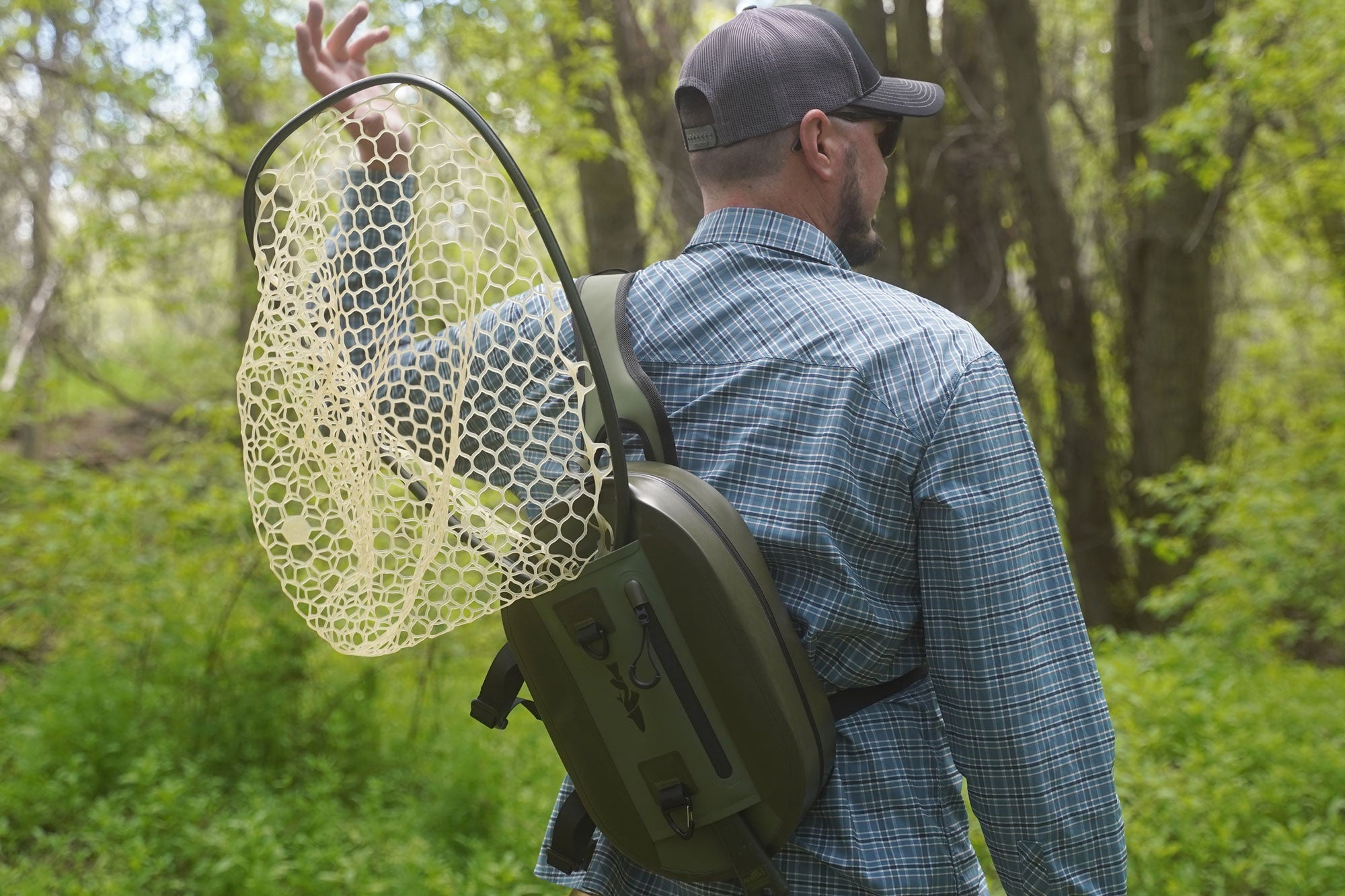
Buy the bag before anything else. If the lodge says 50 pounds and soft-sided, a hard roller is a problem you've paid for. A dry duffel solves the floatplane question, the skiff-floor question and the rainy-transfer question in one purchase, and it's the travel gear I replace least often. Our dry bags collection covers the range, and the backpacks and accessories shelf has the smaller pieces that live inside it.
Then protect the rods. A rod tube that survives a baggage belt and a floatplane hold is cheap insurance against a week of borrowed gear — see the rod tubes collection. And if you want the whole planning process in one place before a first big trip, our travel eBook is the shortcut.


Frequently Asked Questions
Is it rude to ask a fly fishing lodge this many questions?
No. Asking a fly fishing lodge detailed questions is not rude, and a good outfitter is relieved to get them, because a specific angler is an easy angler to satisfy. The one courtesy that matters is timing: send the long list by email rather than dumping 23 questions on someone at 7 p.m. mid-season. Lead with what you want out of the week, then ask.
How many of these questions should I ask before booking a fly fishing lodge if I'm short on time?
Ask the eight in the table near the top of this guide — ratio, cancellation terms in writing, what's excluded, who's guiding, the blown-out-day plan, the specific week, the last-leg weight limit and the bad-week story. Each has a wrong answer that should change your decision. The other fifteen refine a trip you've already decided is viable.
How do I check that a fly fishing guide is actually licensed?
Check with the state, province or national authority where the guide operates, because requirements differ everywhere. Alaska, for example, requires annual registration of sport fishing businesses, guides and vessels through the Alaska Department of Fish and Game. Asking "are you licensed and registered where you operate, and can you confirm that in writing?" sorts out most of it.
Should I ask these questions of the lodge or of a booking agent?
Ask whoever is taking your money, because that's who owes you the answer. Booking direct, ask the lodge. Booking through an agency, ask the agency — and expect them to already hold the cancellation documents, the ratio commitments and an honest read on which weeks fish best. An agent who can't answer the money and ratio questions from memory isn't adding much.
What single question do most anglers forget to ask before a guided fly fishing trip?
The weight limit on the final leg. Anglers plan carefully around their airline allowance, then discover the floatplane, bush plane or skiff carrying them the last hour has a much smaller limit and wants soft bags only. That's the question that produces a repack in a gravel parking lot and a rain jacket left in a hangar.
Is it reasonable to ask a lodge for references from past guests?
Yes, and it's completely normal in this business. A lodge that's been running a while has guests who love it and will happily take a ten-minute call. Ask specifically for someone who fished a tough week — high water, big wind, a shut-down bite — because how an operation behaves in a bad week is the only real test of it.
When in the planning process should I be asking these questions?
Ask the eight core questions before you pay anything, and the rest before you pay the balance. Prime weeks at good lodges are often committed a year or more out, so the questions come earlier than most anglers expect — see how far in advance to book a fly fishing trip for the timing side of it.
Related reading
- The Before You Book hub — every question in this series, organized by decision.
- Booking agent versus booking direct — who should be answering these 23 questions for you.
- What all-inclusive really covers — the long version of question 12.
- Deposits, cancellation and trip insurance — what to do once you've read the terms.
- Is this trip right for my skill level? — so you can describe yourself honestly in question 9.
- FFIP Certified — how we vet guides and lodges, and what we look for.
Go ask the questions
Here's what I'd leave you with. These 23 questions aren't a test. They're the first conversation in a relationship with someone who's going to spend six days trying to put you on fish, and the specific ones make that person's job easier. Ask about the bad week. Ask for the ratio in writing. Ask what's not in the price. Then go fishing, and be the kind of guest who gets invited back.
If this saved you a bad booking, I'd like to hear about it — find us on Instagram at @flyfishinginsiderpodcast and tell me which question got the most useful answer. If you want more of this, follow along with the podcast and join the FFIP Insiders, where the trip-planning conversations happen first. Twenty-five years in, helping anglers catch any fish, any time, and anywhere is still the whole point.
Tight lines, everyone!
The trip you keep talking about — go take it
Every angler has one destination they've described a dozen times and never booked. Tell us which one it is and we'll build the trip around it.
Book a TripFly Fishing Insider Podcast has a referral partnership with Frontiers International Travel. If you book after being introduced through us, we may receive compensation at no additional cost to you.
A note on prices, policies and rules. Everything here reflects what Fly Fishing Insider Podcast could verify as of September 2026. Deposit amounts, balance dates, cancellation windows, single supplements, gratuity norms, air taxi weight limits and guide licensing rules all change, sometimes at short notice. The deposit, cancellation and baggage figures quoted are one operator's published terms used as a yardstick — not an industry standard, not a quote. Treat every number as a planning range and read the actual policy wording before you pay. Nothing here is insurance, legal or financial advice. Frontiers International Travel confirms live pricing, policies and availability at the time you book.