
How physically demanding a fly fishing trip is depends almost entirely on the trip format, not on the fishing. A drift boat day asks you to sit, cast, and step out onto gravel. A remote freestone wade can ask for eight miles on slick, basketball-sized rock. Match the trip to your body before you book, not on day two.
Todd called me from a gravel bar in Montana on day two of a six-day walk-and-wade week. He wasn't hurt and he was fishing well. He just wanted to tell me, in the flat voice of a man doing math, that the guide had called the morning stretch "a little walk in," and the little walk in had been a mile and a half of cobble the size of bowling balls, then four hours standing in fifty-degree water, then the same mile and a half back. Four more days of that. He had booked the wrong trip.
I'm Christian Bacasa, I host the Fly Fishing Insider Podcast, and I book travel as an Authorized Agent for Frontiers International Travel. Twenty-five years in the sport, guiding here in Utah, and enough trips hosted elsewhere to notice a pattern: nobody publishes an honest demand profile of each trip type. Lodges say "moderate." Outfitters say "suitable for all abilities." So anglers book on the photos and meet the physical reality on day two.
How physically demanding is a fly fishing trip, honestly?
How physically demanding a fly fishing trip is ranges from "a boat seat and a cooler" to "walk eight miles on loose rock in the rain," and both ends get sold with the same photographs. A trout in a net looks identical whether it came from ten feet off a drift boat gunwale or the fourth mile of a canyon.
Here's the thing: the fishing isn't the demanding part. Casting a 9-foot 5-weight all day is a forearm-and-shoulder proposition, and most anglers adapt inside a day. What wears people out is everything around the casting — the standing, the walking, the footing, the cold, the sun, the work of staying upright in current. All of it is set by the trip format, which is a choice you make months out.
| Trip type | Hours on your feet | Footing | What it really asks | Sit down when you want? |
|---|---|---|---|---|
|
Drift boat float Montana, Utah's Green, Colorado |
1–2 hours total | Gravel bars, a boat ramp, a boat seat | Stepping in and out of a boat a few times; casting from a seated position | Yes — you're seated most of the day |
|
Flats skiff Belize, Bahamas, Yucatán |
4–7 hours standing | Flat, stable casting deck; occasional firm sand | Standing balance for hours, sun exposure, sharp eyes, a cast on demand | Yes — the seat is two steps behind you |
|
Tailwater wade Green, Bighorn, San Juan |
5–7 hours | Even cobble, predictable depth, known channels | Hours standing braced in cold current; short walks from the vehicle or boat | Usually — a bank is rarely far |
|
Freestone wade backcountry Rockies, Patagonia |
6–9 hours | Slick, loose, basketball-sized rock; no two steps alike | 3–8 miles of walking, thigh-deep push, a long walk out on tired legs | Rarely — you sit where there's a bank to sit on |
|
Alaska fly-out lodge Katmai, Bristol Bay, Naknek |
4–7 hours | Spongy tundra, gravel bars, braided channels | Climbing in and out of a float plane; short tundra walks; water in the mid-40s°F | Sometimes — tundra makes a fine seat |
|
Jungle or remote backcountry Bolivia, Mongolia, headwater camps |
7–10 hours | Sand, roots, jungle floor, boulder gardens, heat | Hiking all day carrying your own gear in heat and humidity, help hours away | Rarely — the day ends when the walk ends |
What does each trip type actually ask of your body?
Each trip type asks something different, and the differences are specific enough to plan around. Here are the rungs.
A drift boat day: you sit, you cast, you step out on gravel
A drift boat day is the gentlest real fly fishing trip that exists, and that isn't a knock. You sit in a molded seat with a leg brace in front of you, cast to the bank, and the river does the moving. You step out three or four times, where a good guide parks the boat on flat gravel in shin-deep water. Time on your feet during a Montana or Green River float is often under two hours across a nine-hour day. My friend Paul books drift boat weeks on purpose now, and he out-fishes the people grinding canyon miles because he's fresh at four when the bugs come off.
A flats skiff: easy on the body, hard on the eyes and the sun
A flats skiff costs about what a drift boat costs your body, with one difference: you stand. On a bonefish or permit day you're on the casting deck for hours, balancing against a small chop, holding a 9-foot 8-weight ready, staring into glare. The flats tax your standing balance, your eyes and your tolerance for equatorial sun — not your legs, and the seat is two steps behind you. Some programs add wade fishing on hard sand, better footing than any trout river in North America. For an easy-on-the-joints trip with world-class fishing, a skiff week is one of the best answers in the sport; our saltwater flats tips cover the skill.
A tailwater wade: moderate, but hours standing in cold current
A tailwater wade is where the demand gets real, and anglers underestimate it because it doesn't look like exercise. Tailwaters below dams — Utah's Green, Montana's Bighorn, New Mexico's San Juan — have even cobble and stable flows, so the walking is modest. What a tailwater asks is that you stand in cold moving water, braced, for five to seven hours. That's isometric work: calves, ankles and lower back holding position against a constant push, in water often between 45°F and 55°F. It's why anglers come off a tailwater tired in a way they can't explain.
A freestone wade: the one people underestimate
A freestone wade is the rung where most mismatched bookings happen. A freestone river is fed by rain and snowmelt rather than a dam, so the bed is scoured and unsorted: slick, algae-coated rock the size of basketballs, gaps between them, flows that move with the weather. Backcountry Rockies streams, much of Patagonia, most of New Zealand's South Island. The honest profile of a good freestone day is three to eight miles on ground where no two steps are the same, thigh-deep current pushing against you, several crossings, and a walk out when your legs are already spent. That walk out is the part nobody warns you about — the fishing pulls you upstream all day, and then you turn around. Todd's week was a freestone week. Our skill-level check is the companion piece: that one is about casting readiness, this one is about the ground under your boots.
An Alaska fly-out: short tundra walks, plus a float plane twice a day
An Alaska fly-out lodge trip is physically moderate and logistically specific. The walking is usually short — a few hundred yards of spongy tundra from a gravel bar to a run — and the water is cold, frequently in the mid-40s°F. What's unique is the aircraft. Getting into a de Havilland Beaver on floats means stepping from a dock onto a float, using a strut and a handhold, and climbing through a door higher than a truck seat, then the reverse, sometimes onto a gravel bar in waders. Twice a day, six days running. Not hard for most anglers, but a specific motion worth knowing about in advance. A road-system or boat-based program skips the aircraft entirely — see lodge, fly-out, or road system in Alaska.
A jungle or backcountry trip: hiking with gear, heat, no help nearby
A jungle or deep-backcountry trip is the top rung and should be booked deliberately. A week chasing golden dorado in Bolivia or taimen in Mongolia can mean seven to ten hours a day on your feet, hiking between pools carrying your own water and gear, in heat and humidity, on sand and roots and boulders. The fishing is extraordinary and the nearest clinic may be a flight away rather than a drive. The failure mode isn't misleading marketing — these operations are candid. It's an angler reading "adventurous" as a compliment rather than a specification.
What actually hurts people on a fly fishing trip?
Three things actually hurt anglers on fly fishing trips, and none of them is the fishing: cold, sun and dehydration, and falling in moving water. Sore legs are just sore legs.
Cold water deserves the most respect
Cold water is the hazard anglers are least calibrated for, because we stand in it voluntarily and it feels manageable right up until it isn't. The National Center for Cold Water Safety notes that the loss of breathing control from sudden immersion peaks in water between 50°F and 60°F — not coincidentally the summer band of a great many trout rivers. The same source cites research finding many people classed as good swimmers cannot swim as little as six to ten feet in cold water. Read that again with a fishing scenario in your head: you are not going to swim your way out of a bad step. That's the entire argument for the belt and the staff.
Sun and dehydration are the quiet trip-ruiners
Sun and dehydration ruin more fishing days than cold does, especially on flats trips and desert tailwaters, and they do it gradually enough that people blame the fishing instead. You get sun from above and reflected from below for nine hours, often with a breeze that hides how much you're sweating. The most usable public numbers are NIOSH's workplace heat guidance: about one cup (8 oz) of water every 15 to 20 minutes during moderate activity under two hours, not exceeding roughly six cups an hour, with electrolytes once you're sweating for hours. NIOSH also notes heat acclimatization takes seven to fourteen days — useful if you're flying from a cold place to a hot one and fishing hard on day one. Build in a lighter first day.
Falling in moving water — the mechanics that work
Falling in moving water is the risk with the most established playbook. The National Park Service's river-crossing guidance is about as clear as public-agency writing gets, and every line transfers straight to wading a trout river:
- Depth. NPS says to avoid crossing water deeper than your knees. Every inch above the knee multiplies how much of you the current pushes on.
- A staff. NPS recommends a trekking pole or sturdy stick for "three points of contact with the river bottom." A wading staff is a third leg, not an admission of anything.
- Angle. In faster current, face upstream and cross at a slight angle downstream. Fighting straight across is how people get turned.
- Feet. Shuffle-step sideways. Crossing one foot over the other is the moment you have one point of contact and a lot of water.
- Your pack. NPS is blunt: release the waist and sternum belts, because if you fall you must get the pack off before it turns you face-down.
- Your wading belt. Worn tight, above the hips. A cinched belt is what keeps waders from taking on the volume of the river if you go in.
- Have a retreat. NPS says never over-commit to one route. In fishing terms: don't wade to a spot you can't wade back from.
On soles: felt grips slick algae better than plain rubber, which is why it lasted decades. Sticky rubber with carbide or aluminum studs is the better answer now, and in some places the only legal one — Alaska prohibits felt or fibrous-soled footwear for sport fishing in fresh water because felt stays damp and transports New Zealand mudsnails, didymo and whirling disease more efficiently than other materials. Alaska Department of Fish and Game notes non-felt soles grip better once studs are added. Studs are the single biggest upgrade available to your footing.
Build cardio and stability before a remote wading trip. James Johnson, who runs camps and a lodge in Alaska, made a point on the podcast that stuck with me: start walking weeks out, and add a little strength and balance work while you're at it, because a remote trip is going to ask for it whether or not you got ready. He's watched both versions arrive at the same gravel bar. You can hear him lay it out on the Alaska dry fly season episode. Preparation is the one variable in the demand equation you actually control — the river isn't negotiable, and neither is the walk out.
Dry Fly Tactics for Selective Trout
A free eBook on fishing dry flies to picky trout — useful whether you're covering eight miles of freestone or one good run from a boat seat.
Download the free eBook →How do I get ready for a trip that asks a lot?
Getting ready for a physically demanding fly fishing trip is about specificity, not intensity. You don't need a program. You need to have already done, in small doses, the things the trip will ask for. Four of them.
Walk more, in the boots you'll actually wear. Highest value, most skipped. New wading boots on day one of a walk-and-wade week is a rough plan — wear them around the neighborhood and on a local river. Same for the pack, loaded the way you'll load it.
Get your ankles used to uneven ground. Treadmill miles don't prepare ankles for basketball-sized rock, because a treadmill never surprises you. Trails, gravel, a rocky creek near home — anything where your foot lands slightly wrong and has to correct. That correction is the actual skill of wading.
Practise standing and casting for twenty minutes at a stretch. Not an hour. Twenty minutes, standing, casting a real line. Most anglers practise in ten-minute bursts and then wonder why hour six on a skiff deck feels different.
Carry water and drink it. Per the NIOSH numbers above, small and frequent beats a liter at lunch — the bottle goes in the pack whether or not you feel thirsty at the truck.
Start six to eight weeks out and none of this is a project. And one plain thing, said once: if you have any health question about a trip, talk to your own doctor before you book a remote trip, not after. I'm a podcast host and a travel agent, not a physician, and a remote lodge is a long way from a clinic.
How do I book a great fly fishing trip when walking or balance is limited?
You book a great fly fishing trip with limited walking or balance by asking for a boat-based program and by asking about distances in numbers instead of adjectives. That's the whole technique.
Let me be plain, because the internet is strangely shy about it: a drift boat or a flats skiff gives you a full six days of world-class fishing with almost no walking at all. Not a consolation prize. The best dry fly eat I've watched happened ten feet off a drift boat. Permit are caught from skiffs. Alaska's Naknek and Kvichak are fished from jet boats. Here's what to ask, in order:
- "Is there a boat-based program, and can I be on it all six days?" Not "can you accommodate me" — ask for the thing by name. Many lodges run mixed programs and will put you in a boat every day if you say so at booking rather than at breakfast.
- "How far are the walk-in and walk-out distances, in miles or yards?" Never ask "is it easy?" — everyone says yes. Ask for a number, and ask separately about the walk out, which gets glossed over.
- "What's the footing where we'll be standing?" Flat gravel and hard sand are different animals from loose cobble. Guides know the answer instantly.
- "Does the guide's boat have a casting brace, and is there a seat on the casting deck?" A knee brace on a drift boat and a leaning post on a skiff change a standing day completely.
- "How far is the lodge from medical care, and is there a written medical evacuation plan?" Ask every remote lodge, whatever your situation. Good operations answer in detail — satellite phone, float plane, the nearest clinic by name, how many hours. Vague answers are information too.
- "Can I fish a shorter day without it being weird?" Half-days, a boat back at two, a nap and an evening session. Lodges do this constantly and never advertise it.
Ask these before the deposit, not after. Our questions to ask before booking a fly fishing lodge covers the money-and-logistics versions. Structure matters too — a lodge, a mothership, or a DIY trip have very different physical profiles, and a mothership is one of the gentlest formats going: you sleep where you fish and the skiff collects you from the swim step.
- Walking a half mile on loose rock is something you'd rather not do twice a day
- Your balance on uneven footing isn't what it was, and you know it
- You want to fish six full days and not be worn out by day two
- You'd rather spend your energy on casting than on getting there
- Standing braced in cold current for hours has stopped sounding like fun
- You already walk on uneven ground regularly — trails, not treadmills
- You'll actually carry a wading staff, not just own one
- You can stand and cast for twenty minutes without thinking about it
- You'll be honest with your guide about pace on the morning of day one
- The program is a tailwater or spring creek with close bank access, not a canyon
One more thing: telling your guide the truth on the morning of day one is the highest-leverage move available to you. Give a guide an accurate picture at 7 a.m. and they'll rebuild the day around it — a different run, a shorter walk, the boat instead of the bank. Give them a brave face and they'll plan the hard version, because that's what you asked for.
What gear actually reduces the physical cost of a trip?
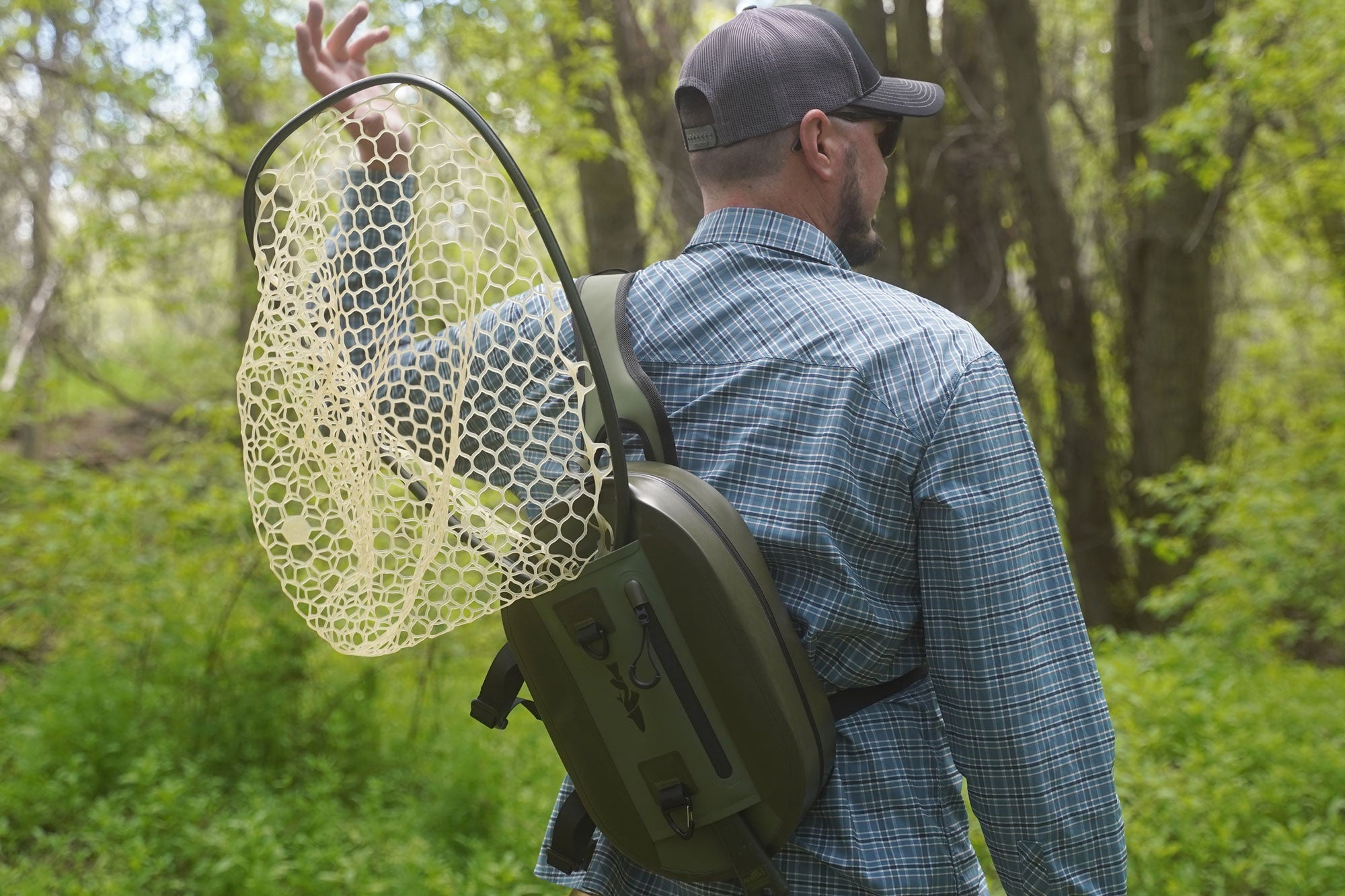
The gear that reduces the physical cost of a fly fishing trip is boring, cheap, and almost never in the photos. A wading staff first — three points of contact in one purchase, and the folding kind that lives on your belt has no downside. Studded boots second. A tight wading belt third. Then a pack that comes off in one motion, and sun layers.
On weight: everything you carry, you carry all day. I've watched anglers haul four fly boxes, two reels, a camera and a rain shell three miles up a canyon to fish one hatch. Go lighter than feels right. Our gear tips that actually matter roundup is heavy on this pragmatism, and the 4-front pack systems and waders and wading jackets collections are where I'd start. For sun, the hats, beanies and neck gaiters collection covers the cheap end.


Frequently Asked Questions
Is fly fishing a good sport for older anglers?
Fly fishing is one of the best lifetime sports there is, because the physical demand is set by the trip format rather than by the fishing. An angler in their seventies fishing from a drift boat or a flats skiff is doing the same sport at the same level as an angler in their thirties hiking a canyon, and often catching more. The adjustment older anglers usually make is a format change, not a skill change: more boat, fewer miles, a wading staff when they wade, and tailwaters rather than freestone rivers.
Can I book a fly fishing lodge trip if I have limited mobility?
Yes, and boat-based programs are the answer. Ask at the booking stage for a program where you fish from a drift boat, jet boat or skiff every day, and ask for walk-in and walk-out distances in actual numbers rather than asking whether a trip is easy. Also ask whether the boat has a casting brace or a seat on the casting deck, how far the lodge is from medical care, and whether a written medical evacuation plan exists. A mothership trip is one of the gentlest formats in the sport.
Can I take a rest day mid-week at a fly fishing lodge?
Yes, and lodges handle rest days constantly without advertising it. A week at a fly fishing lodge is not a contract to fish every hour; you can take a morning off, come back at two, skip a fly-out, or fish the water in front of the lodge instead. Say so at breakfast rather than at the last minute so the guide roster can be adjusted, and ask at booking whether half-days are available.
Does altitude make a western fly fishing trip harder?
Altitude does add to the demand of a western fly fishing trip, and it's the variable anglers flying in from sea level notice most. Many Rocky Mountain and Utah trout streams sit between 6,000 and 9,000 feet, where the same walk costs more than it does at home for the first day or two. The practical response is the same as for heat: arrive a day early, take day one at an easier pace, drink more water than usual, and raise any altitude health question with your own doctor before the trip.
What should I tell a guide or lodge about my physical limits before I book?
Tell a guide or lodge the practical specifics, framed as preferences rather than problems: how far you'd like to walk in a day, whether you'd rather fish from a boat, whether standing for long stretches suits you, and whether you'll be using a wading staff. Say it at booking and again on the morning of day one. Guides rebuild a day around accurate information without a second thought. A health question belongs with your own doctor before a remote trip.
Related reading
- Before You Book: the complete fly fishing trip planning guide — the hub for this whole series, if you're working a booking decision from the start.
- Is this trip right for my skill level? — the casting-and-fish-fighting companion to this article. Read both and you've covered the two honest self-assessments.
- Lodge, mothership, or DIY? — the three structures have very different physical profiles, and a mothership is the gentlest of them.
- Questions to ask before booking a fly fishing lodge — the money and logistics questions that belong next to the physical ones above.
- Bringing a partner who doesn't fish — useful when a gentler trip format is also the one your partner would enjoy.
- Alaska: lodge, fly-out, or road system — the clearest example of how much trip structure changes what a week asks of you.
Pick your rung, then go fish
Long story short: there are only trips that ask for things you'd rather not do and trips that ask for things you'll enjoy, and the two get sold with identical photographs. Find your rung honestly, ask for it by name, and you'll come home talking about fish instead of about your legs. That's the whole point — helping anglers catch any fish, any time, and anywhere, on terms that actually work for them.
If you match a trip to yourself well, tell me about it — I'm @flyfishinginsiderpodcast on Instagram, and the "I booked the boat week and it was the best fishing of my life" messages are my favorites. And if you'd rather have this come to you, join the FFIP Insiders; that's where the trip-planning pieces land first.
Tight lines, everyone!
The trip you keep talking about — go take it
Every angler has one destination they've described a dozen times and never booked. Tell us which one it is and we'll build the trip around it.
Book a TripFly Fishing Insider Podcast has a referral partnership with Frontiers International Travel. If you book after being introduced through us, we may receive compensation at no additional cost to you.
If you want help matching a trip format to what you want your days to look like, that's most of what I do as an Authorized Agent for Frontiers — start on the FFIP travel page. Frontiers has been placing anglers since 1969, and "which lodges run boat-based programs all week" is the kind of question they answer from experience rather than a brochure.
A note on conditions, rules and this article's limits. Everything here reflects what Fly Fishing Insider Podcast could verify as of September 2026. Water temperatures, river flows, wading-footwear regulations, lodge program structures, walk-in distances and medical evacuation arrangements all change — sometimes season to season, sometimes at short notice. Treat every figure here as a planning range rather than a guarantee, confirm wading-sole rules with the state or country you're fishing, and confirm a lodge's daily program and evacuation plan in writing before you pay. This article is trip-planning information, not medical guidance: if you have a health question about a trip, talk to your own doctor before you book. Frontiers International Travel confirms live pricing, policies, program details and availability at the time you book.