
Grass carp vs common carp comes down to whiskers, menu and feeding zone. Common carp (Cyprinus carpio) have two pairs of barbels and root the bottom for insects and crayfish, so you fish sinking flies. Grass carp (Ctenopharyngodon idella) have no barbels, eat mostly plants and often feed near the surface, so you fish floating or slow-sinking flies.
Start with common carp if you want the most shots: they live almost everywhere, eat a wide range of flies and reward a repeatable drag-and-drop. Pick grass carp once you've caught a few commons and want a spookier surface puzzle, and only after checking your state's rules, which range from "must release" to "must not release" depending on where you stand.
My buddy Todd texted me a photo last summer with one line under it: "Why wouldn't this thing eat?" He'd spent a full evening on a warmwater pond tossing a crayfish pattern at a big, pale fish that kept slurping something off the surface along a weed line. He led it, let the fly settle, gave it a twitch. Nothing.
I zoomed in on his photo and smiled. No whiskers. Long, torpedo body. That wasn't the carp he thought it was. Todd had been pitching a bottom bug to a grass carp that was eating at the top, which is a little like offering a steak to someone who's standing at the salad bar.
When a new angler asks about fly fishing for carp, somebody always chimes in that grass carp act completely different. They're right. Let's break down how to tell them apart, what each eats, how to fish for each and where the legal lines are.
Part of our Carp on the Fly series. New to carp? Start with the beginner's guide to carp on the fly.
On episode 117 of the Fly Fishing Insider Podcast, hosted by our former host Greg, carp angler Matt Martin explained why grass carp are grazers that call for a totally different fly than the common carp most of us chase. Episode page.
- Check the mouth first. Common carp have two pairs of barbels on the upper jaw; grass carp have none.
- Match the feeding zone. Common carp mostly feed on the bottom, so sinking flies and the drag-and-drop win. Grass carp graze plants and often feed near the surface, so floating and slow-falling flies win.
- Go quieter for grass carp. Soft, accurate casts matter more than distance.
- Rules vary a lot. Florida requires anglers without a permit to release grass carp immediately, while Utah asks anglers not to release them at all. Check your state before you fish.
Why Do Anglers Mix Up Grass Carp and Common Carp?
Anglers mix up grass carp and common carp because both are big, olive-to-bronze members of the minnow family that cruise the same shallow, weedy water, and from 40 feet away in glare they look alike. Most beginner advice is also written for common carp, the species most fly anglers target.
Here's the thing: the two fish want different flies in different parts of the water column. Fish a common carp game on a grass carp and you'll get ignored all afternoon. The good news is that once you know a few tells, you can make the call in seconds.
How Do You Tell a Grass Carp From a Common Carp?
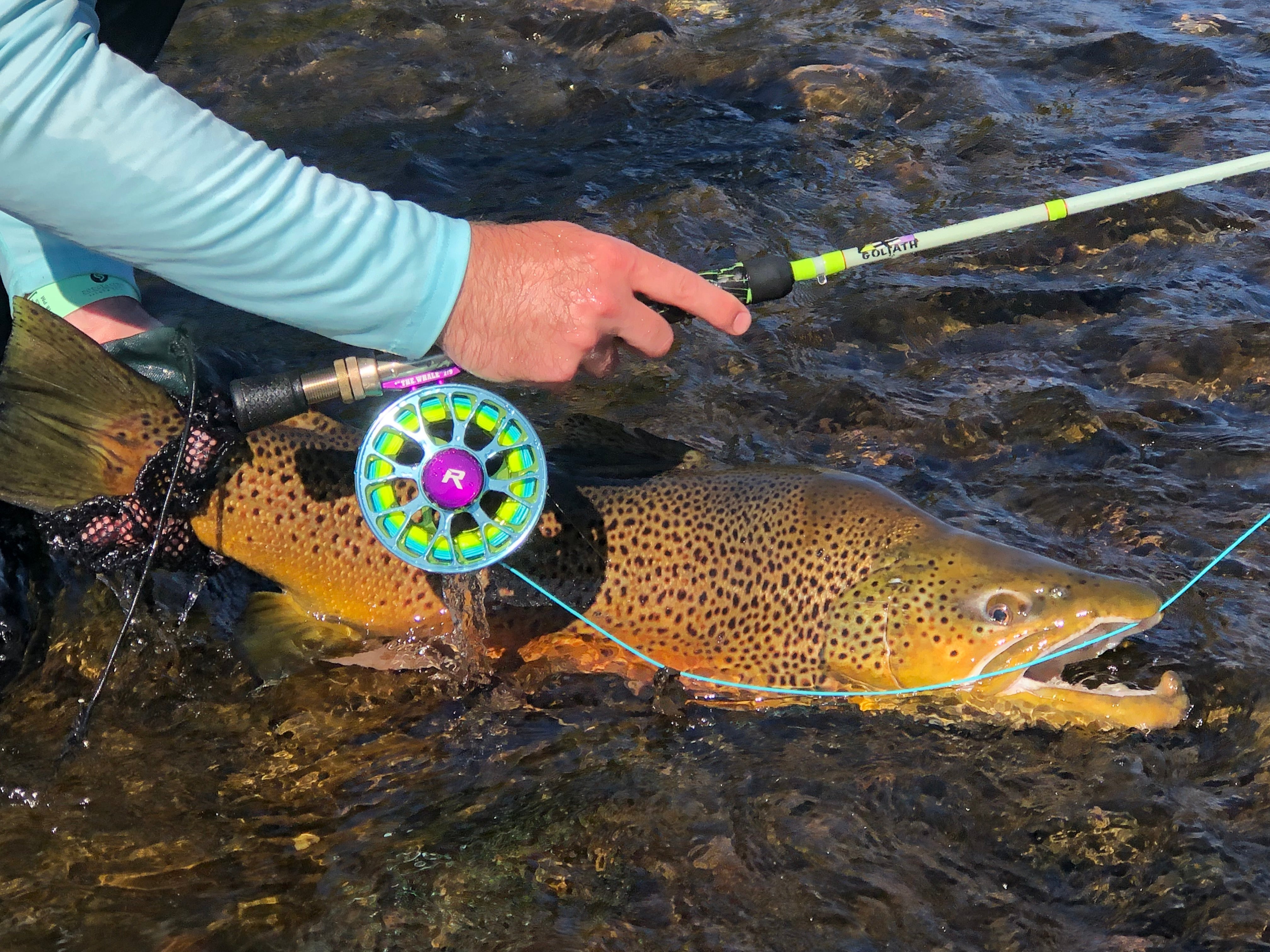
The fastest way to tell a grass carp from a common carp is to look at the mouth: common carp have two pairs of barbels (whiskers) on the upper jaw, and grass carp have none. The Minnesota DNR's grass carp profile lists the missing barbels and a shorter dorsal fin as the key differences. From there, body shape and color seal it.
Common carp (Cyprinus carpio)
- Barbels: two pairs on the upper jaw.
- Mouth: small, subterminal and protrusible, according to the Florida Fish and Wildlife Conservation Commission. It points down and extends like a vacuum hose.
- Body: deep and thick with a high back. The Utah Division of Wildlife Resources fishing guidebook describes carp as gray to brassy green or yellowish green, covered with large scales, with a large spine at the front of the dorsal fin.
Grass carp (Ctenopharyngodon idella)
- Barbels: none.
- Mouth: Fisheries and Oceans Canada describes it as terminal to subterminal, so it sits more forward on the face than a common carp's.
- Body: longer and more cylindrical. The Minnesota DNR calls it torpedo-shaped, silver to olive in color.
- Scales and fins: large, dark-edged scales give a cross-hatched look, and the dorsal fin is short.
A quick analogy I use: a common carp is built like a pickup truck with a vacuum bolted to the front bumper. A grass carp is built like a sedan with a lawnmower where the grille should be. One is designed to dig; the other is designed to graze.
Where Did Grass Carp and Common Carp Come From?
Both grass carp and common carp are introduced species in the United States, but they arrived about 80 years apart and for very different reasons. Common carp are native to Europe and Asia, and the Minnesota DNR notes they were intentionally introduced into Midwest waters as a game fish in the 1880s.
Grass carp are native to eastern Asia, from the Amur River of eastern Russia and China south to the West River of southern China, according to the U.S. Fish and Wildlife Service's ecological risk screening for grass carp. That report says they were first imported in 1963 to aquaculture facilities in Auburn, Alabama, and Stuttgart, Arkansas, the Stuttgart import coming after years of searching for a biological control for problem aquatic weeds. The USGS groups grass carp with bighead, silver and black carp as the four species commonly called Asian carp.
What Do Grass Carp and Common Carp Eat?
Grass carp eat mostly aquatic plants, while common carp are omnivores that feed largely on the bottom. That difference drives almost every fly choice below.
The Fish and Wildlife Service report describes grass carp feeding on higher aquatic plants and submerged grasses, with detritus, insects and other invertebrates as a side dish. It also notes intensive feeding kicks in at about 20 °C (68 °F) and warmer. Translation: grass carp are summer fish.
Common carp, by contrast, feed by sucking up bottom silt and picking out insect larvae, crustaceans, snails and other small food, per the Florida FWC. That's why feeding commons leave mud clouds and tails in the air.
There's overlap. The Connecticut Department of Energy and Environmental Protection's grass carp tactics sheet says fallen mulberries are a favorite food for both grass carp and common carp in June and July. Still, a grass carp's default setting is grazing, and a common carp's is digging.
Matt Martin made the same point on episode 117 of the Fly Fishing Insider Podcast. He described grass carp as grazers and said anglers were catching them on deer hair flies tied green to look like algae or a floating piece of grass, while the common carp he fishes for will eat nymphs and even chase streamers.
Grass Carp vs. Common Carp: Side-by-Side Comparison
| Factor | Common carp | Grass carp |
|---|---|---|
| Scientific name | Cyprinus carpio | Ctenopharyngodon idella |
| Quick ID | Two pairs of barbels, deep body, high back, long dorsal fin, bronze to brassy | No barbels, torpedo body, short dorsal fin, silver to olive, cross-hatched scales |
| Native range | Europe and Asia | Eastern Asia (Amur River south to southern China) |
| Arrived in the U.S. | Late 1800s, stocked as a food and game fish | 1963, imported for aquatic weed control |
| Diet | Omnivore: insect larvae, crustaceans, snails, some plants | Mostly aquatic plants and grasses, plus fruit, seeds and some insects |
| Where you find them | Rivers, lakes, reservoirs and urban water nearly nationwide | Ponds, lakes, canals and rivers, often where they were stocked for weed control |
| Feeding zone | Mostly bottom (tailing, mudding) | Weed beds and the top few inches of the water |
| Best fly style | Soft hackles, crayfish, small leeches and buggy nymphs | Berry, seed and grass imitations, slow-sinking foam or soft flies |
| Presentation | Drag-and-drop or lead and let it settle | Soft landing in the fish's path, little or no movement |
| Leader and tippet | Fluorocarbon, commonly 3X to 2X | Monofilament helps floating flies ride high; go as heavy as the fish will allow |
| Rod | 6- or 7-weight | 8-weight and up; Connecticut DEEP suggests a 9- or 10-weight |
| Difficulty | Challenging but repeatable | Very spooky; fewer good shots per day |
| The fight | Long, heavy runs | Explosive first run, then more runs near the net |
If you want to see how quiet you need to be around grass carp, this short video from Drew LooknFishy walks through three tips for catching them on the fly.
Are Grass Carp Legal to Catch and Keep?
Grass carp are legal to fish for in many places, but the rules on keeping or releasing them vary widely by state and even by lake, so check your state's current regulations before you make a cast.
Many grass carp were stocked on purpose to control weeds. The Fish and Wildlife Service notes that many states allow only sterile triploid grass carp, which carry three sets of chromosomes instead of two, and it runs an inspection program to confirm shipments contain no fertile fish.
Now look at how differently two states handle it:
- Florida: The FWC's general freshwater regulations say it's illegal to possess grass carp without a permit and that they must be released immediately.
- Utah: The 2026 Utah Fishing Guidebook from the Division of Wildlife Resources puts grass carp on its list of non-native nuisance fish. Anglers who catch one are asked not to release it, to keep the fish (dead) and to report the catch to a DWR office. Bighead, black and silver carp are on that same list.
Those rules point in opposite directions. In Connecticut, anglers must sign on to a state permit before harvesting grass carp at Candlewood Lake and Squantz Pond, and some states ban possession entirely. So look up your state's regulations, check posted rules at the water and call the local fisheries office if it's unclear. On private water, ask the owner what they want done with any grass carp you hook.
Common carp are usually simpler. In Utah, for example, they have no statewide daily limit, though at least one water, Pelican Lake, requires anglers to kill every common carp they catch. My full Utah breakdown is in our guide to carp fly fishing in Utah.
Get the next carp tactic first
New carp tactics, guest insights from the Fly Fishing Insider Podcast and gear deals, straight to your inbox. Free signup on our homepage.
Sign up freeHow Do You Catch Common Carp on the Fly?
To catch common carp on the fly, find a fish that's actively feeding on the bottom, put a sinking fly a foot or two from its face and let it eat without pulling the fly away. Here's how I approach it.
- Pick the eaters. Nic Hall, the Denver urban angler I talked with on episode 229 of the Fly Fishing Insider Podcast, sorts carp into cruisers moving from point A to point B, tailers that are nose-down and feeding, and fish coming to the top to gulp food. He goes after the tailers first because they're eating, they're less spooky and his hookup rate is better. I agree completely. Our guide to reading carp behavior goes deeper.
- Choose a bug that sinks fast and looks alive. A soft hackle, small crayfish or bead-head leech in a natural color.
- Use the drag-and-drop. Nic described casting past the fish, dragging the fly across its path (never toward its face, since prey doesn't swim at a predator), then dropping the rod tip when the fly is six to eight inches away so it sinks right into the feeding zone. It's laid out step by step in our drag-and-drop method guide.
- Watch the fish, not the line. A tilt or the fish stopping over your fly is your cue to strip-set.
- Run fluorocarbon. It sinks and resists abrasion. Anglers commonly use 3X to 2X for commons.
How Do You Catch Grass Carp on the Fly?
To catch grass carp on the fly, find fish that are feeding at or near the surface, match what they're eating with a floating or slow-sinking fly and set it down gently in their path without moving it. Think spring-creek trout, not dredging.
- Find the food source first. Weed beds, overhanging mulberry trees and shorelines where seeds or grass clippings collect are all worth checking. Connecticut DEEP notes grass carp often sit just below the surface, where fins and mouths give them away.
- Match it. Foam berry flies in purple to red for mulberries, a tuft of white for cottonwood fluff, or a green, grassy pattern for fish grazing weeds. Connecticut DEEP notes that egg patterns and beads make good berry imitations.
- Land it softly and leave it. Grass carp are curious, and Connecticut DEEP suggests presenting in the fish's general area and giving it time to find the food rather than casting on its head. Drew Ross, writing for Orvis, found a slowly falling fly draws a better response and that dragging a fly around a grass carp usually backfires.
- Stay out of sight. Slow movements, no shadows over the fish and no slapping casts.
- Set when the fly disappears. On the surface you'll see the eat. Let the mouth close before you set, like a big trout on a hopper.
When grass carp are keyed on berries, stand under the tree and watch for a few minutes before you cast. You'll see exactly where fruit lands, how the fish react to the plop and which fish is the hungriest. Then make one quiet cast to that fish. Patience at the tree is worth more than a dozen casts at the water.
Land either carp with a hand under the belly. Matt Martin's tip on episode 117 applies to common carp and grass carp alike. Don't try to tail a carp like a salmon, because the soft tail folds and the fish slides right out of your hand. Lead a tired fish into shallow water, slide a hand under the belly with the pectoral fins braced against your fingers, and carry a net that is actually sized for big fish.
When Should You Choose Grass Carp or Common Carp?
Choose common carp when you want the most opportunities and the fastest learning curve, and choose grass carp when you want a harder, surface-oriented challenge on water where they're legal to target. Here are the honest trade-offs.
Choose common carp if…
- You're new to carp and want lots of shots to practice on. Commons live in far more waters.
- You want a repeatable system: read the fish, drag-and-drop, set.
Choose grass carp if…
- You love dry-fly sight fishing and don't mind refusals.
- You have a local pond or canal with a grass carp population and clear rules about catching them.
- You're ready to step up in rod weight. Connecticut DEEP recommends a 9- or 10-weight for big grass carp, and it warns that they make an explosive first run and then more runs once they're near the bank or boat.
The trade-off with grass carp is volume: fewer shots and more spooked fish. Drew Ross put it bluntly for Orvis, saying even a well-presented fly is more likely to scare a grass carp than get eaten. Commons humble you in their own way, since a tailing fish can ignore a perfect cast. Either way, you'll become a better angler.
Advanced Tactics for Anglers Who Want Both
On water that holds both species, carry two rods or at least two leaders: fluorocarbon with a sinking bug for commons, and monofilament with a floating or slow-sinking fly for grass carp. By the time you retie, the fish you wanted is usually gone.
Watch the thermometer, too. On a cool morning I hunt commons; when the afternoon heats up and fish show on the surface, I look for grass carp.
Also learn the shape of each eat. A common carp's take is often just a tilt and a puff of mud. A grass carp at the surface opens its mouth and the fly vanishes.
And think about where your fly ends up. Nic Hall pointed out that carp don't usually move far for food, so your fly has to be in the right place. That goes double for a grass carp grazing a small patch of weeds.
Here's my full conversation with Nic on urban carp.
The Flies and Gear I'd Carry for Both Carp
A few flies, a stout net and the right leader cover both species. For the full fly list, see the carp fly box, and our carp fly rod setup guide covers rods, lines and leaders.
Our shop doesn't carry a dedicated mulberry pattern right now, so tie or grab a foam berry locally for surface work. If you're stepping up for grass carp, the Genesis Fly Rod in 9-foot 8-weight is a good value choice with more backbone than a 6-weight.


Add a Rising Diamond File (carp mouths are tough) and a good pair of polarized glasses so you can see barbels, fins and the eat.
Frequently Asked Questions
Do grass carp have barbels?
No, grass carp do not have barbels. Common carp have two pairs of barbels on the upper jaw, so the presence or absence of whiskers is the quickest way to tell the two species apart.
Will grass carp eat a fly?
Yes, grass carp will eat a fly, but they're pickier and spookier than common carp. Berry, seed and grass imitations and slow-sinking soft flies, set down gently near surface-feeding fish, are the best bets.
What is the best fly for grass carp?
The best fly for grass carp is whatever matches the food they're eating that day. Under mulberry trees, that's a foam berry. On weed beds, it's a green, grassy pattern.
Can I keep a grass carp I catch?
Whether you can keep a grass carp depends entirely on where you catch it. Florida requires anglers without a permit to release them immediately, while Utah's DWR asks anglers to keep them (dead) and report the catch. Always check your state's current regulations first.
Are buffalo fish carp?
No, buffalo fish are not carp. The Oklahoma Department of Wildlife Conservation explains that buffalofish belong to the sucker family (Catostomidae), are native to places like Oklahoma and have no barbels, while carp belong to the minnow family (Cyprinidae).
Will bighead or silver carp eat a fly?
Bighead carp and silver carp rarely eat flies, because the USGS describes both as filter feeders that strain plankton from the water. Utah, for one, lists both as nuisance fish that anglers should not release.
Two Fish, Two Games
Todd went back to that pond a week later with a floating fly and a lot more patience. He got it done, and said it felt like learning a new sport. Common carp teach you to read the bottom. Grass carp teach you to slow down and look up.
If you're just getting started, head back to Carp on the Fly: The Complete Beginner's Guide. If you live in or are visiting the Beehive State, our Utah carp guide covers my home waters. For more species, see our warmwater fly fishing tips.
Tight lines, everyone!
Next in the series: Carp Fly Fishing in Utah. Join the FFIP Insiders for gear deals, trip intel and tactics to help you catch any fish, any time, and anywhere.
Join freeShow us your carp on Instagram @flyfishinginsiderpodcast