
Short answer: for trout, a reel is mostly a line holder with a brake — match it to your rod weight, get a drag you can adjust smoothly, and spend the savings on line. For anything that runs hard, the drag becomes the most important part of the purchase. Here are the seven elements that actually matter.
When you start looking to purchase a new fly reel, search for aspects related to quality, size, compatibility with a rod, and features that suit your fishing. Below I break down the key aspects so you can find a reel ideal for your goals.
The 7 key elements of fly fishing reels
1. Quality and price
Fly reels vary significantly, from around $50 to over $1,000 as the typical range. With that spread it's often hard to tell what's good or bad. Material quality and anodization, design, drag system, and size all contribute to the variation.
Despite the perceived complexity of fly fishing, the basic design principles of fly reels are quite similar across price ranges — it's the finer details that set each offering apart. Read Part 1 for the full breakdown.
2. Size and compatibility with rods
A crucial aspect is choosing a reel that holds the necessary backing and fly line for your rod weight. A 5-weight rod should be paired with a reel accommodating line weights 4-6. Size matters especially in relation to the species targeted — a saltwater rod requires a larger arbor and more backing for longer runs.
Many people talk about weight and balance, but in my opinion that's overblown as a priority. The weight of the right-size reel is close enough, and with line changes you can count on overall weight shifting significantly anyway. Read Part 2.
3. Drag systems
The strength of your target influences the drag you need. There are two main types: click-and-pawl and disc drag.
Click-and-pawl reels are less expensive with a simple mechanism, suitable for most freshwater scenarios, though less forgiving when applying varying pressure. Disc drags are more modern, offer enhanced adjustability, and are preferred for larger, stronger fish in fresh or salt. With large targets, drag is paramount for controlling the fish. Read Part 3.
4. Arbor size
Arbor size refers to the diameter of the spool. Large arbor reels have become standard, picking up more line per rotation, which is ideal for fish that take line quickly. A smaller arbor might be sufficient in environments like beaver ponds where capacity and rapid retrieval aren't critical.
More small reels are now offered with larger arbors, because the disadvantages simply don't apply as long as weight and compatibility match up. Read Part 4.
5. Manufacturing and construction
Reels are typically made two ways: die-cast and machined. Machined reels, carved from a solid block, are generally perceived as more durable; die-cast reels are formed by filling moulds with molten metal. The process affects both price and perceived value — die-cast less expensive, machined more.
The real advantage of machining is precision across varying axes. That means reels can be lighter, designed with fewer limitations, and built from a wider range of materials. Read Part 5.
6. Versatility with extra spools
An extra spool provides versatility, letting you switch line types without buying multiple reels. We aren't all made of money, so adjusting a reel at lower cost is often the answer. Some reels offer cassette spools, which are inexpensive and let you carry multiple lines for one rod.
These have become particularly helpful for stillwater anglers who need to change line type based on where fish are feeding in the thermocline. Extra spools are also useful in varied conditions or when targeting different species. Read Part 6.
7. Warranty and brand reliability
Finally, consider the manufacturer's warranty. Brands offering lifetime warranties are generally preferred, since standing behind a product indicates reliability. The reality is that few warranties are ever needed, and most don't cover anything outside manufacturer's defect — even lifetime warranties have limitations.
Instead, I look for quality assurance and evidence that the manufacturing is solid and repeatable. Read Part 7.
Putting it together
Use these seven elements to make an informed decision. Select a product that aligns with your specific needs, and remember that 90 percent of the time your reel is purely holding your line. It's the other 10 percent that helps you land the fish of a lifetime — so take the search seriously and don't underestimate a reel when the details matter.
One more thing worth considering: many manufacturers contribute to conservation. Knowing a small portion of your purchase supports the fisheries you're using is a worthy factor.
Reels we carry
I've shopped for reels for years and talked to countless friends and pros about what to use. There aren't many tried and true brands, and every day there seems to be a new reel company. Here's what we stock, mapped to the elements above.
- Armor II Reel — 3/4, 5/6, and 7/8, in Matte Fire Orange, Slate Gray, or Forest Green. The all-round pick for trout, and matte finishes also cut glare off the reel face.
- Gideon Fly Reel — 3/4, 5/6, 7/8, in Emerald Green or Gunmetal.
- WLR Reel — a dedicated 1/3 weight for small streams. A reel actually built for that line weight makes a real difference to balance.
- LW Reels — black bodies with a green or orange knob and spool cap.
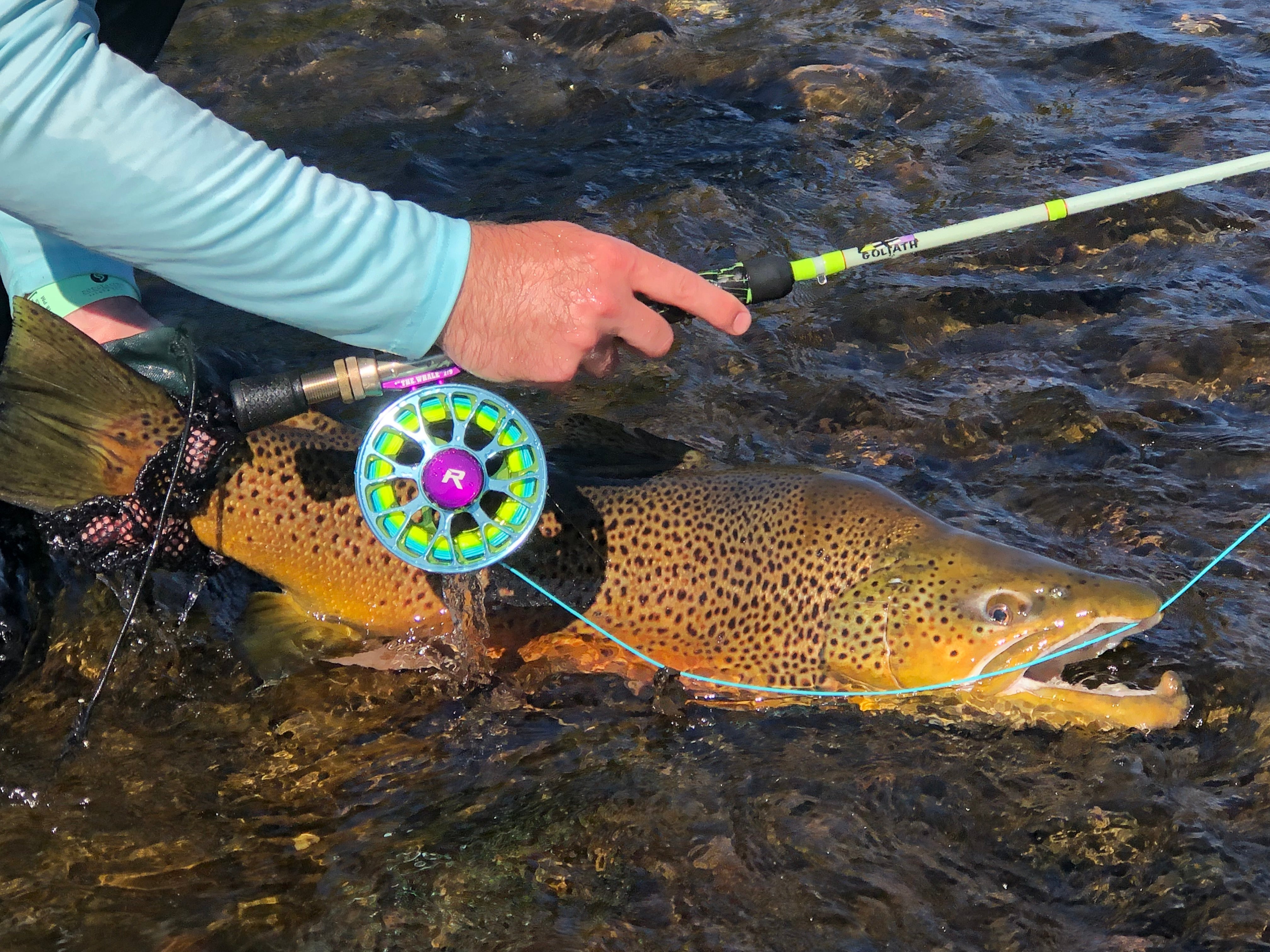
- "THE WHALE" Reel — 7/9, 9/11, and 12/14. This is the big-water and saltwater answer, where drag and arbor size genuinely matter.
- Moonlit Eclipse Reel — 2/4, 5/6, 7/8, left-hand retrieve as standard with right-hand available.
- NIRVANA Vintage Click Pawl Reel — if the click-and-pawl section above appeals, this is that reel. The sound is the whole point.
Want it ready to fish out of the box? The Silvertip II 3/4 and 5/6 arrive pre-spooled with weight-forward floating line, and the Yellowstone Grizzly is straightforward and well priced.
Buying a whole outfit? A matched rod and reel combo removes the compatibility guesswork covered in element 2. Protect what you buy with a Travel Reel Case, and browse everything in fly rods, reels and combos.
Since element 6 is about carrying multiple lines, it's worth reading Understanding Fly Fishing Lines alongside this guide — line does more for your casting than the reel ever will.
The rest of the series
- Part 1 — Understanding Quality and Price
- Part 2 — Compatibility and Size
- Part 3 — Drag Systems
- Part 4 — Arbor Size
- Part 5 — Manufacturing and Construction
- Part 6 — Extra Spools and Versatility
- Part 7 — Lifetime Warranties and Brand
Also worth reading: The Anodization Process and Why We Do It, and How to Buy Used Fly Fishing Reels.
The trip you keep talking about — go take it
Fly fishing trips you'll never forget, planned with Frontiers Travel. Don't wait.
Book a TripTight lines, everyone!

By Christian Bacasa
Host of the Fly Fishing Insider Podcast
Fly Fishing Insider Podcast Official Website
@flyfishinginsiderpodcast
@dupeafish
Watch on YouTube
Fly Fishing Insider Podcast has a referral partnership with Frontiers International Travel. If you book after being introduced through us, we may receive compensation at no additional cost to you.